How Dinner Was Planned in 1901: Time, Preparations and Kitchen Labour
What began two hours before dinner, what was prepared the previous day and what was left until serving? Household organization in the original recipes.
What had to happen before dinner was served, when the kitchen lacked electric refrigeration and familiar appliances? Molokhovets's answer lies in dozens of recipes: stock required hours, meat for little pies was set aside in advance, fish was finished near serving, and some sweet and vegetable preparations began the previous day or in autumn. We follow this logic without inventing a schedule for every Russian family.
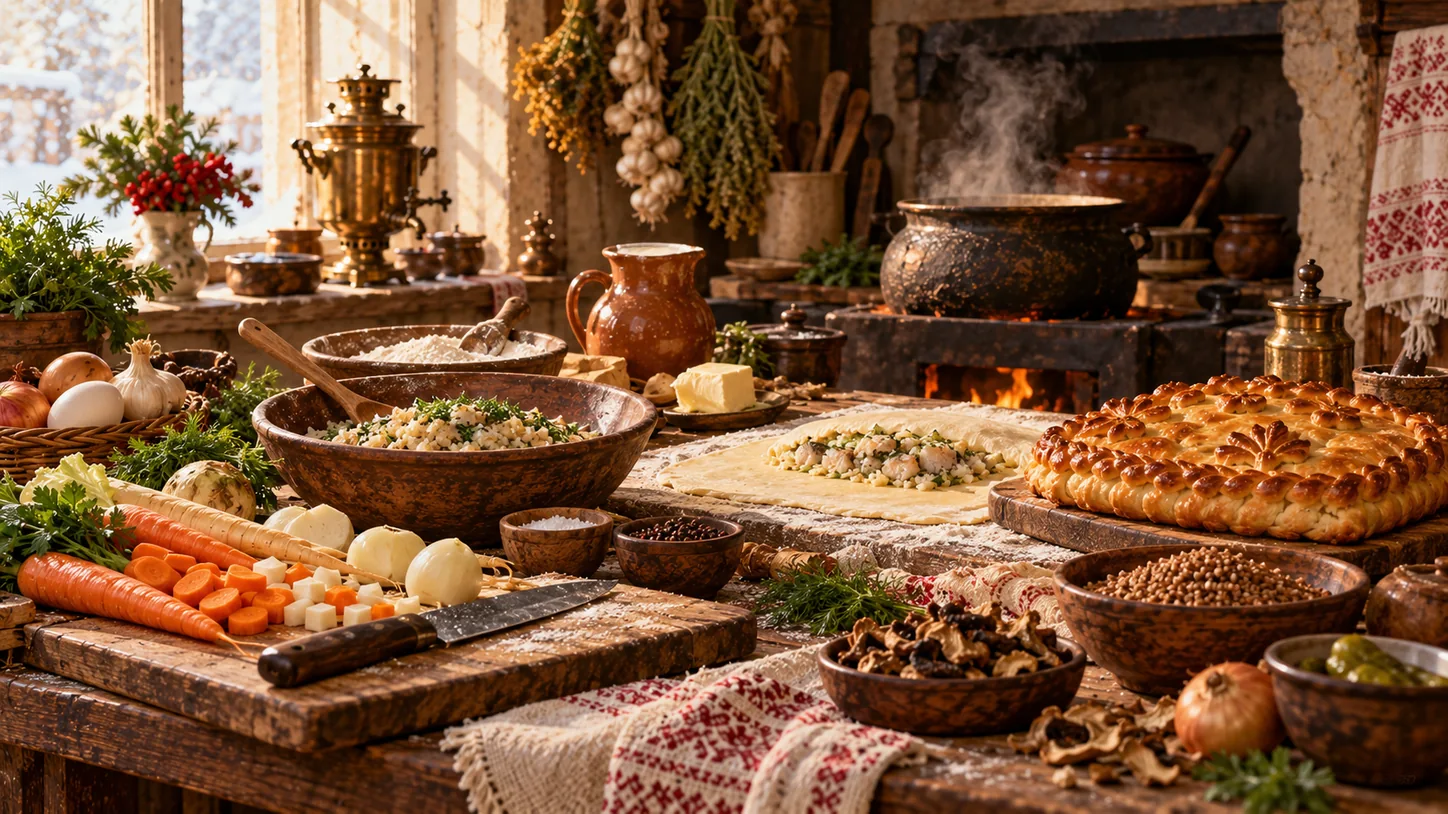
This is a sequence drawn from different recipes, not one day's timetable. Nos. 1, 333, 140 and 3342 illustrate work requiring an early start and work finished just before serving. The author does not require all these dishes to be made simultaneously.
Work began with the arrangement of the kitchen
In Kitchen Arrangement, Molokhovets explains how to organize the kitchen of a small apartment: position the stove or oven, provide ventilation, avoid unnecessary furniture, hang needed tools and leave space to work.
Tools should be within reach and the area unobstructed. Another section lists utensils: table, sieve, skimmer, coarse sieve, sauté pan, kettle, iron sheet and other objects used in different dishes.
This is important evidence of the organization of household labour, not a universal dwelling plan. The author discusses apartments of different sizes and sometimes assumes servants; other families could have had different conditions.
Stock: work several hours before serving
Basic yellow stock No. 1 shows the sequence in detail. Meat and roots are prepared, foam removed, then the stock simmered for two or three hours. The author separately states that an hour and a half before serving the pan should be set aside, the liquid allowed to settle and fat removed again.
These intervals should not simply be added into a mechanical timer. They describe stages of a larger process, some overlapping. Clearly the stock cannot be started five minutes before guests arrive; it sets the kitchen's work in advance.
In simpler yellow stock No. 2, some skimming and straining may be omitted if nourishment matters more than appearance. This is both another recipe and an opportunity to reduce work.
Little pies: filling was selected while the soup cooked
In No. 333, Beef-Filled Little Pies, Molokhovets explicitly directs the cook to cut off a piece of beef from the stock and finely chop it about two hours before dinner. It is fried with onion, cooled, combined with eggs and herbs and used as filling.
The operations depend on one another. The meat is not an independent last-minute purchase but is allocated beforehand from the soup preparation. Time is then needed for cooling the filling and working with the dough.
Our study of economical household management examines use of the various parts of ingredients. Here the order matters: one operation has to finish before the next becomes possible.
Fish: some dishes were finished just before serving
Assorted fish selyanka No. 140 begins with stock from roots, fish bones and heads, which is strained and combined with mushrooms and seasonings. About twenty minutes before serving, the soup is finished with fresh fish fillets and other components.
Preparatory work could thus be completed earlier, with the final stage closer to the moment the dish reached the table. The pike-perch note in Section IX similarly places the fish in the liquid half an hour before dinner.
Historical cooking times are not modern standards for safe fish preparation. We use them only to analyze the organization of work.
Sweet preparations sometimes began the previous day
Lemon Cider or Sherbet for Tea No. 3342 begins with lemons and sugar, after which the mixture is left until the following day. It is only then heated and put in a jar. Even a sweet accompaniment to evening tea was not necessarily an hour's work.
Cold desserts required a different kind of preparation. Blancmange No. 2003 is moulded and chilled on ice. This is not an exact timetable, but evidence that the dessert required lead time before serving.
Our studies of evening tea and historical desserts connect these recipes to table organization and advance preparation.
Some work began long before dinner itself
Dried Roots No. 4009 explicitly specifies early autumn: young vegetables are prepared, dried separately and stored for future stocks and shchi. Planning was measured in seasons rather than hours.
No. 3711, Soaked Apples, also describes preparations for winter use. Historical storage methods should not be regarded as safe modern instructions. What matters for the analysis is the distinct stage of seasonal work preceding future dishes.
The study of seasonal menus compares summer, autumn and winter arrangements in more detail.
What was left for the following day
Roast Veal No. 849 is accompanied by suggestions for serving the meat again: cold at breakfast the next day, in tartines or in a new hot dish. Kitchen planning could extend beyond one dinner.
The fourth-category December menu mentions soup left from the previous day and bones used for another soup. The author explicitly connects two dinners.
Historical leftover storage methods should not be transferred to modern practice. Proper cooling, storage time and reheating require independent verification against current safety standards.
Who carried out these operations?
Kitchen Arrangement mentions servants, even suggesting a sleeping place in a small kitchen where another room is unavailable. Some of the household conditions discussed thus assume hired labour.
But the word servants does not prove that every householder employed workers. The author also addresses less affluent families adapting to circumstances. It is historically wrong to say that every family had a cook.
In other homes the householder could cook herself, with relatives or paid workers. Actual distribution of labour requires diaries, letters, censuses and household accounts rather than a cookbook alone.
What the book reveals about daily life
The comparison reveals several levels of planning: hours before dinner, immediately before serving, preparation on the previous day and seasonal stores, alongside organization of space, utensils and labour.
These are possible scenarios in a manual, not a minute-by-minute description of a specific family's life. Even within one edition, elaborate festive and simpler dishes require different time and equipment.
The historical value lies precisely in these scattered instructions: they reveal the tasks Molokhovets set for the home kitchen without inventing how every household actually performed them.
Original recipes and historical sources
Elena Molokhovets, A Gift to Young Housewives, 1901 edition. Original source links are retained below.
- No. 1 — Basic Yellow Broth, Medium Strength · Russian original
- No. 333 — Small Pies with Beef Filling · Russian original
- No. 140 — Assorted Fish Selyanka (Solyanka) · Russian original
- No. 3342 — Lemon Cider or Sherbet for Tea · Russian original
- Section LIV-II: Arranging the Kitchen — Stoves, Chimneys, Ventilation and a Small Household Kitchen · Russian original
- Section LIV-II: Kitchen Utensils — An Illustrated Historical Equipment Catalogue · Russian original
- No. 2 — Simpler Yellow Broth · Russian original
- Section IX: Fish — Historical Fish Notes and the Complete English Recipe Index · Russian original
- No. 2003 — Cream Blancmange · Russian original
- No. 4009 — Dried Mixed Soup Roots · Russian original
- No. 3711 — Fermented or Soaked Apples · Russian original
- No. 849 — Ordinary Oven-Roasted Veal on a Baking Sheet · Russian original
- December · Class IV Dinner Menu (1901) · Russian original
Related reading
- One Ingredient, Several Dishes: Thrift in Molokhovets’ Cookbook
- The Russian Tea Table in 1901: More Than Tea and Jam
- Blancmange, Oblatki and Puddings: Forgotten Desserts of 1901
- Seasonal Food and Winter Stores in Russia Around 1901
- Who Prepared Dinner in 1901? Cooks, Householders and Domestic Servants
- Water, Firewood and Heat: Running a Kitchen in 1901
- Fish Kettles, Sauté Pans and Waffle Irons in the 1901 Kitchen
- How Much Did Fish Cost in Molokhovets's Book? Prices in Kopecks and Their Limits
Historical labour schedules are not modern cooking advice. The 1901 texts contain old times for boiling, storage, chilling and serving food again. Practical cooking requires modern standards of temperature, storage and food safety.