Who Prepared Dinner in 1901? Cooks, Householders and Domestic Servants
Who worked at the stove, bought and issued supplies, what a cook's duties included and what Molokhovets herself wrote about domestic labour.
Who actually prepared the elaborate dinners described by Elena Molokhovets? Although the title addresses householders, the 1901 introduction mentions male and female cooks, issuing provisions and separate meals for servants. Behind the dishes lies hired domestic labour, women's daily duties and relationships between employers and workers. We examine these people without treating one manual as a portrait of every family in the Russian Empire.
The sources are the 1901 preface and Meals for Servants, Valentina Veremenko's study of urban female servants and Ivan Kokorev's recollections of cook Akulina Ivanovna in earlier Moscow as presented in a historical essay. The cities and decades differ, and those distinctions are retained.
A gift to householders does not mean the householder did all the cooking
The preface to the twenty-second edition addresses the woman responsible for running a household. It discusses calculating portions and expenses, issuing provisions, checking stock quality and planning menus. The author explicitly mentions male and female cooks expected to follow prescribed proportions.
In a household with servants, the householder could control budget and supplies while a hired woman did the work at the stove. Many less affluent families had no servants and women cooked themselves. Ownership of the book does not prove employment of a cook.
The author's viewpoint is that of a household organizer. To hear workers' voices requires memoirs, hiring advertisements and historical research rather than recipes alone.
The cook, the maid and the all-purpose servant
Urban domestic service was not one homogeneous occupation. Affluent households might distinguish cooks, maids, laundresses and nurses. With more modest means one worker might combine cooking with cleaning, washing, heating and errands.
Veremenko distinguishes experienced servants able to negotiate conditions from inexperienced girls for whom a city household might be their first paid work. This affected wages and the distribution of duties.
A cook was not necessarily someone who did nothing but cook. In one home it might be a specialization, in another one part of numerous daily duties.
What happened before cooking began
The essay about Moscow cooks cites Ivan Kokorev's recollection of a conversation with Akulina Ivanovna. Her description includes firewood and water, market trips, firing the stove, the samovar, cleaning rooms, laundry and dinner preparations.
This is testimony from mid-nineteenth-century Moscow, not a literal timetable for a St. Petersburg cook in 1901. It shows labour concealed by an instruction to boil for three hours: fire, water, utensils, provisions and order must first be secured.
Many such stages remain outside Molokhovets's recipes. Basic yellow stock No. 1 requires time and sequence, and behind it stands the physical work of a person at the stove.
Who bought provisions and who carried them home
Purchases might be made by the householder, cook or another member of the household. Resources, trust, shop locations and family habits affected the arrangement. Selecting and delivering goods need not be one task.
Kokorev's cook includes market visits among her duties. Molokhovets's preface emphasizes another stage: timely purchasing, issuing provisions and exact stock accounting.
We can envisage a householder calculating requirements and a cook purchasing or receiving ingredients from the pantry, but neither source establishes a universal practice. Heavy purchases could be delivered separately or carried by domestic workers themselves. The study of vegetable trade concerns supply; here the question is who received it in the kitchen.
Pantry, measures and records: why provisions were counted
Molokhovets goes beyond ingredient lists. Provisions should be issued beforehand so workers do not repeatedly need access to the pantry. The preface discusses spoons, garnets, glasses of specified size, product weights and even water.
Stock preparation is particularly revealing: water volume must correspond to meat and portions, otherwise the soup may be weak. This is both a technical recommendation and expenditure control.
For a cook, such records might structure the day: receive supplies, observe quantities and finish at a specified hour. But they express the author's intended norm, not proof of actual compliance in all homes. The article on dinner costs distinguishes menu costs and household budgets.
The book includes a separate servants' menu
Meals for Servants gives quantities for four people. Fried potatoes are proposed for breakfast and sauerkraut shchi for dinner, with several ingredient variants including meat, pork or pork fat.
The existence of a separate menu matters. The author organizes the food of those working in the household as well as meals for a family receiving guests. Servants are part of domestic economics.
This does not establish that all servants ate worse food or always separately. Arrangements depended on family, employment conditions, resources and duties. The recipe gives a model, not a universal rule.
The workday did not end when soup was served
Serving dinner was only the visible result. Washing dishes, cleaning the kitchen, dealing with leftovers and preparing the next meal followed. A worker combining positions might still be responsible for rooms, water, fuel and laundry.
In Power Without Power (2019), Veremenko examines the complex relationship between the employer's family and hired women, influenced by qualifications and bargaining power. An experienced worker might negotiate better conditions or move to another employer.
Freedom varied. Less experienced recent arrivals could be particularly dependent on lodging and wages. Romanticizing a comfortable historical kitchen as carefree would be misleading.
Culinary skill gradually became a profession
Around the turn of the century, courses and schools provided systematic training in housekeeping and culinary art. Veremenko's study of women's culinary education distinguishes programmes for householders from those preparing professional workers and housekeepers.
Teachers, premises and ingredients for practical classes cost money, limiting access. Some graduates hoped to secure better positions in domestic employment or other occupations.
Reading Molokhovets and completing professional training were different experiences. Cooking skill, household management ability and social position did not necessarily coincide.
What a kitchen worker looked like: caution with visual evidence
William Carrick's genuine photographic portrait Russian Kitchen-Maid, made in mid-nineteenth-century St. Petersburg, shows a woman in an apron with kitchen utensils. It documents a professional image, not uniform dress in every house or forty years later.
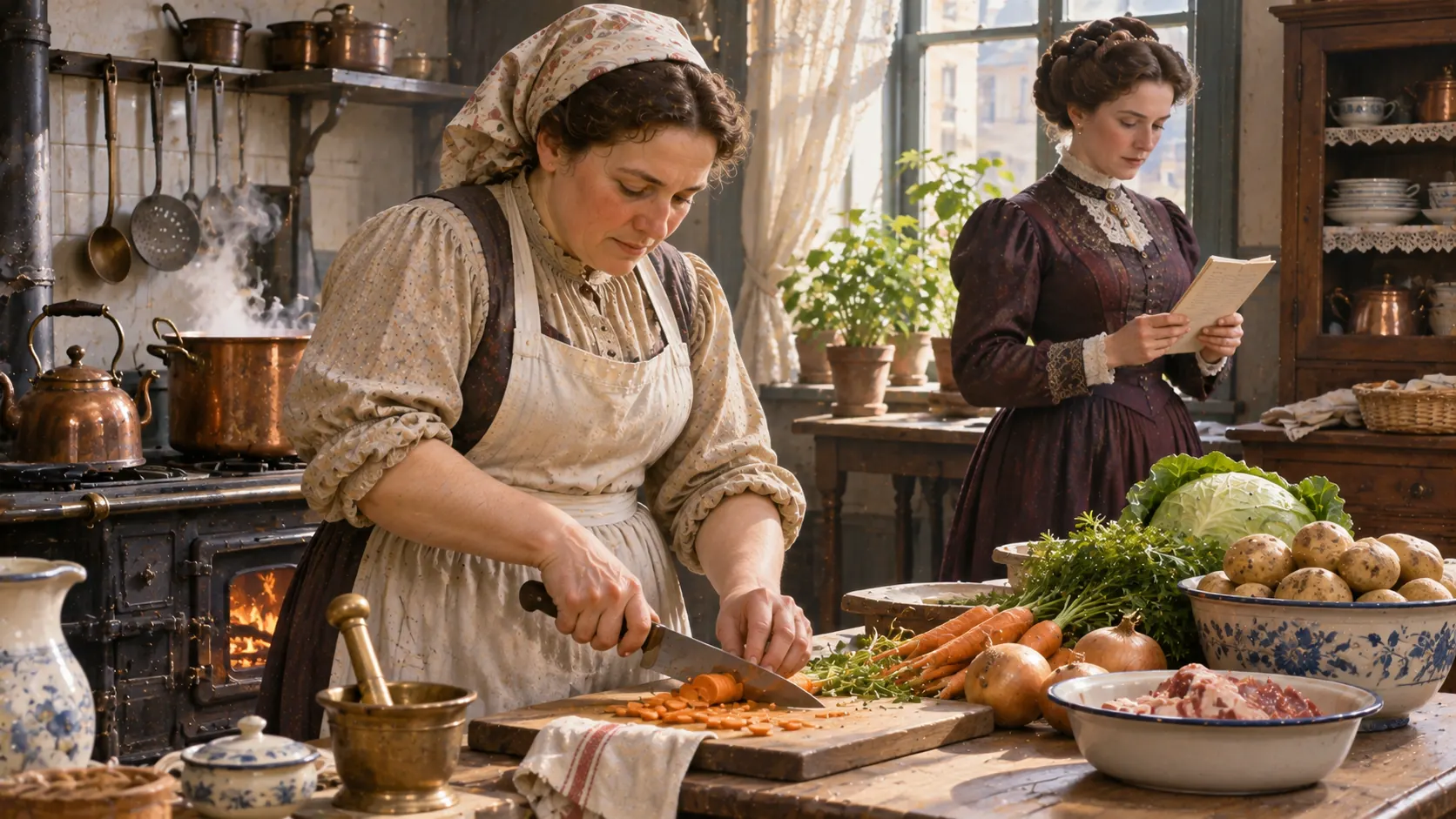
The article's image is a modern artistic reconstruction. It shows a cook preparing vegetables and a householder recording expenses to illustrate divided duties. It is a conjectural scene, not a reconstruction of a particular Petersburg address.
What Molokhovets alone cannot establish
Recipes cannot determine the number of families employing servants in 1901, an average cook's working hours or wages in each town. Statistical studies, employment contracts, diaries and advertisements are necessary.
The book clearly presents the householder as organizer: planning menus, issuing provisions and controlling consumption. Someone else might do the work at the stove. That labour transformed a neat ingredient list into hot food.
The history of Russian cuisine is thus also the history of people whose everyday efforts rarely appear in recipes. Related studies examine water, fuel and cooking, and dining outside the home.
Original recipes and historical sources
Elena Molokhovets, A Gift to Young Housewives, 1901 edition. Original source links are retained below.
- Preface to the 1901 edition (in Russian)
- Section II: Meals for servants (in Russian)
- Valentina Veremenko: domestic service and household relations (2019)
- Historical essay on Moscow cooks and Ivan Kokorev's recollections
- No. 1 — Basic Yellow Broth, Medium Strength · Russian original
- Valentina Veremenko: women's culinary education (2021)
- William Carrick, Russian Kitchen-Maid, historical photographic portrait
- No. 337 — Small Pies with Rice and Eggs · Russian original
- No. 627 — Potato Purée · Russian original
- No. 3687 — Rye Bread, Sifted and Coarse · Russian original
Related reading
- From Market Garden to Sennaya: Vegetables in St. Petersburg
- The Cost of Dinner and Food Expenditure: Molokhovets and Workers' Budgets
- Water, Firewood and Heat: Running a Kitchen in 1901
- Dining Outside the Home: Taverns, Cookshops and Dining Rooms in St. Petersburg around 1901
- How Dinner Was Planned in 1901: Time, Preparations and Kitchen Labour
- What Did a Russian Dinner Look Like in 1901?
Editorial note: domestic labour cannot be reduced to an idealized scene in a beautiful kitchen. The reconstruction illustrates divided duties, while working conditions and household resources differed widely. Historical cooking methods do not replace modern food-safety standards.