The Cost of Dinner and Food Expenditure: Molokhovets and Workers' Budgets
A dinner for 6–8 people costing 2–3 roubles in Molokhovets, and St. Petersburg workers' food expenditure in a 1908 survey: why these figures cannot be compared directly.
Molokhovets provides an apparently ready answer to the cost of dinner: the least expensive of her four categories was estimated at about 2–3 roubles for 6–8 people. Can this tell us how an ordinary St. Petersburg family ate? Several years later economist Sergei Prokopovich surveyed workers about food expenditure. The sources complement one another if their figures are not conflated.
Two dates, two different measures: the 1901 cookbook estimates one dinner of a particular category for 6–8 people. Prokopovich's 1908 survey, published in 1909, estimates monthly food expenses subsequently annualized for selected workers. Direct arithmetic comparison is invalid.
Two or three roubles for dinner: what the figure meant
At the beginning of Section II, Menus or Register of Dinners, Molokhovets offers four price categories. The most expensive dinners for 6–8 people are estimated at 10–15 roubles and more, the second at 7–10, the third at 4–6, the fourth at 2–3. The fourth usually has three courses, sometimes four. The author acknowledges the conditional nature of these estimates: local prices varied and changed.
The estimated price of a proposed dinner is not a family's daily expenditure. A menu does not automatically include breakfasts, suppers, tea, food purchased outside the home or kitchen running expenses. Categories classify proposed combinations of dishes rather than establishing how all Russians ate every day.
Our study of dinner categories discusses menus in more detail. Here the question is different: what share of expenditure was food in particular surveyed households?
Seven years later researchers asked workers about expenses
In February and March 1908, the twelfth section of the Imperial Russian Technical Society distributed St. Petersburg questionnaires on workers' budgets. Economist Sergei Nikolaevich Prokopovich prepared Budgets of St. Petersburg Workers, published in 1909.
Questionnaires were distributed through trade unions, self-education societies, adult workers' schools and consumer societies. Of approximately six thousand forms, 1,016 were returned; only 632 were suitable for statistical processing. Some were incomplete, incomparable or did not identify household composition.
This was not a census of all St. Petersburg workers or the Russian Empire. The survey more readily reached people connected with workers' organizations who could complete a detailed form. Prokopovich discusses its limitations and respondent bias. The shares apply to the surveyed budgets, not the country's average standard of living.
What counted as food: home, cooperative or tavern dinners?
Question 16 asked monthly expenses for breakfast, dinner, supper and tea for the worker and co-resident family. Question 17 distinguished dinners at home, in an artel or in a tavern. Questions 18 and 19 asked whether purchases were cash or on credit in a shop account book, and the remaining debt.
This is a much broader expense category than one dinner in Molokhovets. A worker might eat outside the home, some food might be provided by an employer, and payment on credit differed in timing from cash purchases. The existence of a question on debt does not prove that all respondents were debtors.
Other questions concerned housing, fuel, lighting, clothing, utensils and dishes. Food was only one household expense; its preparation required time, fuel and equipment. The study of dinner organization examines the preceding labour.
How much of the surveyed budgets went on food
Chapter V gives food expenditure tables. For two groups not eating food supplied by an employer, the shares of total expenditure were 48.74% for 307 married or family workers (household food), and 37.30% for 263 single workers (one person's food).
These are specific subgroups. The full processed sample contained 317 family workers and 315 single respondents; some received employer-provided food. The free-board tables have their own populations, so 307 and 263 must not be replaced by 317 and 315.
For the 307 family workers, the table gives estimated annual food spending of 364 roubles 83 kopecks per household and 96 roubles 55 kopecks per family member, with average household size 3.78. These are estimates derived from the 1908 survey, not a 1901 price list or the cost of a particular cookbook dinner.
The difference in shares does not simply mean that a family dinner was more expensive: one covers several diners and household expenses, the other one person's expenses. Budget composition, food arrangements and earnings also differ.
Why these amounts are not exact household accounts
Prokopovich acknowledges that most workers kept no continuous records of all expenses. Researchers therefore asked mainly about the preceding month and annualized the answers. This made surveying easier but depended on memory and approximate estimates.
The author openly discusses data quality. Some forms were excluded, and total stated expenses in the remaining forms exceeded income by 2.9%. This does not necessarily mean every family ran the same actual deficit; memory errors, incomplete data and ways of covering shortages may have affected it.
The published digital table for single workers also contains an arithmetically inconsistent total: dividing total food expense by the number of observations does not agree with the printed average. Until the printed edition is checked, we do not use that disputed average. The expense shares are quoted as published with methodological qualifications.
Why a 1901 dinner price cannot be divided into a 1908 budget
It is tempting to take 2–3 roubles from the cookbook and divide annual household food expenses by that amount to calculate affordable dinners. Such a result would appear precise but answer the wrong question.
First, seven years separate the sources. Second, the book gives an approximate cost for a specific menu for 6–8 diners, whereas the survey estimates all food expenses over a month and annualizes them. Third, model menus for one readership cannot be assigned to surveyed workers as everyday meals. Fourth, common purchase dates, places and product compositions are unknown.
The same risk applies to individual products. Even kopecks per pound of fish do not establish average cost per cooked portion, much less family purchasing power without a separate method.
Which documents could establish living costs more accurately?
A historian of purchasing power needs comparable series: dated city price lists, market reports, actual household accounts, wage and household composition data. Year, city, weight units, quality, season and wholesale or retail status matter.
Vegetable supply history helps trace goods from grower to shop but does not replace retail statistics. Molokhovets's menu shows proposed dinner organization, not the percentage of St. Petersburg households following it.
Matching household accounts and market reports for one city and period would enable more reliable calculations. For now the sources should remain alongside one another rather than being collapsed into a falsely precise table.
What we nevertheless learn about the early twentieth-century table
Molokhovets shows planning: assembling a dinner and choosing an approximate price category. Prokopovich shows the place of food in the expenses of some St. Petersburg workers: payment was regular and food accounted for almost half of expenditure in the surveyed family group.
These are two perspectives on household economics. Together they show that food history is not just recipes, ingredient names and festive table setting, but also earnings, time, trade, number of diners, household habits and the uncertainty of historical statistics. Related studies examine paid kitchen labour and meals sold in taverns and cookshops.
Original recipes and historical sources
Elena Molokhovets, A Gift to Young Housewives, 1901 edition. Original source links are retained below.
- Section II: Dinner Registers — Monthly Dinner Plans and Household Serving Notes · Russian original
- S. N. Prokopovich, Budgets of St. Petersburg Workers (1909), Chapter I: survey methodology
- S. N. Prokopovich, Budgets of St. Petersburg Workers (1909), Chapter V: food expenditure
- Presidential Library: Budgets of St. Petersburg Workers (1909)
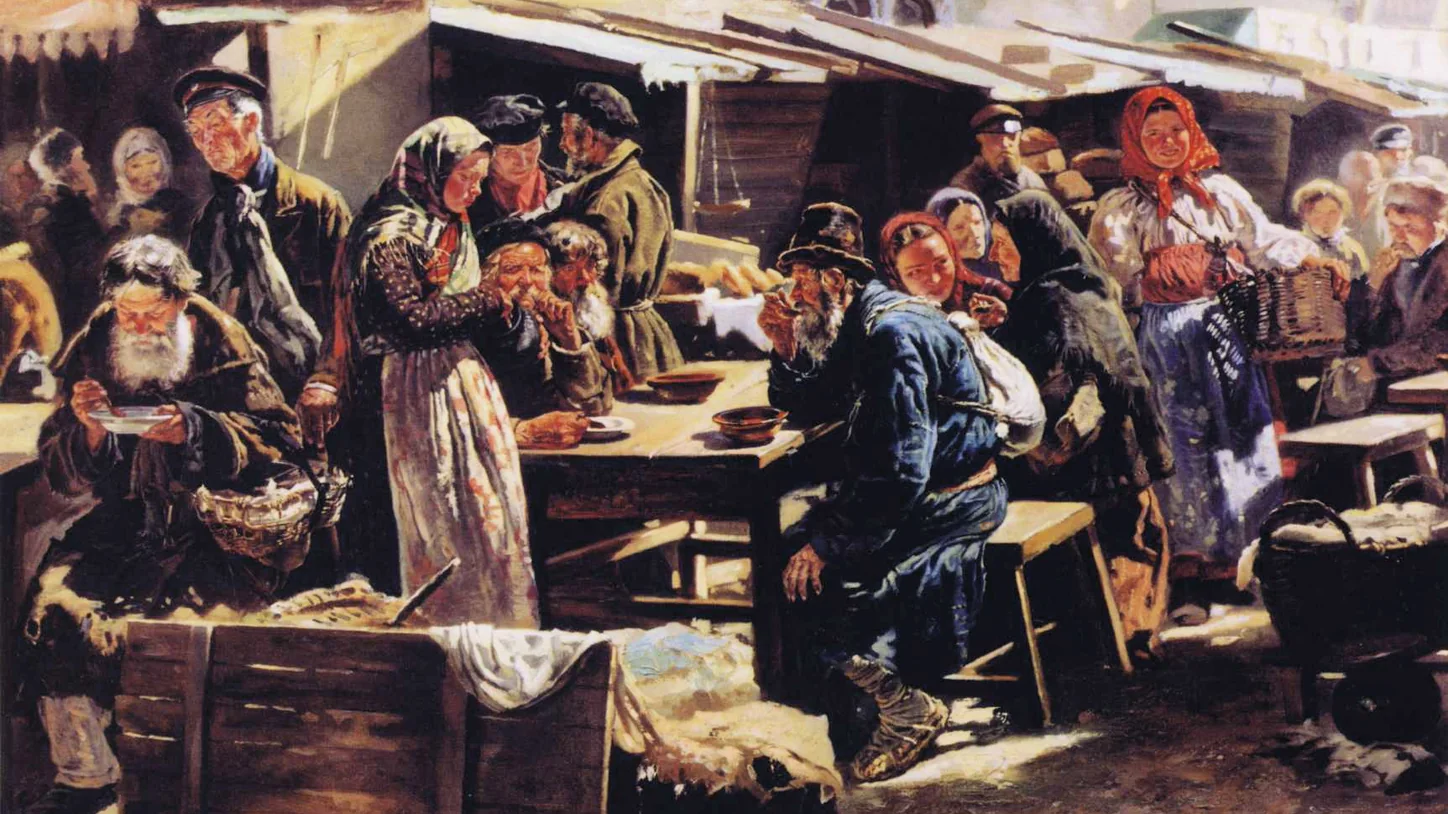
- Wikimedia Commons: Vladimir Makovsky, Dinner (1875), public domain
- Historical Russian Dinner Menus, Month by Month · Russian original
Related reading
- What Did a Russian Dinner Look Like in 1901?
- How Dinner Was Planned in 1901: Time, Preparations and Kitchen Labour
- How Much Did Fish Cost in Molokhovets's Book? Prices in Kopecks and Their Limits
- From Market Garden to Sennaya: Vegetables in St. Petersburg
- Who Prepared Dinner in 1901? Cooks, Householders and Domestic Servants
- Dining Outside the Home: Taverns, Cookshops and Dining Rooms in St. Petersburg around 1901
- How Chinese Tea Reached the Russian Table: Kyakhta, Merchants and Molokhovets
The percentages and amounts refer to the specific survey subgroups. The 1909 publication is catalogued by the Presidential Library; its electronic copy is available in reading rooms, and the referenced text of Chapters I and V is linked below.