What Did a Russian Dinner Look Like in 1901?
Explore formal and economical dinner menus in 1901, including four historical price classes and the recipes of Elena Molokhovets.
Imagine planning a dinner in Russia at the beginning of the twentieth century. How many courses would you serve? What would you offer guests? How much would count as an expensive meal? In the 1901 edition of A Gift to Young Housewives, Elena Molokhovets answered these questions not with one ideal banquet, but with an entire system of dinners at different prices.
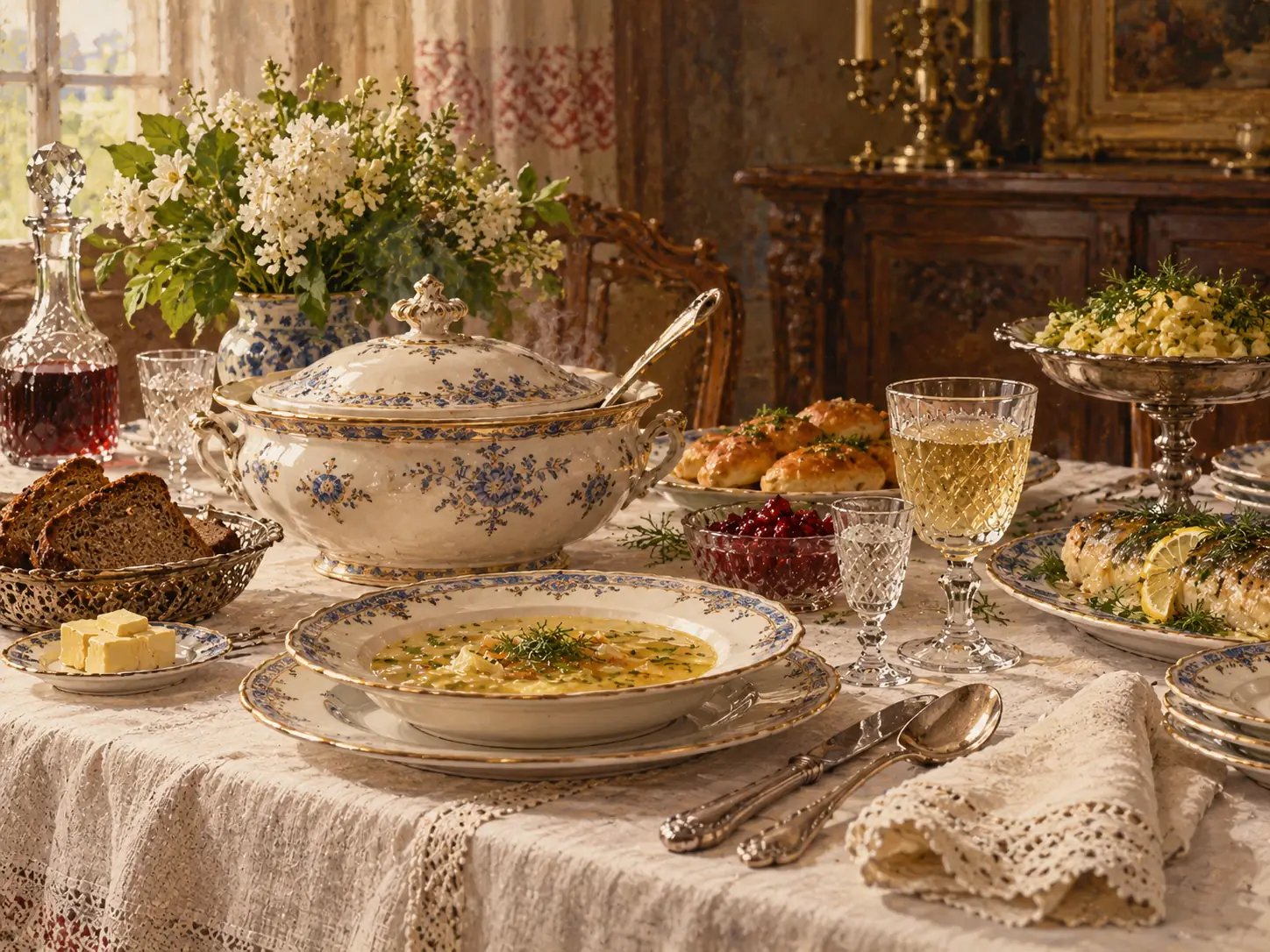
Not one menu for everyone
Section II of the book offers 600 meat-inclusive dinners, arranged into four price classes. These are suggestions for choosing and composing meals, not evidence that all residents of the Russian Empire ate such dinners daily. The classes distinguished budgets and numbers of courses.
Four classes, four different budgets
At the start of Section II, “Menu or Register of Dinners,” Molokhovets explains that a housekeeper may select a dinner according to preferences and means. Her price estimates are explicitly approximate: costs differed across Russia and changed over time.
Class I meant large formal dinners. For 25 people, the author suggested a cost of 40–60 silver rubles excluding wine; for 6–8 diners, about 10–15 rubles or more. Class II comprised five, sometimes six, luxurious courses, estimated at 7–10 rubles for 6–8 people. Class III offered something similar but usually one course fewer—four or five—with an estimate of 4–6 rubles. Class IV had three, sometimes four, courses at about 2–3 rubles for the same group size.
These sums cannot be translated into present-day prices by a simple currency conversion. Without historical wages, local markets, ingredients and purchasing power, such arithmetic would be misleading. The proportions nonetheless make the author's point clear: the cookbook taught household budgeting as well as cooking.
Avoid repetition—and consider the color of each course
Before the monthly menus, Molokhovets sets out four rules for composing a dinner. She recommends alternating more and less substantial dishes and avoiding repetition of the same main ingredient in consecutive courses.
Her attention to appearance is especially striking. After a pale soup, she advises against chicken or fish in a similarly pale sauce and favors visual contrast. She likewise discourages two successive sour, sweet, cold or meat dishes. These are historical principles of arranging a meal, not modern scientific dietary advice.
The dinner thus appears as a sequence in which changing flavors, presentation and the diner's impression matter. Understanding this helps explain the original menus: they are deliberate compositions rather than random lists.
A Class I dinner in November: from soup to coffee
The November register for Class I gives a lengthy formal dinner. It begins with a choice of clear game soup or fish soup based on meat stock, accompanied by small pastries and other appetizers. Next come roast pork with chestnut sauce, a salmon-and-sturgeon pâté, and a hot vinaigrette of roots and greens.
There follow soufflé, chilled punch, roast game with salad, and cream ice cream or jelly; cheese, fruit, coffee and tea conclude the meal. The source names wines between courses. Their inclusion is part of the historical record, not a serving plan we recommend today.
This should not be described as an ordinary household dinner. Molokhovets explicitly puts it in her most expensive class, intended for particular guests and means. Its elaborateness is obvious in the combination of game, several kinds of fish, hot and cold dishes, and sweets.
A Class IV dinner in November: simpler, but not just one dish
The November Class IV register gives shorter combinations. The first includes open pastries with fresh herring, vegetable broth, roast goose and lemon mousse. A second menu lists cabbage soup with preserved sorrel and porridge, calf's head with prune sauce and an apple pie made from pancakes. A third proposes lemon soup, stewed beef with sauce and salad, and apples fried in batter.
Even the less costly suggestions may surprise a modern reader. That does not imply that poor households regularly served goose and mousse. These were options for households of a type that had access to the ingredients and resources described, not a survey of popular nutrition.
The distinction from Class I was primarily scale and number of courses—not that the cheaper category necessarily consisted of one plain bowl of gruel.
What lay between the extremes?
Classes II and III occupied the middle of the scheme. On our modern digital site they are presented together in one monthly register because that is how this part of the source is organized. In Molokhovets' explanation, however, they remain different cost classes: the third generally has one course fewer than the second.
The November register for Classes II–III begins with clear broth and toast, followed by a cold fish dish called “mayonnaise” in the historical text, English pudding, hazel grouse with salad, and orange-flavored cream ice cream. Here, too, there are several dishes, but not the long series of courses of the grand Class I dinner.
This is one example from one month, not the universal model. Molokhovets allows readers to choose and combine menus while respecting her rules. We therefore keep access to the entire historical register instead of inventing a single “perfect dinner of 1901.”
Why the months matter
The menus are arranged by month. Changes in vegetables, greens, fruit, game and hot dishes become visible. Compare November with the Class I July menu: summer brings botvinya, airy strawberry pie, raspberries and berries, while the elaborate form of the formal dinner remains.
Our English-language navigator of 36 monthly registers covers twelve months and three groups of original lists: I, combined II–III, and IV. The historical book has four price classes but the navigator contains three sets of monthly pages. That distinction should not be confused.
Can the book tell us what everyone ate?
Only in a limited sense. It illuminates the author's culinary ideals, price estimates, available foods and recommended household practices. It is neither a census of meals nor one family's diary, and certainly not a portrait of every social class. A formal dinner cannot be projected onto peasant or working-class life.
The same section includes separate chapters on breakfast, evening tea, cold drinks and food for servants. Their presence reminds us that meals also reflected household organization and social distinctions. What makes the source valuable is precisely its variety: elaborate entertainments, more economical dinners and everyday advice can be read side by side.
For the ritual of setting the table, see the Russian study of table service. The study of food costs and workers' budgets explains why a cookbook's estimated dinner prices cannot simply be divided by workers' wages.
Compare three original November menus
Principal source: Elena Molokhovets, A Gift to Young Housewives, 1901, Section II, rules for composing dinners and monthly registers. All historical prices and menu examples above come from the cited book, not from a modern reconstruction. Continue with the English menu navigator and the guide to old Russian units.