Dining Outside the Home: Taverns, Cookshops and Dining Rooms in St. Petersburg around 1901
How cookshops, taverns and people's dining rooms operated, what particular meals cost, how prepared food was delivered and how it differed from home cooking.
Molokhovets's book explains how to assemble dinner at home. But what did students, clerks, artisans, lodgers and other people do when they had nowhere or no time to cook? They could eat in a tavern, cookshop or inexpensive dining room or buy prepared meals. These establishments differed in price, service and clientele far more than one modern category suggests. Contemporary accounts and research illuminate them alongside the domestic dinner.
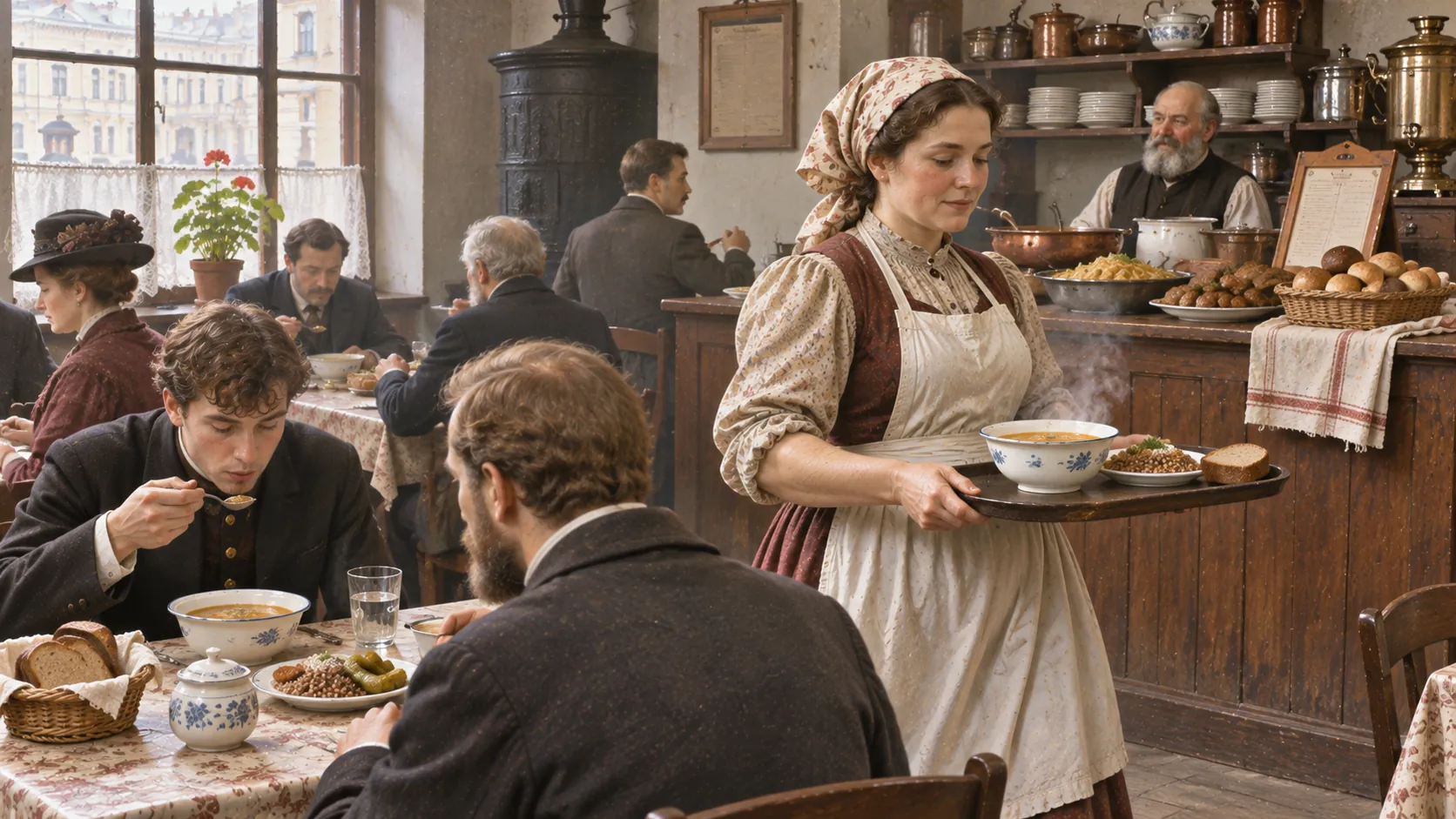
The principal source is Yulia Demidenko's study Cookshops and Dining Rooms with extracts from A. A. Bakhtiarov and nineteenth-century documents. Bakhtiarov's 1895 description concerns low-cost eateries; historical research on workers' food concerns everyday labour. The 1901 cookbook provides a domestic comparison, not dining-room prices.
Why cooking at home was not always convenient
The capital housed more than families with their own kitchens and servants. Students rented rooms, migrants worked in workshops and some single clerks lodged in furnished rooms. Small accommodation might lack convenient cooking facilities.
Demidenko describes eating outside the home as an everyday necessity for various Petersburg residents, particularly those for whom a separate kitchen was costly. This does not mean most inhabitants always ate out: family dinners retained significance.
A later survey from 1909, cited in research on workers' meals, found that among 1,750 respondents, 54% ate dinner at home and 20% in dining rooms. These figures are not Petersburg statistics for 1901 and cannot be applied to every occupation.
Tavern, cookshop and dining room: the distinction
A tavern offered hot food, tea, company and sometimes entertainment. A kukhmisterskaya, or cookshop, more often provided regular inexpensive dinners for students, modestly paid officials and artisans. The term stolovaya, dining room or canteen, became increasingly familiar around the turn of the century. Boundaries were not strict: similar businesses might have different names in records and memoirs.
Dmitry Zasosov and Vladimir Pyzin describe taverns and their attendants in recollections of Petersburg in the 1890s–1910s, mentioning shchi, porridge, peas, inexpensive fish and boiled meat fried with onion. Eyewitness accounts convey atmosphere without establishing a uniform menu or quality.
A Greek cookshop did not necessarily serve Greek food
Bakhtiarov describes Greek cookshops serving ordinary urban customers. In Demidenko's cited example, they offered familiar shchi, borscht, stocks, cutlets and zrazy. The name did not guarantee a national cuisine.
Such cookshops existed in the city centre, including Nevsky Prospekt. One historical description gives prices: two courses 25 kopecks, three 35 and four 45. These are prices for a particular described type of cookshop, not a universal 1901 Petersburg tariff. Some establishments offered subscriptions, others separate portions and more expensive dishes.
Kopeck prices without income information explain little. The separate study of dinner costs and workers' budgets addresses comparability.
Dinner subscriptions and meals delivered home
Cookshops could serve more than people at their tables. Demidenko describes delivery of prepared dinners to lodgers, bachelors and others who preferred eating in their rooms without cooking.
Regular dinners were sometimes prepaid for several days or a month, with an example of a subscription discount. Advance payment also created dependency on the proprietor. Writer Yevgeny Grebenka humorously observed that portions became more generous near the end of a subscription to encourage renewal. This is literary observation, not a measurement of all proprietors' conduct.
Three practices thus differed: cooking at home, eating a purchased dinner on the premises, or ordering finished dishes to one's lodging. Delivery is not simply a recent invention.
Student dining rooms: inexpensive dinner as mutual support
Special student establishments arose near institutions on Vasilyevsky Island and the Technological Institute. The history of Petersburg dining rooms mentions a student dining room opened in Kuznechny Lane in 1888 with prominent hygienists involved, and another on the Tenth Line of Vasilyevsky Island in 1890.
Food cost, composition, sanitation and advance payment were considered. Zasosov and Pyzin later recalled dinners costing 10–15 kopecks in some student dining rooms. Their recollections concern the broader period around the turn of the century; these prices cannot be assigned to a particular 1901 establishment without verification.
Dining rooms saved students money and kitchen work while providing regular hot food.
The cheapest meals and the gluttons' row
Alongside cookshops were food shops and inexpensive eateries for the poorest residents. In an 1895 report Bakhtiarov described suppliers of cheap meat products and the gluttons' row on Nikolskaya Square. His account describes cheek meat, offal and other parts less sought after by affluent customers reaching eateries and stalls.
This should not be treated as picturesque nostalgia: savings could come at the cost of poor sanitation, low-quality food and low-paid labour. Not every inexpensive dining room was unsafe; charitable and model establishments could have stricter rules.
Bakhtiarov's testimony concerns 1895. Its shipment figures and prices cannot become 1901 statistics without further evidence.
People's dining rooms: hot meals as assistance
According to Demidenko, one of Petersburg's first people's dining rooms opened in 1892, initially in connection with the threat of cholera and the need to help those in need. Later benefactors developed similar establishments to provide poor residents with inexpensive, relatively clean and nourishing hot meals.
The history distinguishes municipal support, private donations and self-financing establishments. Some sold dinner tickets that affluent donors could purchase for people in need. Descriptions of the von Derviz family's public dining rooms include a cashier, tickets and several dinner options.
Accounts of particular dining rooms in 1908 and 1912 concern later developments, not the network as it existed in 1901. Cheap meals could be a charitable mechanism and part of public sanitation policy, not just a commercial service.
Restaurant dinner: another menu and clientele
At the other end of the system were restaurants with detailed menus, individual dishes and more expensive service. Interior, table setting, appetizers and drinks mattered. Research into restaurant businesses describes historical categories and locations of restaurants and taverns.
Petersburg restaurants might offer dishes recognizable from Molokhovets, including consommé, fish with sauce, roast and puddings. Similar names do not prove that a restaurant followed a particular cookbook recipe. The related table-setting study illustrates how dining depended on venue and means.
Clientele, price and service distinguish a tavern, cookshop and expensive restaurant more usefully than forcing each into one modern equivalent.
What Molokhovets provides for comparison
The cookbook includes dishes also encountered in descriptions of urban meals: basic yellow stock No. 1, mushroom shchi No. 162, crumbly buckwheat porridge No. 378 and rice-and-egg pies No. 337. These describe domestic techniques, not the menu of a particular dining room.
They may be compared with kinds of dishes reported in taverns, but proportions, ingredients and expenses cannot be assigned to cookshops. Running a domestic kitchen also required fuel, water, labour and equipment, discussed in another study.
Eating out purchased a finished result and saved time, sometimes at the cost of limited choice and lower quality.
Why Petersburg had no single typical dinner
A cookshop served regular subscribers, a cheap eatery people with little money, a student dining room students, a people's dining room those needing help, and a restaurant customers expecting another level of food and service. Some ordered food to their rooms, others carried meals to work or cooked themselves.
This completes the first fifty stories: the kitchen of 1901 was more than a collection of recipes. It depended on markets, people's labour, housing, financial resources and urban infrastructure. Understanding historical dinner means considering all these circumstances together.
Original recipes and historical sources
Elena Molokhovets, A Gift to Young Housewives, 1901 edition. Original source links are retained below.
- Yulia Demidenko, Cookshops and Dining Rooms
- A. A. Bakhtiarov: inexpensive Petersburg eateries, 1895
- Historical Materials: workers' food consumption
- Dmitry Zasosov and Vladimir Pyzin: recollections of Petersburg
- Yulia Demidenko: statistics and geography of restaurants
- No. 1 — Basic Yellow Broth, Medium Strength · Russian original
- No. 162 — Shchi with Mushrooms · Russian original
- No. 378 — Firm, Fluffy Buckwheat Porridge for Shchi and Borscht · Russian original
- No. 337 — Small Pies with Rice and Eggs · Russian original
- Culture.ru: catering in the Russian Empire
Related reading
- The Cost of Dinner and Food Expenditure: Molokhovets and Workers' Budgets
- How a Dinner Table Was Set in Russia in 1901
- Water, Firewood and Heat: Running a Kitchen in 1901
- Who Prepared Dinner in 1901? Cooks, Householders and Domestic Servants
- What Did a Russian Dinner Look Like in 1901?
- From Market Garden to Sennaya: Vegetables in St. Petersburg
Editorial note: prices and descriptions concern particular establishments and different dates, not the average Petersburg bill in 1901. Sanitation, food quality and working conditions varied; historical description does not endorse those practices.