How a Dinner Table Was Set in Russia in 1901
A historical study of table setting, household service and dining customs in the 1901 Russian cookbook.
The 1901 edition of Elena Molokhovets' A Gift to Young Housewives contains not only recipes and suggested dinners but an entire section on arranging the dining table. It tells readers where to place appetizers, how to decorate a formal dinner, where bread and cutlery belong, and why used utensils were replaced after each course. These are recommendations for a particular readership, not universal everyday rules followed by everyone in Russia.
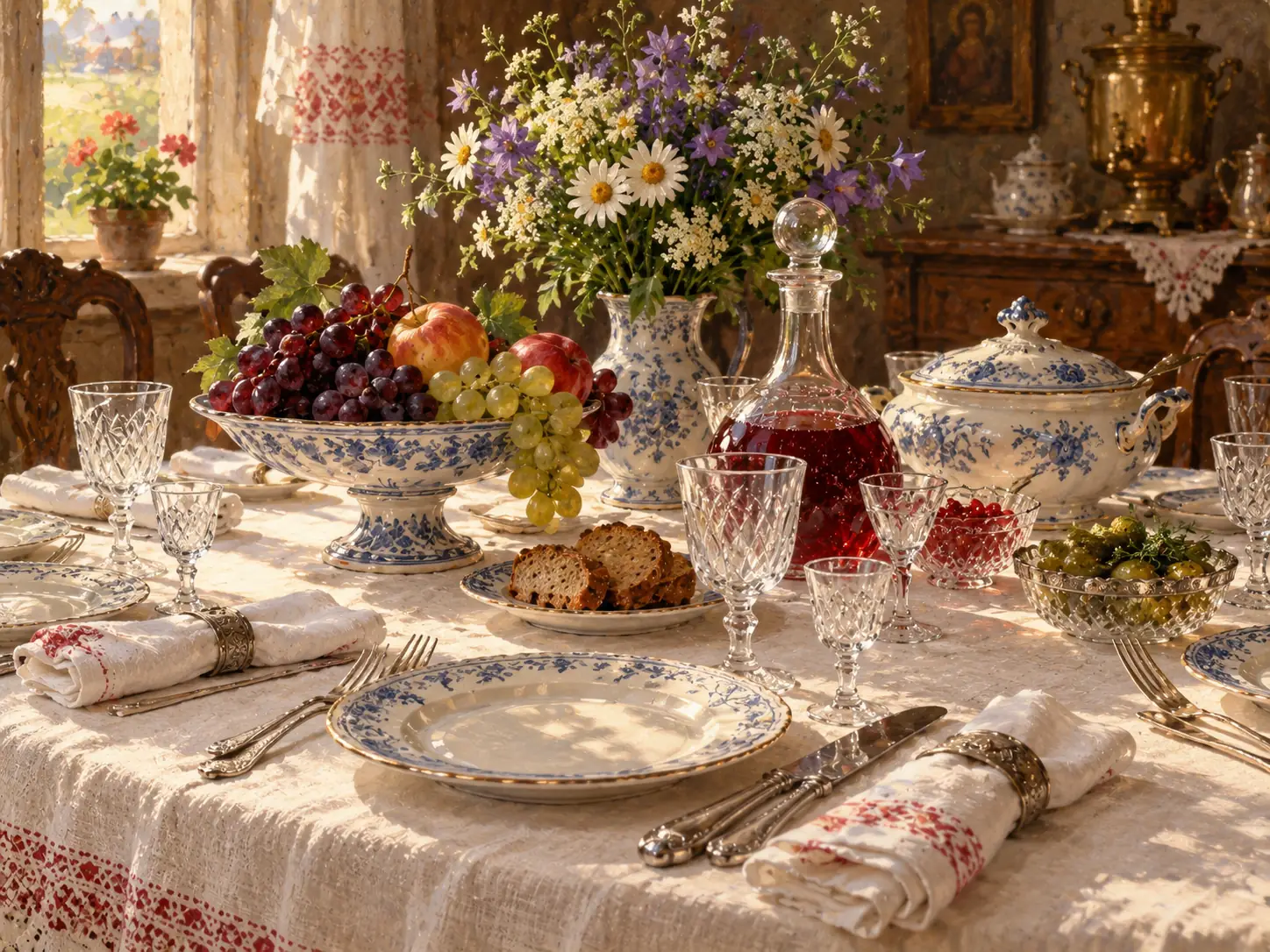
The table changed with the occasion
Molokhovets distinguishes an appetizer table, a formal dinner, a simpler dinner and a family supper. The decorations, dishes and order of service differ. The principal source is Section XXXVII, “Setting the Table and Serving Dishes,” in the 1901 edition.
A separate table for appetizers
At the beginning of Section XXXVII, Molokhovets suggests placing a separate appetizer table near the dining-room door or in an adjoining room. Small plates might hold sliced cheeses, fish, ham, sausages, game and other foods. Bread and rolls, butter, napkins and forks are provided separately.
The details are surprisingly precise. Bread should be sliced thinly; napkins may be arranged at the corners of the table and others folded into triangles in a particular order. Decanters and small glasses also appear in this historical description, not as a suggestion for today's hospitality.
Another, more elaborate version uses a rotating tray at the center of a square table. Six shallow bowls contain appetizers and a seventh holds bread; plates and napkins surround them. These are structured arrangements, not just casual collections of food placed before dinner.
A formal dinner: linen, flowers and a centerpiece
The formal table begins with a cloth and a central ornament. Molokhovets recommends a silver or glass étagère—a tiered stand carrying fruit, sweets and flowers. Additional flower vases might stand nearby; for evening dining she mentions candelabra with candles or lamps.
The expensive étagère is not the only option. The author immediately explains how to construct a similar ornament from glass vases of different sizes, grapes, fruit and flowers. This is characteristic of her household manual: it sets out an ideal and then supplies a less expensive alternative.
According to Molokhovets, the occasion, number of guests, season and time of day should influence the decoration. A dinner in honor of a particular person might have a bouquet emphasizing their place. The dining table was conceived as an event planned in advance, not merely a surface for serving food.
Where were plates, bread and cutlery placed?
For a formal dinner, Molokhovets suggests roughly one arshin of space per guest to prevent diners crowding one another. An arshin measured approximately 71.1 centimeters. Flat plates were set in front of the guests, with a folded napkin beneath the plate. A small bread plate to the left carried several kinds of bread and pastries served with soup.
Her cutlery arrangement may surprise a modern reader: the description places knife, fork and spoon to the right of the plate. This is a specific plan from the 1901 text, not a universal rule of etiquette for every household or historical period. Drinking vessels were arranged before the plate, and the author suggests one small saltcellar for every one or two guests.
The instructions also include water jugs, fruit knives and a side table near the door from which dishes could be brought to guests. Formal service depended on spare utensils and work space as much as on a handsome tablecloth.
Why utensils were replaced after every course
Molokhovets explicitly advises that used knives, forks and spoons should remain on the plate when it is taken away. Only clean utensils should be placed back on the tablecloth. This was a matter of order and cleanliness within the formal-service system she describes.
The author then discusses the duties of a servant, who must promptly remove used plates and replace them with clean ones. She recommends serving from the left, beginning with women and ending with men. We report that as the author's own rule for this kind of dinner, not a direction that all modern servers should follow.
These passages reveal labor as part of the ceremony. Dishes had to be transported to the dining room, used utensils collected, and fresh ones provided at the proper time. The formal table depended on the resources and workers available to the household.
Dessert, cheese and a debate about ice cream
Molokhovets does not stop at the first course. In the dinner sequence she describes, cheese follows the sweet dish, then fruit and sweets. Coffee is served later, after diners have left the table. A similar ending can be found in the November Class I dinner register.
One particularly revealing remark concerns the recent fashion for eating sweet dishes, including ice cream, with a fork. Molokhovets disapproves and calls it inconvenient. The comment is more interesting as evidence that fashions in table manners were being debated than as an answer to the modern question of which utensil is “correct.”
A simpler dinner and a family supper
The book follows its formal example with a less elaborate dinner table. Flowers and fruit remain, but the number of decorations and vessels is reduced. Where matching ornamental vases are unavailable, simple flowerpots wrapped in paper and ribbons may substitute. The general order remains but the show is less elaborate.
For a family supper, Molokhovets describes another arrangement with appetizers on a separate table and prepared dishes on the main one. Instead of emphasizing rapid replacement by a servant, she discusses the host and hostess serving their guests. Cold fish, roast meats and desserts might be laid out, with plates adapted to the successive courses.
She also advises against casually combining crockery with unrelated colors and patterns. But separate courses could have their own coordinated sets. The text thus distinguishes formal service, family serving and less expensive settings rather than presenting one compulsory scheme for every dinner.
Dining equipment: a separate world of objects
Another section, “Modern Dining and Tea Table Equipment,” describes items that can seem unfamiliar today. There are nickel-plated warmers, devices for carrying hot food, special knives and forks for meat and game, wooden utensils for salad, and spoons intended for fish or dumplings.
The rotating appetizer tray appears again under the term frühstück. Here it denotes a serving implement, not a meal. The same list mentions small knife rests, fork rests and a crystal plate with a cover for cheese.
Such items are evidence of what the author proposed to her readers, not an inventory of every dining room in Russia. They show how thoroughly serving temperature, comfort, food handling and the tasks beyond the kitchen could be planned.
What can the setting of a table tell us about life?
The service section reveals expensive tableware and cheaper substitutes, formal and family meals, specialist utensils and servants' work. The arrangement depended on room size, the number of guests, season and the course sequence.
It would nevertheless be incorrect to project these recommendations across all households in 1901: urban apartments, workers' homes and village dwellings could have very different facilities and practices. Other evidence is necessary to reconstruct those settings.
Read alongside our study of the four dinner classes, Section XXXVII gives a fuller picture: one source asks what might be served, and the other how the author proposed organizing the table and its service. The study of evening tea reveals yet another social setting.
Three original sections about dining
Compare the November Class I menu, our English month-by-month menu guide, kitchen utensils in 1901, and the Russian historical research on cold dishes and aspic.