The Russian Tea Table in 1901: More Than Tea and Jam
How an evening tea could replace supper in a household entertaining guests around 1901, according to the original cookbook.
Tea at Elena Molokhovets' table did not necessarily mean tea with jam and biscuits. In the “Evening Tea” section of her 1901 cookbook she describes a late gathering where tea could take the place of supper. A samovar, breads and pastries, fruit, cheese, cold meats and several types of butter might all be laid out. The original pages let us reconstruct how such a table was organized.
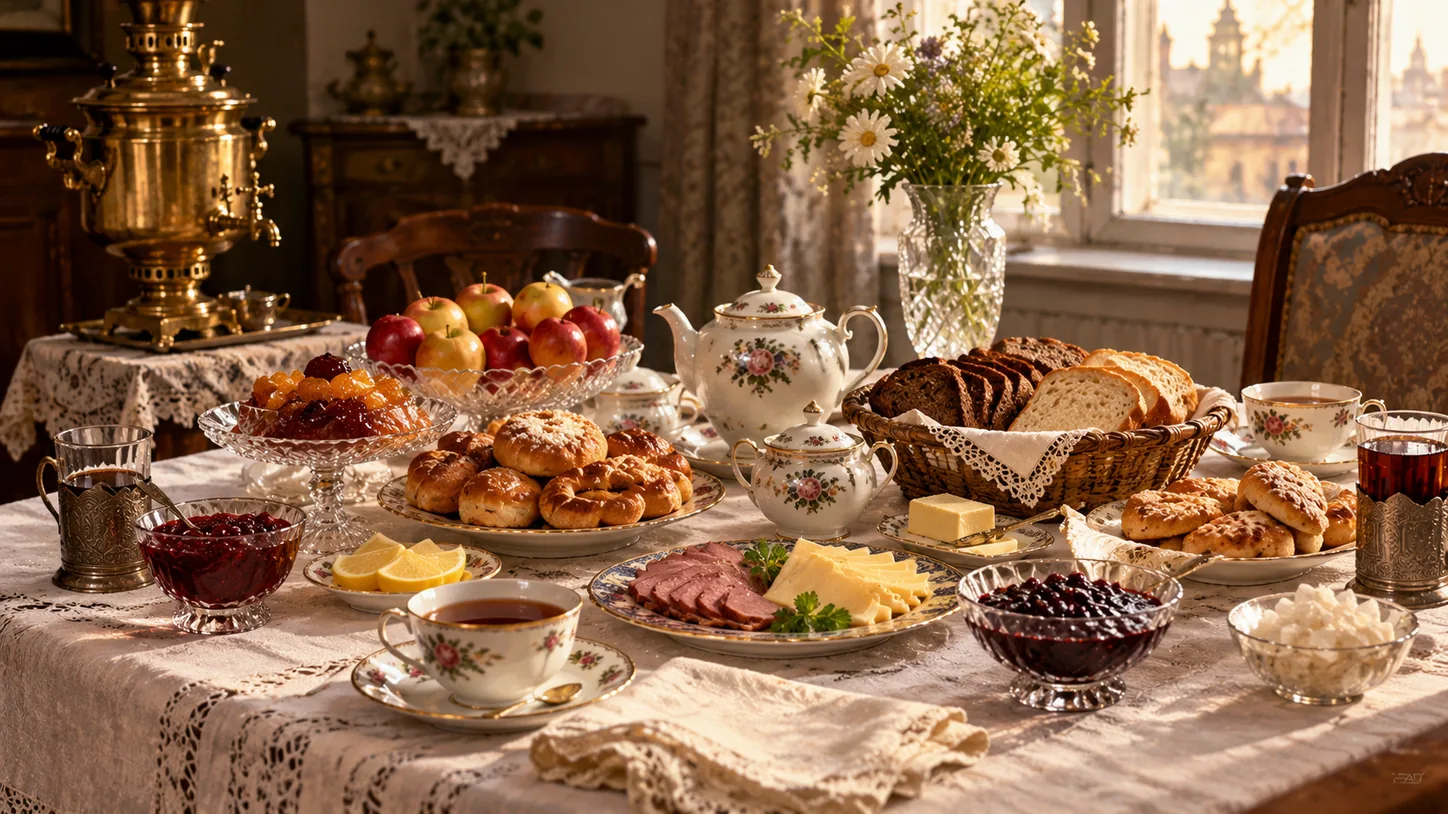
Evening tea could replace supper
In “Evening Tea” in Section II, Molokhovets proposes a large table for guests, with a separate samovar, several kinds of bread, baked goods, fruit, preserves, butter, cheese and savory snacks. It is an example of entertaining, not evidence that every Russian family ate this way each evening.
The author begins with visitors gathered for conversation, not a recipe for a drink. If the evening was not to stretch far beyond midnight, late tea poured by the hostess could replace a separate supper. The unusually broad food list follows from that situation. Guests were to choose between sweet and savory items, not merely drink boiling water flavored with tea leaves.
Histories of nineteenth-century urban tea drinking, including an Arzamas overview, also discuss tea as part of social life and household routines. Even so, Molokhovets' example is advice for her own audience, not a description of every home in the empire.
A samovar next to the long table
Molokhovets suggests spreading a clean cloth over a long dining table and placing a smaller table with a samovar at one end. A tall fruit vase stands in the middle, while dessert plates and utensils are arranged on either side. These instructions concern placement and order as much as decoration.
The samovar also features in recipe No. 3495, “Tea.” For a large family or many visitors, Molokhovets describes making a strong infusion with one small samovar and supplying boiled water from a second, larger one, so guests can receive tea of consistent strength.
The chapter on dining and tea-table equipment includes nickel-plated samovars. This tells us that the samovar was both a working appliance and a furnishing—but one household manual cannot prove that every family had the same model, let alone two samovars.
How Molokhovets suggested brewing tea
In No. 3495, the author names tea merchants she considered reliable. For ordinary tea she gives roughly a teaspoon of dry leaves for four people, recommends covering the teapot with a towel, avoiding an excessively long stay atop the samovar, and allowing the tea to infuse.
When serving a large company, she describes placing tea in a clean muslin bag inside a small samovar to make a concentrated infusion, which can be diluted with boiled water in glasses. She also mentions cream, milk, lemon, preserves and other additions.
Some of Molokhovets' opinions about water temperature, sugar and the health effects of additions belong to the historical record, not modern verified health advice. We can describe how she proposed serving the drink without endorsing every claim she made.
Fruit and jam arranged symmetrically
The table setting pays remarkable attention to vases. In the center, Molokhovets recommends apples, pears, oranges, mandarins and grapes. On either side, separate crystal dishes of preserves are placed near small saucers and teaspoons: jam might be added to tea or eaten separately.
An alternative is preserves on one side and sliced oranges sprinkled with fine sugar on the other. The author even specifies symmetrical placement. These details suggest advance planning; fruit preparations could begin earlier in the day.
The text refers to recipe No. 2416 when discussing candied orange peel, but in the available transcription No. 2416 is an onion-and-caraway sauce. This mismatch is present in the historical source. It would be misleading to silently “correct” it by guessing which recipe was intended.
Breads and pastries served with tea
The “Evening Tea” instructions call for thinly sliced bread arranged in rings or rows on a tray: dark bread, French-style white rolls and other varieties. Bread baskets with biscuits, buns and babas—bought or homemade—stand to either side of the fruit centerpiece.
For homemade baked goods the book points to a large section that survives online as Section XXXIX. Examples include tea buns No. 3084, braided buns No. 3138, unleavened rolls No. 3139, biscuits for tea or coffee No. 3158, and lemon sponge cake No. 3190.
These were alternatives, not a demand to serve every pastry at once. Their recipes document different doughs, ovens and serving methods, even where the modern translations of their names might sound similar.
Meat, cheese and butter were also served
The savory selection could be considerable. Molokhovets proposes small plates of thinly sliced veal, ham, beef, hazel grouse, turkey, chicken, tongue and cheeses, arranged near the bread. She even suggests alternating paler and darker foods to create an orderly appearance.
The butter selection extended beyond plain butter No. 3616 to hazel-grouse butter No. 3633 or liver-flavored butter No. 3634. The book also contains cream cheese No. 3659 and butter-and-tvorog cheese No. 3660, offered for tea or breakfast.
This explains how evening tea could stand in for supper; it does not establish that such abundance was normal across all social groups. The author describes a particular arrangement for a particular occasion.
“Cider” at tea was not necessarily an apple drink
The late-tea list includes what Molokhovets calls “lemon cider.” The meaning becomes clear in No. 3342, “Lemon Cider or Sherbet for Tea.” It is not modern apple cider. Rather, the text describes a concentrated preparation of lemons and sugar taken in small amounts with water or tea, sometimes in place of a sugar cube eaten alongside tea.
Nearby are an orange version, No. 3343, and lemon sherbet, No. 3344. The example shows why an old product name should not be translated uncritically as if it denoted the same item found in a modern shop.
Evening tea was not simply a dessert course
There were jams, fruit and pastries on the table, but Molokhovets also gave separate chapters to creams, cold desserts and puddings. The Russian editorial essay on blancmange, wafers and puddings treats them separately rather than collapsing everything sweet into the tea table.
Yet cream wafers No. 1807 are expressly described as suitable for tea or coffee. This shows how one cookbook recipe can belong to a baking chapter and still find a place in the instructions for evening entertaining.
What the tea table reveals about domestic life
The book describes who poured tea, where the samovar stood, how plates, fruit bowls and bread were arranged, and how guests selected food. Tea drinking was part of organizing a household and welcoming acquaintances. Read alongside the Russian essay on formal table setting, it reveals different forms of dining within one source.
Once more, these are the author's recommendations, not evidence that all families used them. The primary sources for this study remain “Evening Tea” and tea recipe No. 3495 in the 1901 edition.
Read the original passages
Additional context: “A Brief History of Tea in Russia,” Arzamas. Related Russian research includes tea routes and Kyakhta, sugar refining, honey and gingerbread, and fruit preserves.