Water, Firewood and Heat: Running a Kitchen in 1901
How kitchens obtained water and fuel, why running water was not available in every apartment, and how cooks controlled stove heat in Molokhovets's recipes.
Before a householder or cook could make stock, water, fuel, fire and a functioning stove were needed. St. Petersburg around 1901 had no single kitchen arrangement: some buildings had mains water, others still relied on delivered water, and wood-burning ranges coexisted with newer heating systems. What lay behind Molokhovets's instruction to put a pot on the fire?
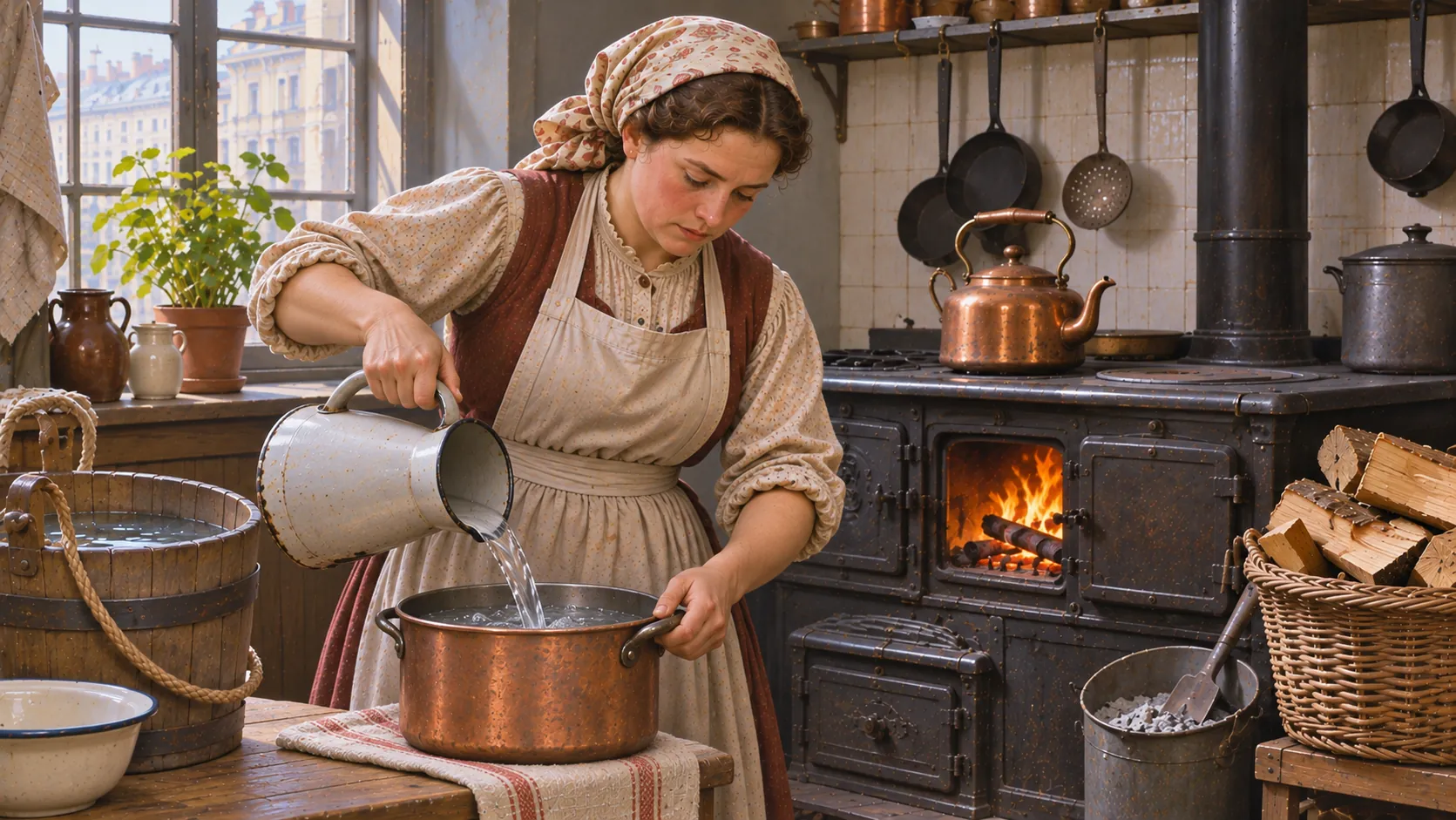
Historical scope: principally St. Petersburg in the late nineteenth and early twentieth centuries. Conditions in other towns and rural homes could differ. Running water already existed in 1901, and not every dinner was cooked in a traditional Russian oven.
Water was more than an ingredient
Stock, bread, washing vegetables and cleaning utensils required water. In late nineteenth-century St. Petersburg its supply depended on the address and building. Some buildings had mains water; elsewhere it was carried, purchased from a water carrier or collected in the courtyard.
Olga Zaerko of the Central State Historical Archive of St. Petersburg notes that the city waterworks company was founded in 1858, the first networks began operating in 1863, and the city purchased the waterworks in the 1890s.
It is therefore wrong to say that tap water did not exist in 1901, but equally wrong to imagine water in every individual kitchen. A building connection, internal apartment pipes and water quality are different issues. Water supply was municipal infrastructure, not an automatic convenience for everyone.
Water carriers did not disappear as soon as mains water appeared
Water carriers remained important for houses without convenient network connections. Encyclopedia accounts of St. Petersburg water supply describe public pumping stations and delivery of Neva water in barrels. Historian Elena Pervushina also mentions colour-marked barrels, distinguishing different sources and uses of water before the spread of the network.
The colour of a barrel does not provide a modern sanitary guarantee. Street sources, carriers and pipes could present different quality problems. Even connected houses did not always provide water conveniently beside the worktable.
For the kitchen this meant additional tasks: carrying water, filling vessels, maintaining a reserve and removing used water. Recipes usually omit them, although dinner could not begin without them.
Where firewood came from
A wood-burning range required fuel. A historical account of heating St. Petersburg describes firewood stored in courtyard sheds, with caretakers sometimes chopping it and carrying it to apartments. Some apartments were let with firewood included in the rent.
These arrangements should not be generalized to every town and dwelling. Some families bought fuel separately; elsewhere part of the work fell to servants. Before lighting the fire, wood had to be delivered, stacked, dried and prepared.
Fuel cost money and occupied space. This complements the study of dinner expenses: the price of ingredients alone is not the full cost of a cooked dish.
A heating stove and a cooking range were not the same
St. Petersburg tenements contained different appliances: room-heating stoves, Russian ovens in smaller houses and kitchen ranges. According to Ekaterina Yukhneva's study of St. Petersburg tenement houses, even buildings with radiators could retain wood-burning kitchens.
Her figures are particularly revealing: by 1900 only about 6% of St. Petersburg buildings had heating that did not rely on firewood, and many retained mixed systems. This concerns building heating, not the precise share of kitchen ranges of each kind. The two must not be confused.
In a one-room dwelling a stove might both heat the room and cook food. Large apartments had separate kitchen areas. There was no single typical Russian kitchen in 1901.
Controlling heat without a temperature regulator
In basic yellow stock No. 1, Molokhovets calls for bringing the liquid to the boil over high heat, simmering for several hours and later moving the pot to the edge of the range. Roots are browned on a hot surface. These are instructions for heat management, not just an ingredient list.
The range had functional zones at different temperatures. Pots were moved, fires strengthened or reduced, and the cook's experience and fuel condition mattered. Recipe times could not guarantee identical results with different draughts, vessels and levels of heat.
Read these details beside the study of dinner planning: the day's work depended on fire well before serving began.
Bread ovens required another rhythm
In No. 3687, Rye, Sifted and Coarsely Sifted Breads, work is divided into evening starter preparation, rising and morning baking. The author describes flour preparation, water, warmth and the oven. The dough vessel needed suitable conditions for hours, not minutes.
This does not mean that everyone baked bread daily at home. Domestic baking required time and fuel planning, while townspeople could buy finished bread, as the study of Petersburg bakeries explains.
One household could combine home cooking with purchased foods. Comparing ovens and bakeries avoids an erroneous picture of a home in which everything was made independently.
Who carried the water and tended the range?
Firewood and water created labour easily overlooked behind the words prepare dinner. In a large household duties might be divided among a cook, caretaker and other servants; in a modest home the inhabitants did the same tasks themselves.
Chopping and carrying wood, transporting buckets, removing ash, cleaning utensils and maintaining the fire required separate work. The study of cooks and householders distinguishes the person planning supplies from the worker cooking, without assuming that every householder employed servants.
No universal length of a kitchen working day can be established: heating, household size, season, menus and engineering amenities differed.
Smoke, ash and sanitation difficulties
A stove required a chimney, draught and regular cleaning. Poor flue operation and carbon monoxide were genuine hazards; ash, soot and rubbish created extra work. Homes with several hearths required attention to several systems.
Likewise, the spread of water networks did not make all water reliably safe. Archival research on Petersburg waterworks discusses early filtration and Neva water-quality difficulties.
Romantic imagery of a cosy range must not conceal smoke, cold, water shortages and physical labour. Nor should every kitchen be imagined equally dirty or dangerous: amenities varied considerably.
1901: old and new coexisted
Around the turn of the century Petersburg contained buildings with and without mains water, apartments with different heating systems, separate kitchen ranges and small dwellings where cooking occurred beside living space. Families did not advance along one uniform path.
New infrastructure reduced some daily work but access was uneven. Rent, location, ability to hire help and household habits also mattered.
On Molokhovets's pages the visible result is stock, bread or mashed potatoes. Behind it stand water, heat, utensils, fuel and people. This invisible infrastructure is essential to understanding the household manual. The related study of ice cream shows how ice and salt served another kitchen technology.
Original recipes and historical sources
Elena Molokhovets, A Gift to Young Housewives, 1901 edition. Original source links are retained below.
- Olga Zaerko, Central State Historical Archive of St. Petersburg: water supply
- Encyclopedia of St. Petersburg: water supply
- St. Petersburg Vedomosti: heating the city in the nineteenth century
- Ekaterina Yukhneva, St. Petersburg Tenement Houses
- No. 1 — Basic Yellow Broth, Medium Strength · Russian original
- No. 3687 — Rye Bread, Sifted and Coarse · Russian original
- Elena Pervushina, St. Petersburg Women in the Nineteenth Century: Home
- Preface to the 1901 edition (in Russian)
Related reading
- The Cost of Dinner and Food Expenditure: Molokhovets and Workers' Budgets
- How Dinner Was Planned in 1901: Time, Preparations and Kitchen Labour
- Bakeries, Kalachi and Sieve Bread in St. Petersburg Around 1901
- Who Prepared Dinner in 1901? Cooks, Householders and Domestic Servants
- From Ice Tub to Confectionery: Ice Cream in St. Petersburg around 1901
- How Food Was Preserved Without Refrigerators in 1901
Historical technologies are not safety instructions. Old stoves, chimneys, fuel and water storage are described for historical study; follow modern requirements for fire safety, ventilation, drinking water and heating equipment.