How Food Was Preserved Without Refrigerators in 1901
A study of historical food preservation using icehouses, cellars, drying, fermenting and seasonal supplies, based on the 1901 cookbook.
How did a kitchen function before the electric refrigerator? Molokhovets' A Gift to Young Housewives (1901) offers a richer answer than simply shopping every day. Households dried food, fermented cabbage, used cellars and stored ice, and planned supplies for winter. These records reveal domestic work—and why historical preservation techniques are not necessarily safe to repeat.
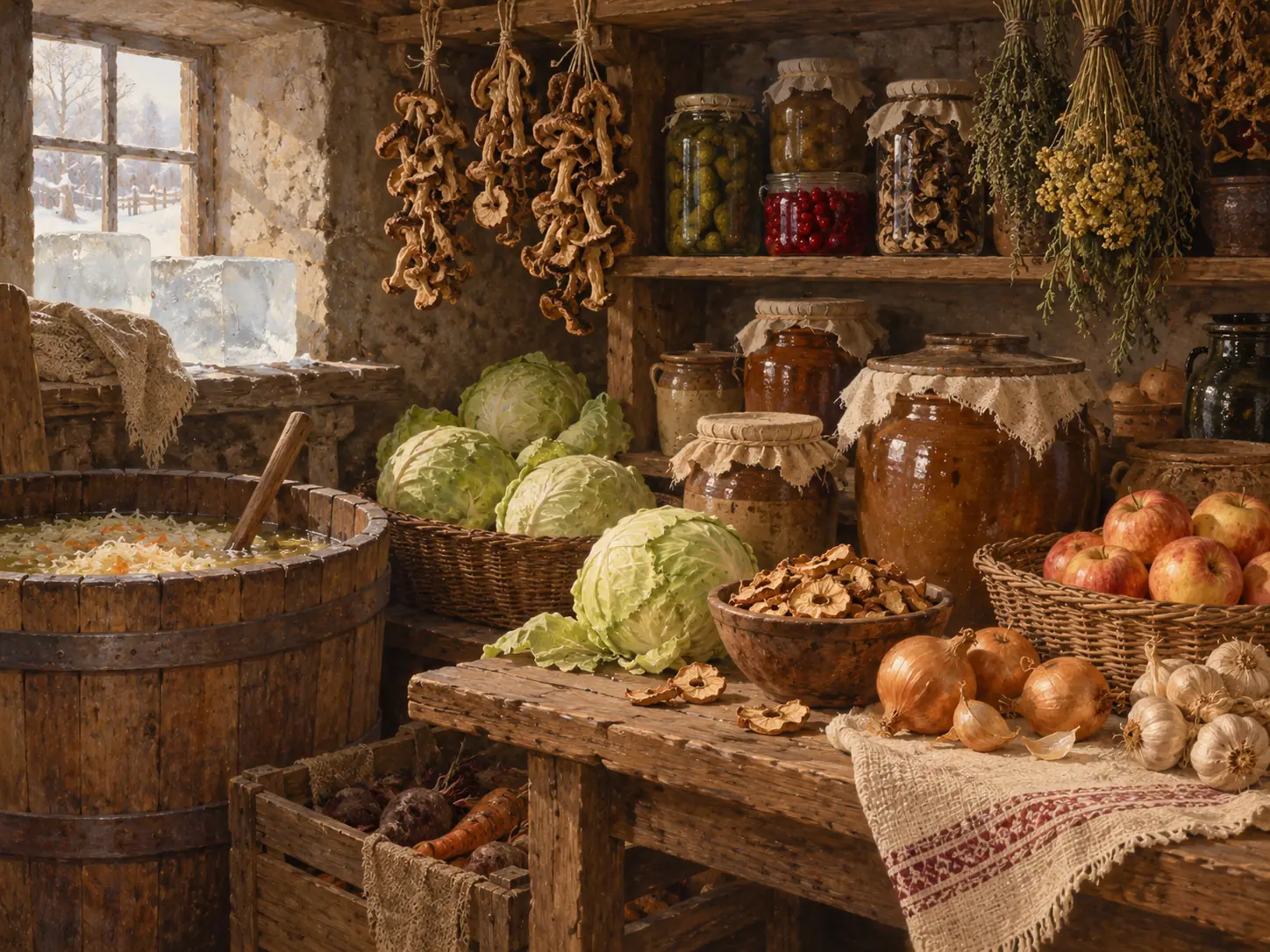
No electric refrigerators, but still ways to keep things cold
Long before electrical refrigeration, cool cellars, icehouses and stored ice helped keep food at lower temperatures. Drying, salting and fermentation supplied different approaches to preservation. The cookbook describes many of these methods, together with the tasks that keeping a household stock required.
Cellars, dry sand and stored ice
Consider recipe No. 3897, “How to Preserve Ordinary Fresh Cabbage.” Molokhovets discusses a cellar where whole heads of cabbage could be suspended or placed in dry sand. The environment had to be maintained: the author recommended checking the cabbages and airing or drying the cellar by opening a window during dry weather. Storage was active supervision, not simply forgetting a vegetable in a cupboard.
Another example is recipe No. 3374, a second method of preserving berries and fruit for winter. Berries were layered with sugar, closed in jars and placed “in ice.” The author linked this arrangement to preserving their aroma and freshness. It demonstrates that some households used cold stores long before ordinary electric refrigerators became commonplace.
But the temperature in a historical cellar or icehouse cannot automatically be equated with that of a modern refrigerator. These recipes do not reveal reliable measurements of temperature, sanitation or safe storage periods.
Berries in bottles: preserving as household labor
In recipe No. 3373, fresh berries were put into dry champagne bottles, sealed, heated in water and then stored in dry sand. The historical point is the sequence of tasks: finding and preparing containers, processing the harvest, putting away supplies, and retrieving them months later for compotes and desserts.
A bottle here served as a storage vessel, not just as a container for a drink. The passage shows how household materials were reused and how seasonal fruit was expected to remain useful beyond its harvest.
This historical heating and sealing procedure is not equivalent to a scientifically validated modern canning method. We deliberately do not reproduce it as step-by-step instructions. The safety of preserved food depends on acidity, equipment, processing temperature, time, and storage conditions.
Mushrooms on strings and mushroom powder
Molokhovets recorded more than one form of preserved mushrooms. Recipe No. 3933, a way of drying porcini, describes threading mushrooms on string and drying them in an oven or in sunlight. They could later be used in cabbage soup, sauces and savory fillings. Drying changed their form without removing them from everyday cooking.
Recipe No. 3939, “Powder of Porcini Mushrooms,” takes another route: dried mushrooms are ground and kept as a fragrant addition to broths and sauces. One forest product could therefore appear whole after soaking or in powder form, when flavor was the main purpose.
A characteristic practical detail is the kitchen stove, whose residual warmth after bread baking could serve for drying. The cookbook mentions repeated drying and the desired final state, but provides no contemporary controls for water activity, contamination or microbiological safety. These are historical observations, not modern storage instructions.
Fermented cabbage: work extending over weeks
Recipe No. 3898, “Shredded (Fermented) Cabbage,” is particularly revealing about household labor. Large tubs, salt, caraway seeds, carrots, apples, lingonberries or cranberries appear in the description. Molokhovets pays attention to a cold location, the condition of containers and ongoing care.
The recipe also passes on a belief about the phases of the moon: cabbage fermented at a new moon was said to remain firm and crisp, while cabbage made at another phase might turn out softer. That is evidence of a period belief, not proof that lunar phase determines fermentation. Treating it as established food science would misrepresent the text.
Fermenting cabbage is different from keeping a fresh head cool. It changes its taste and properties. In Molokhovets' book the resulting cabbage might be used for soups, sides or served on its own. The proximity of instructions for fresh and fermented cabbage shows how one crop could be allocated across winter supplies.
Apples, plums and the warmth remaining after baking
Recipe No. 3715 describes drying apples: they are peeled and cored, then dried with gentle oven warmth or sunlight, before being kept in a dry place. The resulting dried fruit could later be made into compotes and sweet dishes.
Recipe No. 3739, “Dried Plums,” explicitly mentions an oven after bread baking. Dried plums could then be used for fillings, pies and fruit drinks. This is evidence of the kitchen stove as a versatile resource: the same source of heat cooked food and preserved a harvest. It does not prove that every household had identical drying equipment or conditions.
Not just fruit and vegetables: dried fish
In recipe No. 4051, “Dried Roach,” a small freshwater fish was dried using oven heat and could subsequently be used, among other things, for soups prepared without meat. Preservation was not limited to plant products, and different types of fish were kept for different culinary purposes.
Once again, the historical account cannot guarantee that parasites, harmful bacteria or toxins would be eliminated. The old description is valuable as evidence of household practice, but it should not be followed as a modern fish-preservation procedure.
What these recipes reveal about everyday life
Across the pages, a household calendar emerges: berries and mushrooms in summer; cabbage, fruit and other supplies in autumn; preserved ingredients used over winter. Different spaces did different jobs—the oven, cellar, icehouse and dry storeroom. A brief entry about stored vegetables sometimes says more about household routines than an elaborate celebratory dish.
The book does not tell us how all Russian families lived in 1901. It describes advice and practices intended for Molokhovets' readership. It is more accurate to treat each preservation entry as an historical document than to claim that every household used these methods.
We can also distinguish an interesting historical practice from a validated modern safety procedure. The 1901 text deserves careful reading, not uncritical imitation.
Open the historical sources
More examples: berries on ice, No. 3374; fresh cabbage in a cellar, No. 3897; porcini powder, No. 3939; dried apples, No. 3715; dried plums, No. 3739; dried roach, No. 4051.
Food-safety references and further reading
For current guidance, consult the UK Food Standards Agency's advice on home food preservation, CDC guidance on preventing botulism in home-canned foods, and the National Center for Home Food Preservation. The Russian editorial library also examines salt and brining, fruit preserves, and butter and oils.