Bakeries, Kalachi and Sieve Bread in St. Petersburg Around 1901
Learn about the urban bread trade, artisan bakers, kalachi, sitny flour and household baking in the Russian Empire.
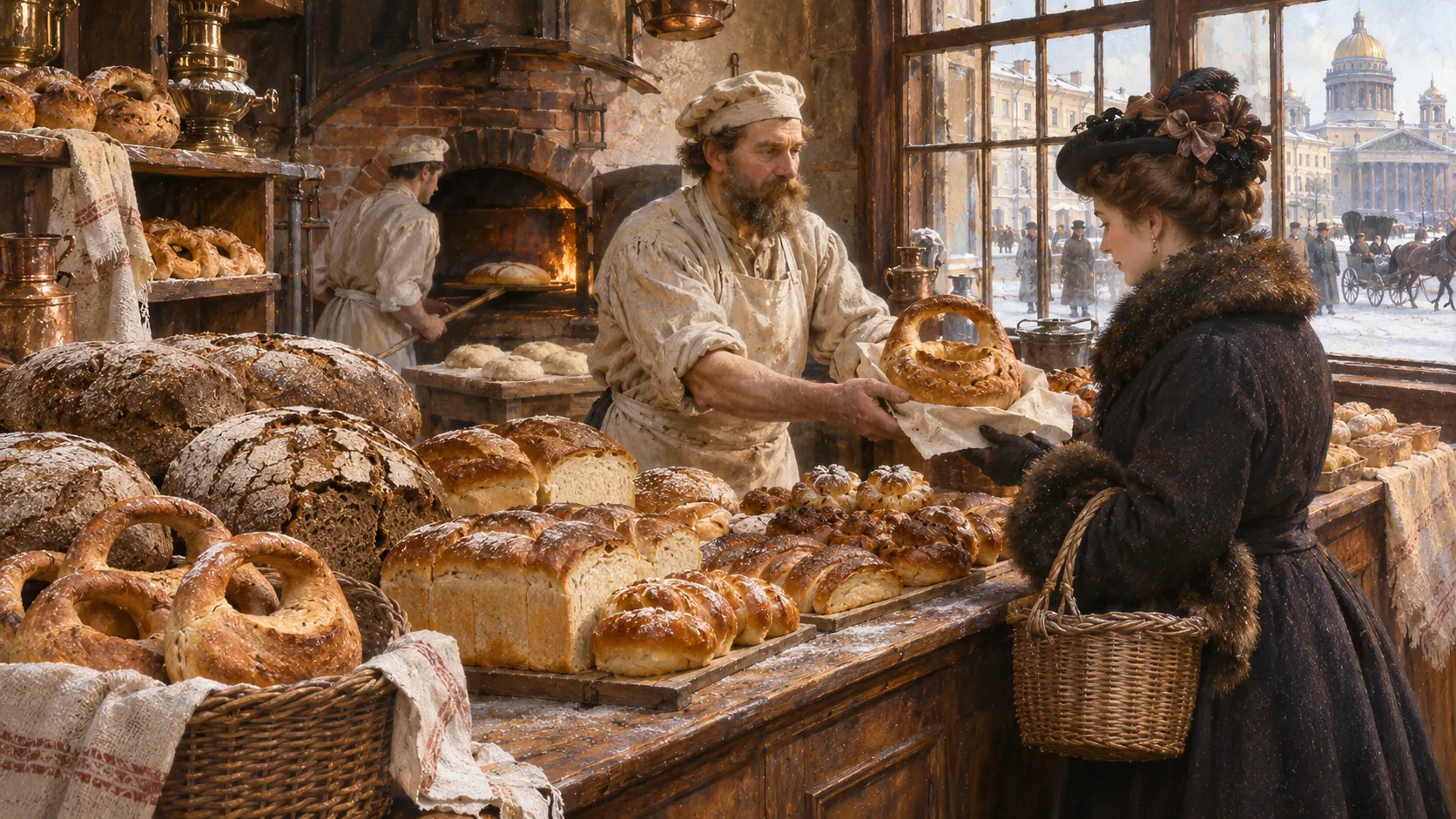
A loaf of bread in St. Petersburg around 1901 could have come from a domestic oven, a small craft bakery, a shop or a street seller. The names on the counter—sitny bread, kalach, rolls and rusks—hinted at flour, shape and tradition. Elena Molokhovets' cookbook records home baking methods, while museums and studies of urban bakers show how the city's bread trade worked.
Two sources for bread history: cookbook and city
The bread recipes of Section XLIX and rolls and pastries in Section XXXIX show household techniques. Meanwhile, the St. Petersburg Museum of Bread documents bread trade in the eighteenth and nineteenth centuries. These are related but different kinds of evidence: one is a book of instructions, the other a history of the marketplace.
Buying bread and baking at home coexisted
The museum describes the development of specialized bakeries, so-called Moscow-style bread shops, foreign bakers and street selling. City authorities regulated bread prices because bread was a basic everyday necessity. Wheat bread became more prominent over time, though rye remained important.
None of this means domestic baking disappeared. In No. 3687, “Rye Breads: Sieve-Sifted and Coarse-Sieved,” Molokhovets describes a sourdough vessel, retaining starter and preparing substantial quantities of dough. Such baking required time, suitable equipment and a store of flour.
Neither one cookbook nor one museum exhibition can tell us exactly what share of all St. Petersburg households purchased their bread every day and what share baked it themselves. They show that the two systems existed together.
Who worked in Petersburg's bakeries?
Vladimir Shaidurov and Nikita Osipov, in their 2025 historical study of German bakers in St. Petersburg, examine workshops and professional organizations. Bakers of German origin held a significant place in parts of the city's baking trade around the late eighteenth and early nineteenth centuries, while many later practitioners were born in the city itself.
The authors note strong positions for German bakers in the 1820s–1840s and changes in the composition of the craft later in the century. Some establishments modernized their equipment, but the whole trade did not suddenly turn into a uniform system of industrial factories.
The word “bakery” might refer to a small artisan workshop, a shopfront with a salesroom, an enterprise employing several workers or retail selling from a tray. A famous firm's history cannot stand in for every baker's experience.
Sitny and reshetny: the bread began with the flour
No. 3687 distinguishes rye flour sifted through a fine sito from flour passed through a coarser resheto, and describes versions using water, whey or sour milk. These terms relate to flour processing and starter management, not merely a round or long loaf.
In No. 3688, “Sieve Bread with Potatoes,” boiled potatoes are added to the dough; No. 3689, “Scalded Sieve Bread,” begins by pouring boiling water over part of the flour. “Sieve-sifted,” “scalded” and “with potatoes” describe different aspects: flour treatment, preparation technique and additional ingredient.
Our English study of millstones, roller mills and krupchatka goes into these old flour terms in greater depth. The customer saw the baked bread, but its properties depended on wheat or rye, milling, starter and the baker's work.
Kalachi and other urban breads
Kalachi, saiki and baranki were recognizable categories of baked goods in the city. The Culture.ru history of the Filippov bakeries discusses such bread and pastry traditions in Moscow and St. Petersburg. Famous brands, however, represented only part of the commercial range.
In the accessible Molokhovets text, the bread chapter does not provide a main recipe for the classic Moscow kalach. No. 3185 is called “Bohemian Little Kalachi,” but the shared element of the name does not justify identifying them as the same product. The history of shops selling kalachi needs evidence about urban bakeries, not a vaguely similar title in a cookbook.
The Filippov shops: celebrated, but not the entire market
The Filippov enterprise grew from a Moscow family bakery business and expanded into St. Petersburg during the nineteenth century. Culture.ru describes the company's development and reputation, including its selection of breads.
An account from the childhood of the artist Mstislav Dobuzhinsky, quoted in a study of Petersburg's sweet shops and bakeries, recalls choices such as flaky rolls, horseshoe-shaped pastries with poppy or caraway, kalachi and small pies. It is a vivid personal memory, not a complete Filippov price list.
A city's bread history also belongs to the numerous ordinary bakers, delivery workers and merchants who supplied customers beyond the famous names.
Domestic baking in 1901: more than rye loaves
Molokhovets gives “American Wheat Bread,” No. 3105, made with dry yeast and milk and baked in a tin. No. 3151, “Small Flat Rolls,” includes cream, egg yolks, sugar and anise; caraway rolls No. 3155 use butter, sugar and optionally rosewater.
These are all flour-based goods but not a single technology. Some require slow sourdough fermentation, others dried yeast and a shorter rise; sweet rolls might be intended for tea or coffee. The word “bread” alone obscures these differences.
“Healthy Wheat Bread,” No. 3697, uses flour retaining bran. The historic author's assessment of its health benefits is not a scientific nutrition conclusion appropriate for contemporary advice.
Ovens, starters and the working day
No. 3687 spends considerable space on the sourdough vessel, the cleanliness of the baking area and keeping starter for subsequent batches. The author warns that the water required depends on the flour's type and dryness. This is particularly valuable as a record of work: flour and fermentation called for judgment, not just the mechanical repetition of a fixed recipe.
“Sweet-and-Sour Bread,” No. 3691, describes a longer sequence of preparing flour, fermenting mixtures and adding ingredients that occupies several days. For a bakery, that would mean planning production; for a household, coordinating bread-making with other duties.
Neither passage demonstrates that every baker followed that precise schedule. Together they show that a fresh loaf involved work before it reached the oven.
Bread as part of a city's economy
Bread production linked millers, craft guilds, shops and street commerce. The Museum of Bread's account of price regulation reflects bread's importance as a staple, but cannot independently establish the precise cost of every kind of loaf around 1900.
Baking was required regularly, unlike the occasional purchase of certain seasonal foods. Some residents could buy prepared bread even when they lacked a suitable oven, time or supplies to make it. Yet we cannot infer that every customer had daily access to the same white flour bread.
What cannot be claimed without further records
Molokhovets' recipes were not a list of every product sold in every St. Petersburg bakery. The success of one chain does not establish uniform citywide stock. An account of bakers' guilds does not describe the dietary access of every family.
For prices and working conditions, we would need period advertisements, trade records, city statistics and books from particular shops. What the existing sources already show is significant: the history of bread includes grain and ovens, but also urban trade, skilled labor, customer habits and unequal household resources.
Original recipes and studies
Other recipes: bread with potato No. 3688, scalded bread No. 3689, sweet-and-sour bread No. 3691, bran bread No. 3697, small rolls No. 3151, caraway rolls No. 3155, Bohemian kalachi No. 3185. Continue with the history of kvass and potato in kitchens and bread.