From Millstones to Krupchatka: Flour in the 1901 Kitchen
Explore the history of flour milling, old terms for rye and wheat flour, and the recipes of Elena Molokhovets.
Flour seems simple: grind wheat or rye, sift it, and make dough. Yet the 1901 cookbook of Elena Molokhovets names krupchatka, sieve-sifted and coarse-sieved flour, refined rye flour, potato “flour” and much else. One chapter estimates how much flour can be obtained from a pood of grain; another specifies the kind needed for gingerbread, pancakes and bread. Those names belong to an era when traditional millstones were increasingly joined by steam-powered and roller mills.
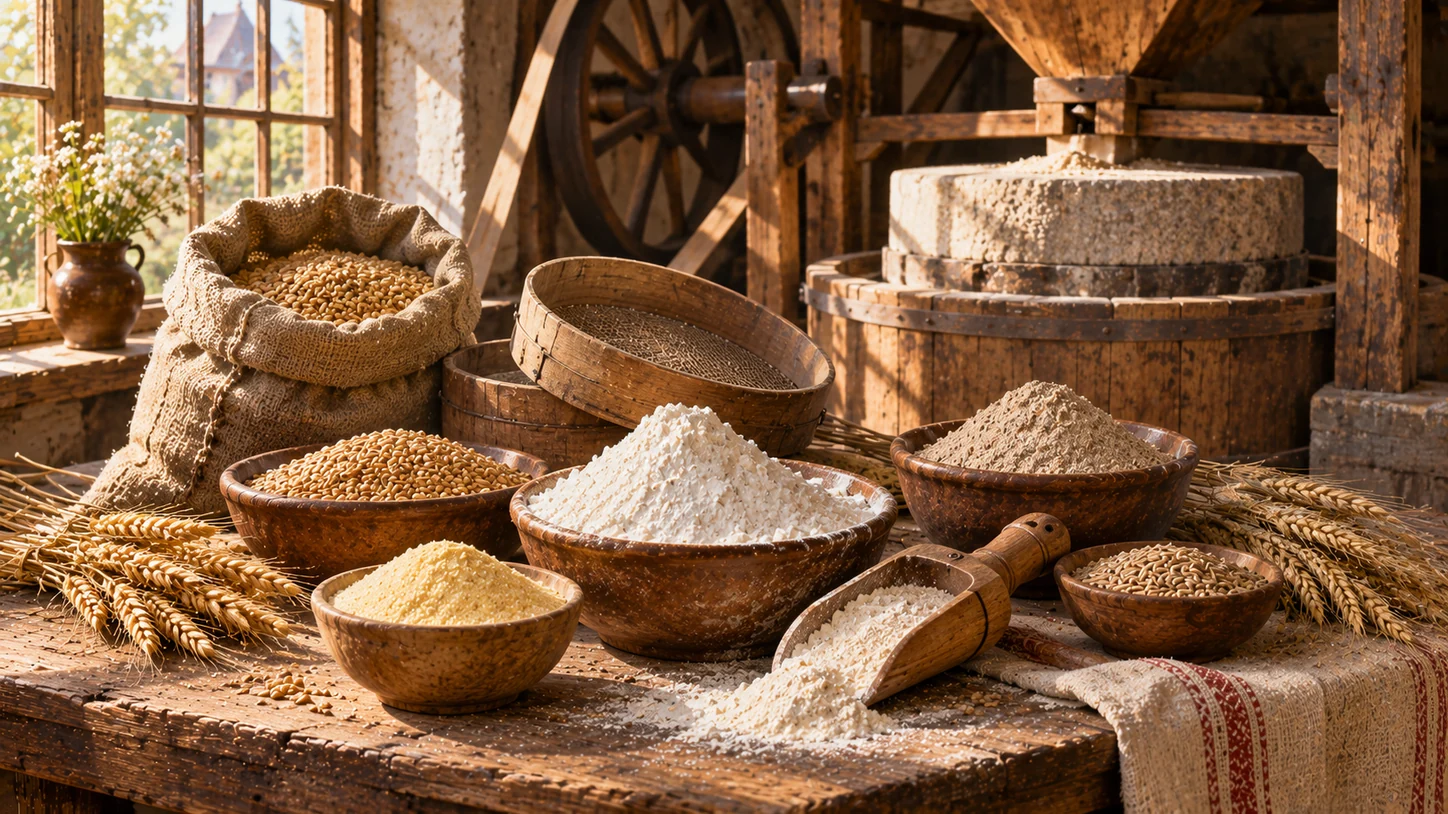
Grain, grade and sieve are different questions
“Rye” identifies the grain; sitnaya refers to finer sifting; reshetnaya to the coarser sieve; and krupchatka historically meant a notably granular kind of wheat flour. None of these expressions is a perfect synonym for the modern labels “premium,” “first grade” or “whole wheat.” Understanding a recipe requires understanding its own period's terminology.
From field to flour sack
Grain arrived at the mill with husks, foreign material and variable moisture. It had to be cleaned, ground and separated into fractions of differing size and quality. Household methods and mill equipment did not always produce identical results: some flour remained coarse, some passed through a finer sieve, and bran could remain in the dough.
In No. 3608, “Yield of Flour and Groats,” Molokhovets does not describe the machinery but provides the economic calculation: what quantities of different products one might obtain from a mass of rye, wheat, barley or oats. Thus a household reference book reaches back to agricultural processing.
Millstones, wind and water
A village mill might turn its stones with the wind or flowing water. The grain was crushed between millstones and the result could then be sifted. Work depended on the stones' condition, the gap between them, the grain and the miller's skill.
In its 1899 account of Russian industry and trade, Brockhaus and Efron emphasize the local character of much earlier milling: transporting flour over long distances was difficult, while wind and water power varied with season and weather. Molokhovets' No. 3602 on buckwheat groats even allows hand-millstones or pounding grain in a mortar. That demonstrates coexistence of household and industrial practices, not the universality of either.
Steam mills changed the scale of production
In the nineteenth century steam engines could drive millstones and new machines without depending exclusively on rivers or the wind. Larger enterprises purchased grain and supplied flour to urban markets. Brockhaus and Efron report 312 steam mills by 1880 and 862 by 1890 in the statistical coverage they discuss. These figures concern those years and that class of enterprise. They are not the total number of mills in Russia in 1901.
Steam mills needed fuel, technicians, machinery, buyers and transport links. Small mills still served nearby villages. Industrialization did not instantly erase traditional equipment.
Roller milling meant more than speed
Roller machines supplemented and sometimes replaced stones. They could perform successive stages of grinding, separate middlings and flour, and sort material by particle size. Mechanical sifters and purifiers were fitted into increasingly complex systems, often using several floors so material could be lifted and sent back through another stage.
An architectural study of late-imperial flour mills in Samara Governorate describes roller machinery, sifters and multi-story buildings. The architecture was part of the technology. A wider range of products became possible because their processing could be controlled more precisely—not because wheat itself had suddenly become different. Nevertheless, not every flour sold in 1901 came from a roller mill.
What “sieve bread” and “coarse-sieve bread” meant
Recipe No. 3687, “Rye Breads, Sieve-Sifted and Coarse-Sieved,” compares ways of preparing rye bread. There is also custard-style sieve rye bread, No. 3689.
To interpret these terms, we can turn to equipment and language. Vladimir Dahl's 1882 dictionary entry for “sieve” distinguishes the fine sito from the more open resheto. The Russian Ethnographic Museum preserves a nineteenth-century sieve. These sources explain how sifting affected particle size and the exclusion of coarse components. “Sieve bread” did not necessarily mean wheat bread: Molokhovets also used the designation for rye.
Krupchatka: a granular wheat flour
Despite its resemblance to the word for groats, krupchatka described a kind of wheat flour. The Brockhaus and Efron entry highlights its granular texture, careful sorting and relatively low proportion of dusty particles. It associates it especially with harder wheat and notes that good krupchatka could cost more than finely milled flour.
Molokhovets specifies sifted krupchatka for “American Wheat Bread,” No. 3105; it is used with honey, eggs and spices in gingerbread No. 3223; and in No. 2679 the dough is processed into small flour granules for porridge. It would therefore be unreliable to replace krupchatka automatically with modern semolina or insist that it is exactly today's premium wheat flour. A modern adaptation has to test milling properties and dough behavior separately.
Rye flour: from bread to honey gingerbread
Rye in the cookbook was not confined to ordinary loaves. In gingerbread No. 3222, Molokhovets distinguishes fine sieve-sifted rye flour from less finely prepared rye and specifies different quantities by volume. The same grain can behave differently as flour.
Rye appears in rusks No. 3690, in rye-and-wheat dough for open cold pâtés, No. 1408, and as refined sifted rye flour in sweet-and-sour bread No. 3691. The author herself notes that the amount of water required depends on the kind and dryness of flour. Historical volumes cannot safely be converted into modern baking quantities without checking.
One pood of grain: an accounting problem
In No. 3608, Molokhovets says that one pood of rye produces 35 Russian pounds of flour. For a pood of wheat, she lists 22 pounds of first-grade flour, 9 pounds of second-grade and 5 pounds of bran. A Russian pood equaled 40 Russian pounds.
The listed wheat products add up to 36 pounds, not 40. The source does not explain the remaining four pounds. Declaring all of them to be losses, cleaning waste or evaporated water would add an unsupported explanation. The figures are a practical rule printed in one edition, not a universal milling coefficient. Their very existence nevertheless shows how closely the author linked recipes to household accounting.
A mill was also a business
Between farmer and baker stood millers, buyers, carriers and trading firms. A Russian archive guide describes the records of V. V. Bogoslovsky's steam flour mill in Saratov, established in 1900: supplier and customer contracts, flour receipts and expenditures, ledgers and employees' pay books. The inventory shows what kind of enterprise a mill was, but does not tell us the price of every sack in 1901 unless the actual documents are examined.
The Old Sarepta museum recounts a steam flour mill associated with the Bauer brothers' trading house near a railway, illustrating links between factory and transportation. The Sholokhov museum preserves roller-mill equipment in Kargin, opened in 1905—four years after the book under study. It is an example of the continuing spread of technology, not a photograph of a mill supplying Molokhovets in 1901.
Choosing flour in the home kitchen
Wheat bread No. 3105 calls for granular wheat flour, rye rolls No. 3146 for sifted rye, and scalded pancakes No. 1657 combine buckwheat and wheat. Even the word “flour” is not always cereal flour: “potato flour” in No. 1701 is treated as starch.
“Healthy Wheat Bread,” No. 3697, proposes milling grain without sifting out bran. Its claims about health and leavening are the author's period judgments, not modern medical conclusions.
From millstone and sieve to the dough
Historical flour names connect everyday baking to larger changes in agricultural processing, transportation, machinery and commerce. We should preserve those words and explain them rather than automatically replace them with modern grades. The sack of flour on a cook's table embodied the work of farmers, millers, merchants, carriers, bakers and housekeepers.
Original sources and further reading
Compare rye breads No. 3687, krupchatka gingerbread No. 3223, rye gingerbread No. 3222, and whole-grain bread No. 3697. Additional research: bread shops in St. Petersburg, Smolensk groats and honey and gingerbread.