From Market Garden to Sennaya: Vegetables in St. Petersburg
A historical investigation of late-night wholesale cart trade, urban vegetable markets, dealers and the kitchen.
Young carrots, cabbage, swede, cucumbers, berries and dried roots appear throughout Elena Molokhovets' cookbook. But how did such produce reach a buyer in St. Petersburg? Journalist Anatoly Bakhtiarov described vegetables sold straight from carts at night, market gardeners who sold part of their future harvest in advance, and dealers who purchased supplies before ordinary market customers arrived. Read beside the 1901 recipes, his account opens a window onto the work between garden and kitchen.
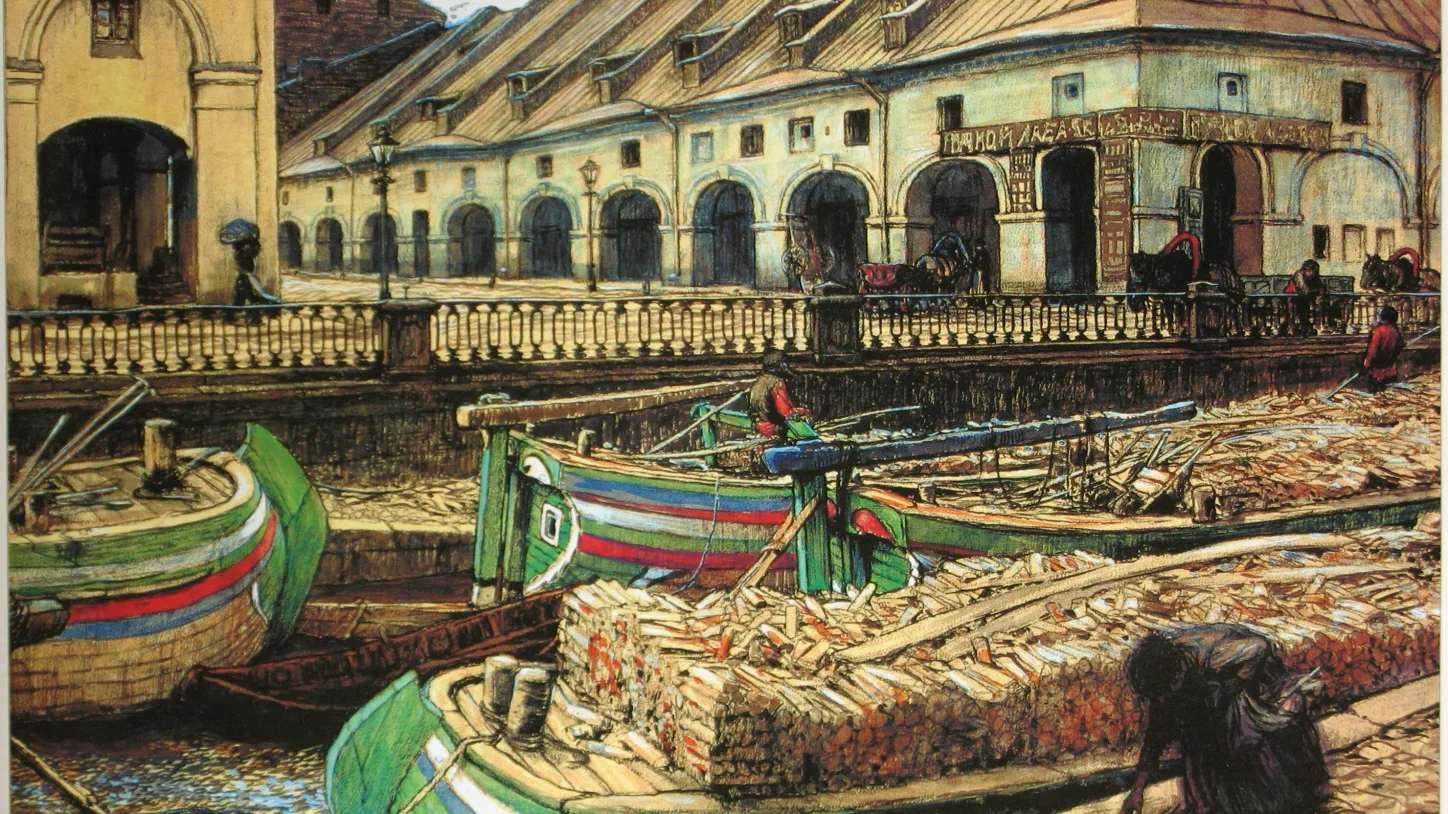
A cookbook and a market account answer different questions
Molokhovets describes ingredients and dishes; accounts of late-nineteenth-century St. Petersburg help reconstruct vegetable buying, dealers and market rows. The latter describe a particular city and a particular period, not the food trade of the entire Russian Empire. Historical hours and prices from the 1890s should not automatically be assigned to 1901.
Some purchases began before harvest
In passages from The Belly of St. Petersburg, Bakhtiarov writes of market gardeners selling a portion of a future crop while it was still growing in the ground. One example concerns cabbage purchased by whole beds, with the number of heads in each bed discussed separately.
That differs considerably from buying one cabbage at a retail counter. A dealer could contract for a substantial amount, organize later sale and take on the task of delivery to city buyers. The passage does not prove that all vegetables near St. Petersburg were sold in this manner.
Molokhovets' “Dried Roots,” No. 4009, provides a related household calendar: it recommends preparing young roots early in autumn. The housekeeper needed to know when produce was available; the dealer also needed to decide when it should be bought.
Why market gardeners brought carts at night
Bakhtiarov describes produce loaded on carts in advance, with market gardeners seeking to reach Nikolskaya Square during the night or early in the morning. Large batches could be offered directly from the vehicles. Buyers included greengrocers and small traders who later took goods to shops elsewhere in the city.
Rather than unloading an entire cart, a seller might place a small sample in front of it: a bunch of carrots, a bundle of onions or another vegetable. Those displays allowed buyers to survey an unusually crowded collection of carts and produce.
The source distinguishes suburban market gardeners on Nikolskaya Square from other ways produce reached Sennaya Market, including carriers and intermediaries. This was not the city's only supply route. Shops, hawkers and other markets also existed.
Trading regulations and actual commotion were not identical
Period descriptions suggest that wholesale buyers were active at night and shops were replenished very early. A separate account of cart trading rules specifies formal operating hours. Bakhtiarov's detailed narrative sometimes describes arrivals and deals outside the apparent official window.
We should not flatten these into one precise timetable. Regulatory hours, the arrival of carts and actual wholesale transactions were distinct matters. Establishing the minute-by-minute operation of the market would require dated municipal regulations together with contemporary testimony.
The useful conclusion is broader and well supported: much of the work of bringing vegetables to urban customers took place before those customers visited a shop or stall.
Why a dealer stood between the grower and the housekeeper
Bakhtiarov criticizes greengrocers and resellers who purchased produce wholesale. His observations suggest that an urban shopper frequently bought vegetables after a transaction between grower and middleman rather than directly from the person who cultivated them. He associates intermediaries with increased prices.
That criticism is a contemporary voice, not an audited calculation of markups. To determine the price difference reliably, we would need matching wholesale and retail records for the same dates and goods, plus transport, rent, spoilage and labor expenses.
Nevertheless, the account makes the chain of work visible: procurement, carriage, storage, preparing goods for the shop and selling in small lots. Each stage could affect the price paid by a city family.
Not every vegetable came from the city's suburbs
The same narrative mentions vegetables carried from other governorates, including cucumbers arriving by railway. St. Petersburg customers were therefore not limited to what grew in a neighboring garden.
But examples of railway shipments should be handled cautiously. The account does not reproduce a complete, independently checked set of freight registers for every stated number of wagons and their value. Such details remain the author's reports, not verified yearly statistics for all supplies.
Molokhovets' monthly dinner menus combine seasonal fresh ingredients and stored foods. That shows the range of dishes she recommended; it does not identify the farm or trader from whom each ingredient was bought.
The first cucumbers and autumn cabbage had different prices
Bakhtiarov mentions expensive early greens that appeared before the main growing season, while ordinary vegetables became more accessible at the height of summer trade. Examples of costly early cucumbers stand next to reports of autumn cabbage being sold wholesale by whole garden beds.
These transactions involved very different units and conditions. A dozen early cucumbers cannot be directly compared with a whole bed of cabbage. Nor should a wholesale price for an unharvested crop be equated with the price per cabbage at a retail stall.
This distinction helps explain the seasonal choices in our study of summer menus and winter stores. The menus themselves, however, are not a monthly price bulletin from which 1901 vegetable prices can be reconstructed.
Shoppers did not always go to a market building
Bakhtiarov also describes vegetable sales in the street and vendors bringing greens closer to homes. Thus a household could acquire produce without visiting a covered hall at Sennaya. Other accounts mention familiar street traders who sometimes accepted delayed payment.
None of that proves that every household bought food on credit, or that sales arrangements were the same throughout the city. Molokhovets' household advice concentrates on domestic organization; market accounts show some of the choices faced before cooking even began.
Purchased cabbage was not yet dinner
After purchase, vegetables still had to be sorted, cleaned, washed and cooked. Molokhovets offers greens for soup, roots for stock, vegetable dishes and salads, and recipes for storage. Her winter vinaigrette No. 1476 combines roots with pickled cucumbers and other preserved vegetables.
That recipe shows how a product could be used long after its first appearance at the market. The safety of historical storage methods is a separate issue discussed in our study of preserving food before refrigeration.
The complete chain includes cultivation, wholesale buying, transport, retail choice, preparation and finally serving. A cookbook describes chiefly the later stages; the market testimony gives us some of the earlier ones.
What cannot be learned from one city account
We do not know the exact total vegetables sold, each dealer's markup or the purchases made by households of every social class. Bakhtiarov's figures need comparison with municipal and trade records before they become statistical conclusions.
Nor should a description of St. Petersburg in the 1890s be applied to provincial towns, rural settlements or the entire empire in 1901. The stronger, more modest finding is that vegetables reaching the home kitchen represented many kinds of labor: gardeners, carriers, wholesalers, traders and domestic workers.
What to cook depended not only on taste but also on season, access, the structure of trade and the household's means.
Sources and related reading
Compare winter vinaigrette No. 1476, Sennaya's fish trade and the Russian study of potatoes and suburban markets.