Buying Fish in St. Petersburg Around 1900: Sennaya Market
An investigation of fish trading, weights, prices, historical market conditions, and kitchen practices around 1900.
In Elena Molokhovets' cookbook, fish usually appears after it has already been bought: pike-perch, small smelt, flounder or sterlet, ready to be examined, cleaned and cooked. But where might a St. Petersburg shopper around 1900 have found it? Contemporary accounts of the Sennaya Market describe fish stalls, frozen catches piled among snow, tanks holding live fish, and bargaining over kopecks. Read beside the 1901 recipes, these sources tell a story of urban commerce—not of every fish market in the Russian Empire.
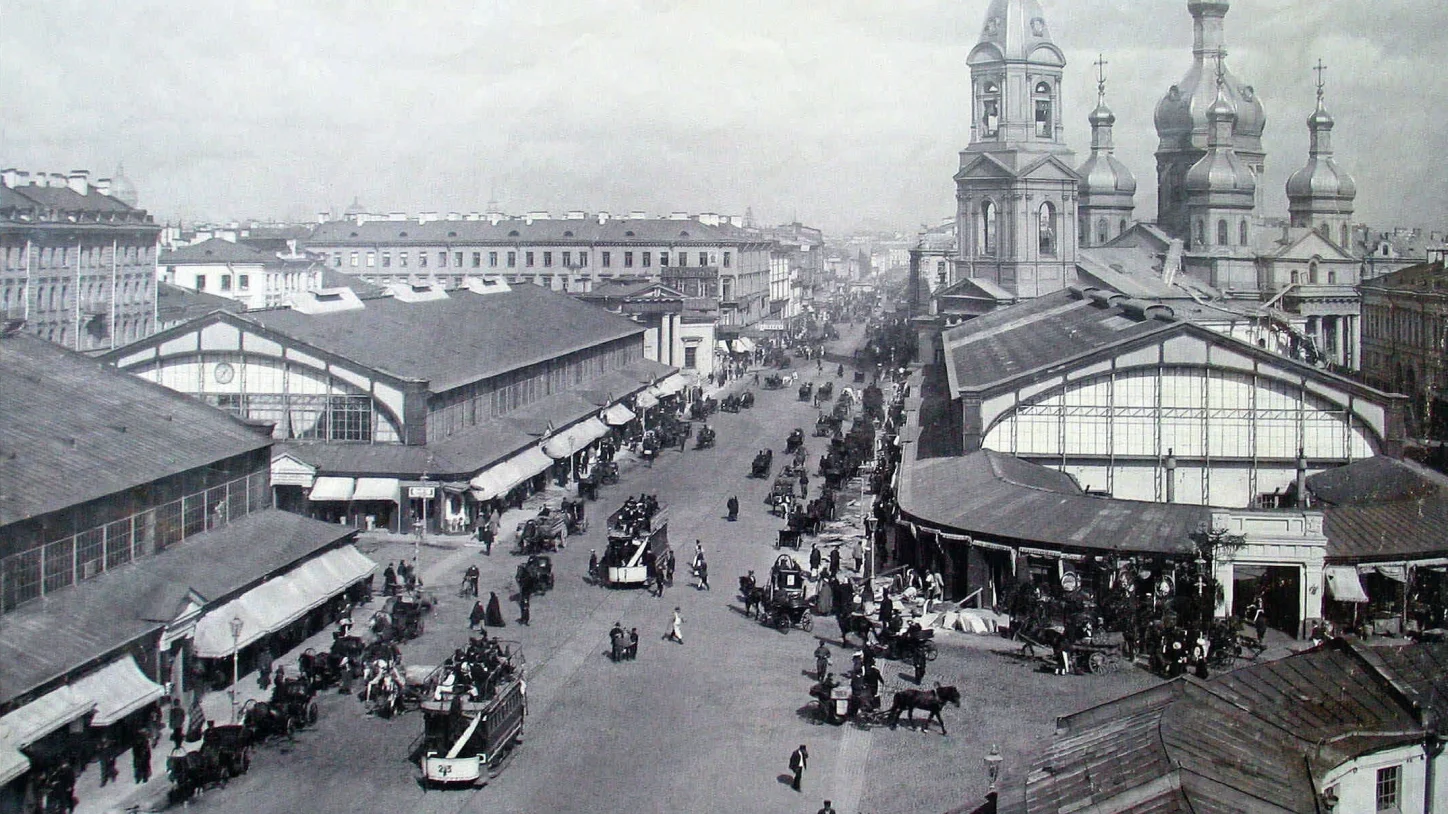
Three different kinds of evidence
Section IX of Molokhovets' 1901 cookbook concerns choosing and preparing fish. Descriptions of St. Petersburg by Anatoly Bakhtiarov and his contemporaries, collected in accounts of Petersburg life in the 1890s, show trade from another perspective. A historical photograph of Sennaya Square around 1900 records the urban setting. Together these sources provide context, but none of them enumerates every household's purchases.
Sennaya was more than a roadside stall
Covered market structures and a busy square can be seen in the photograph. Descriptions from the end of the nineteenth century present Sennaya as a center for meat, fish and green produce. Goods were organized in trading rows, with distinct merchants and assistants. Period writers describe signs for meat, fish and vegetable sections, numbered stalls and regulations affecting sellers.
The market was an organized trading environment in which buyers selected among merchants and products, not simply an isolated individual selling on a street corner. Accounts differ in some details about buildings and alterations over the decades; reconstructing an exact floor plan from a single description would be unsafe. The reliably documented point is the existence of specialized market trade.
Frozen fish on snow, live fish in tanks
A description of Sennaya's fish row in the 1890s mentions frozen pike-perch stacked among snow, smoked whitefish, salmon and pickled lampreys in barrels. Other fish were sold alive from large containers of water.
In Section IX, Molokhovets distinguishes live, recently dead (described by the period word sonnaya, literally “sleepy”), fresh and frozen fish. These categories reflected a product's state and the preparation it required. They help explain why the same trading row could supply fish in several conditions.
Storing fish in snow, however, did not guarantee microbiological safety. Historical practices lacked the continuously measured temperature control and hygiene demanded of today's commercial supply chains.
Smelt and pike-perch: geography in commercial names
Molokhovets remarks that small snetki (smelt) reached St. Petersburg frozen and particularly praises those from the Belozersk area. For pike-perch she mentions fish from Gdov. Such references indicate a valued geographical origin, or at least an origin the author believed meaningful for the buyer.
Accounts of the market list fish arriving from different rivers, lakes and seas. A major city relied on trade beyond its immediate local catch. Yet one cookbook cannot establish what percentage of St. Petersburg's supply came from each fishing district, or reconstruct the route of one shipment. Our Russian article on fish prices considers the book's numerical estimates separately.
Scales, Russian pounds and the buyer's trust
Period market accounts mention weighing scales and officially stamped weights. Live fish could be lifted from a tank and weighed before purchase. The procedure required shared units and confidence in the merchant's measurements.
Molokhovets quotes prices for some fish by the funt, or Russian pound. This was a historical unit of about 409.5 grams, not a modern standardized package or serving. Our English historical measures guide explains the conversions.
The weight bought was not necessarily the weight of edible flesh. Heads, scales, bones and entrails could be removed or used in another preparation. Therefore a price per Russian pound of whole fish cannot simply be treated as the cost per pound of ready-to-cook fillet.
Why a final price might differ from a printed one
Late-nineteenth-century descriptions emphasize bargaining. The seller asked a price, the buyer sought to lower it, and skill in choosing a stall and judging a product mattered. A single price noted in a cookbook should therefore not be mistaken for a receipt from an actual purchase.
Bakhtiarov also describes middlemen in vegetable trading, with growers supplying larger quantities and retailers selling smaller ones to residents. That exact model cannot automatically be applied to every fish stall, but it illustrates how complex city commerce could be.
Prices varied with season, demand, storage and the condition of fish. Molokhovets places observations on salted and frozen fish near her price information. Without that context, historical numbers may create a misleading picture.
Religious fasting changed demand
A writer describing the Petersburg market observed particularly busy fish trading during Great Lent. Alongside expensive fish, cheaper kinds were also bought for meals observing the fast. Molokhovets' range of fish soups, roasts, cold fish dishes and historical dinner menus offers a useful comparison.
However, the presence of fish dishes in a cookbook does not prove that a particular person purchased them according to the religious calendar. Establishing such a connection for an individual household would require other documents. Market observations and menus are complementary rather than interchangeable evidence.
How Molokhovets judged freshness
In her general notes on fish, the author advises buyers to examine gills, eyes and skin, to look for signs of repeated freezing and to notice flesh coming away from the bones. Such descriptions show historical concern about spoiled or misrepresented food and how a household guide tried to help its readers avoid a bad purchase.
These visual signs are not a reliable modern test of food safety. Bacteria, parasites and breaks in the cold chain cannot be ruled out by the color of gills or the appearance of eyes alone. We read the passage as a history of consumer caution, not as current shopping advice.
From the market basket to the fish kettle
After purchase came cleaning, cutting and cooking. Some fish in the book were boiled whole or roasted, and large specimens might require a special kettle with a rack to lift the fish out without breaking it. The Russian study of kitchen utensils describes this equipment.
Multiple steps might be necessary to prepare a dinner, as shown in the study of meal planning. Fish bones and cooking liquids could also contribute to other dishes, as discussed in our study of household economy. Where fish was sourced and how it was preserved influenced kitchen work, but these materials cannot establish what one particular family did.
What we know, and what we do not
The accounts of Sennaya describe late-nineteenth-century trade in St. Petersburg; Molokhovets' 1901 cookbook describes how readers were advised to choose and prepare fish; the surviving photograph provides a credible urban setting. None is a complete statistical record of fish commerce in 1901.
It would be misleading to claim that all Russian fish was sold through covered market buildings, that every buyer bargained, or that all fish listed in St. Petersburg were available in every province. A cookbook's price is not a verified average market price. The sources do allow a more modest, and more useful, connection: from fish stalls and weighing scales to the household cook's preparations.
Inspect the sources
For an older image, consult the Presidential Library's photograph from 1879; it must not be mislabeled as a view from 1901. Related research includes fish glue and gelatin, the trade in salted herring, and winter trade in game.