Seasonal Food and Winter Stores in Russia Around 1901
How summer ingredients appeared in winter dinners, from monthly menus to dried fruit and preserved mushrooms.
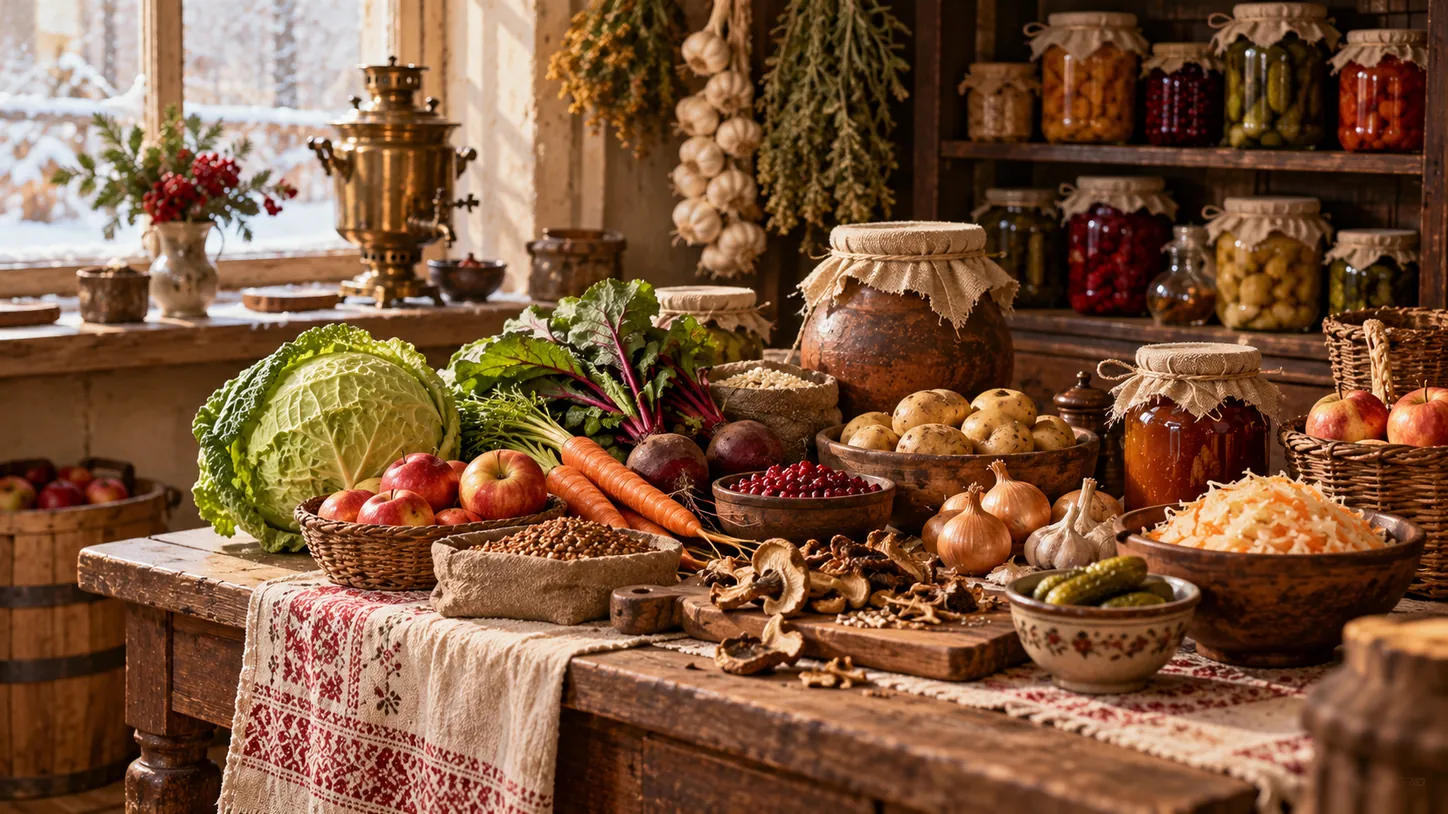
Young vegetables, fresh berries and chilled soups appear in Molokhovets' summer menus. Autumn brings game, roots and chestnuts. Winter features pickled cucumbers, dried mushrooms, preserves and fruit stores. Yet the monthly dinner lists of the 1901 cookbook reveal something more complex than “what ripened this month.” By comparing June, autumn and December menus with preservation recipes, we can follow products across the seasons.
A suggested monthly dinner is not an account of every real meal
In the monthly menu registers, Molokhovets proposes dinners at different levels of cost. They reveal what the author considered suitable combinations and what ingredients she recommended. They do not prove that every menu was served daily—or that people across the Russian Empire ate the same dishes.
June: young vegetables and berries
The June Class I menu includes young carrots, turnips, potatoes and cabbage with milk sauce, strawberry-and-raspberry punch, ice cream or strawberry jelly, and fresh berries. This is a prosperous formal dinner, not an ordinary meal that can be attributed to every family.
In the June Class IV menu there are broth with sorrel or spinach, jelly made with fresh berries, strawberry pie and botvinya with salmon. Botvinya No. 205 calls for fresh cucumbers, herbs, sorrel and cold serving. No. 1580 is a light pie made with fresh strawberries or raspberries. Such details strongly connect particular dishes to seasonal produce.
But not every June dish relied on the fresh harvest. The summer register includes sauerkraut shchi No. 42. This is a useful correction to the claim that preserved cabbage could only be eaten in winter. Old stores and fresh summer ingredients could coexist in one menu.
Autumn: roots, game and the last fruit
The October Class I menu offers roast game, chestnuts with red wine, fish and desserts involving fruit and berries. There are also references to preserved foods; not every berry mentioned in autumn must have been freshly picked.
The November Class IV menus feature apples, swede, potatoes, buckwheat and soup with pickled sorrel. Compared with June, roots and stored ingredients have a greater role. Yet the cookbook does not show whether each item came from a household cellar or a shop.
The most explicit link between autumn harvesting and winter cooking is No. 4009, “Dried Roots.” Molokhovets recommends preparing young roots at the beginning of autumn, when they are fresh and inexpensive. Carrots, parsley roots, celery, leek and peas appear in the description; the dried mixture was to be used in stocks and cabbage soup. An ingredient produced in one season could be designed for use months later.
November and December: stores become meals
In the November Class IV register, shchi with pickled sorrel No. 46 combines prepared sorrel with stock, sour cream or cream, and dried mushrooms. The December Class IV list contains soup with pickled cucumbers, dishes using preserves, and salads with pickled foods.
The “Winter Lenten Vinaigrette,” No. 1476, is particularly revealing: potatoes, beetroot, turnips, pickled cucumbers, cooked beans, pickled cauliflower and gherkins. This is not just an assortment of vegetables but a mixture of roots, pulses and products previously preserved.
Reading menus alongside the storage chapters shows how seasonal transitions worked in the author's plan. Summer and autumn produce did not simply vanish in winter; its form, taste and culinary use changed. The recipes nevertheless describe historical practice, not safe modern canning procedures.
“Fresh mushrooms” in a December dinner?
The December Class I menu includes “fresh mushrooms in sour cream,” pointing to Nos. 3934–3935. That does not prove that fresh porcini were regularly harvested in December. The original references resolve the apparent contradiction.
No. 3934 is called “How to Preserve Fresh Mushrooms in Butter.” It describes a preparation for keeping porcini and later serving them with sour cream. No. 3935, “How to Keep Porcini Fresh in Sour Cream,” similarly treats mushrooms for storage and reheats them for serving.
This is precisely why an isolated menu entry can mislead. The word “fresh” is used within the historical text alongside preservation techniques. Following the recipe numbers is essential before making a claim about seasonal availability.
Summer berries in a winter dessert
The December Class I menu includes a fruit-and-berry compote, referring to preserved products in Nos. 3373–3404. In No. 3373, Molokhovets expressly discusses preserving summer berries for winter compotes, fruit soups and ice cream. No. 3374 provides another historical method for keeping fruit until a later season.
Dried fruits also appear in finished dishes. Sweet fruit soup No. 191 uses dried apples, prunes, raisins and other fruit, while No. 189 accepts fresh or dried cherries. These are clear links between seasonal storage and later service.
Our study of food preservation without refrigerators covers cellars, icehouses, oven drying and historical canning methods. Here the focus is the result: how a summer ingredient could reappear as part of a December meal.
Roots and apples: keeping crops for months
No. 3711, “Soaked Apples,” recommends storage on ice followed by transfer to a dry cellar in winter. No. 3976 describes keeping beetroot in dry cellar sand. No. 4034 describes trenches for beetroot, carrots and turnips.
These accounts are evidence of households planning storage space and future use. They cannot reconstruct the exact temperatures, humidity, spoilage, microbial safety or quantities lost in every home. The intention to preserve a crop is not proof of how reliably it remained edible.
Why dinner classes mattered alongside the seasons
The monthly menus have different cost classes. The June Class I dinner is elaborate, with fish, game, berries, ice cream and multiple courses. The June Class IV register gives shorter combinations of soups, cutlets, vegetables and porridge.
Winter shows the same division. The December Class I dinner has elaborate fish, meat and confectionery, while the December Class IV register offers shorter sequences of soup, a main dish and dessert. Both are the author's sample choices, not ledgers of specific household expenditure.
It would therefore be misleading to conclude from one impressive December dinner that “Russian winter food” was always abundant and varied. The source offers several budgets and different ideals of a suitable meal.
What seasonality tells us about a kitchen in 1901
Three observations emerge. First, the text names fresh herbs, vegetables and fruit in summer. Second, households could prepare some produce for use in later months; fungi, roots, cabbage and berries cross the boundary between seasons. Third, menus depended not only on the calendar but also on financial resources, equipment and the housekeeper's plans.
Molokhovets was writing a manual, not a statistical report on the empire's nutrition. The best way to explore its seasonality is to open two monthly registers, compare the dishes and follow the recipe references. That is where the link between household planning and the finished table becomes most concrete.
Compare original seasonal menus
Other relevant sources: dried roots No. 4009, mushrooms kept in butter No. 3934, mushrooms in sour cream No. 3935, berries for winter No. 3373, winter vinaigrette No. 1476 and all English-linked monthly menus. Continue with salt and seasonal provisions and the Russian research on berry preserves.