How Much Did Fish Cost in Molokhovets's Book? Prices in Kopecks and Their Limits
Small Baltic herring for 7 kopecks, flounder for 9–12, frozen smelts for 10 and pike-perch for 18: what the 1901 edition actually tells us.
What did fish cost in Russia at the beginning of the twentieth century? Elena Molokhovets's book gives specific sums in kopecks per Russian pound of salakushka, flounder, smelts and pike-perch. These figures are not a universal price list for the Russian Empire. We examine the edition's evidence, differences between fish and why direct conversion into modern money would be mistaken.
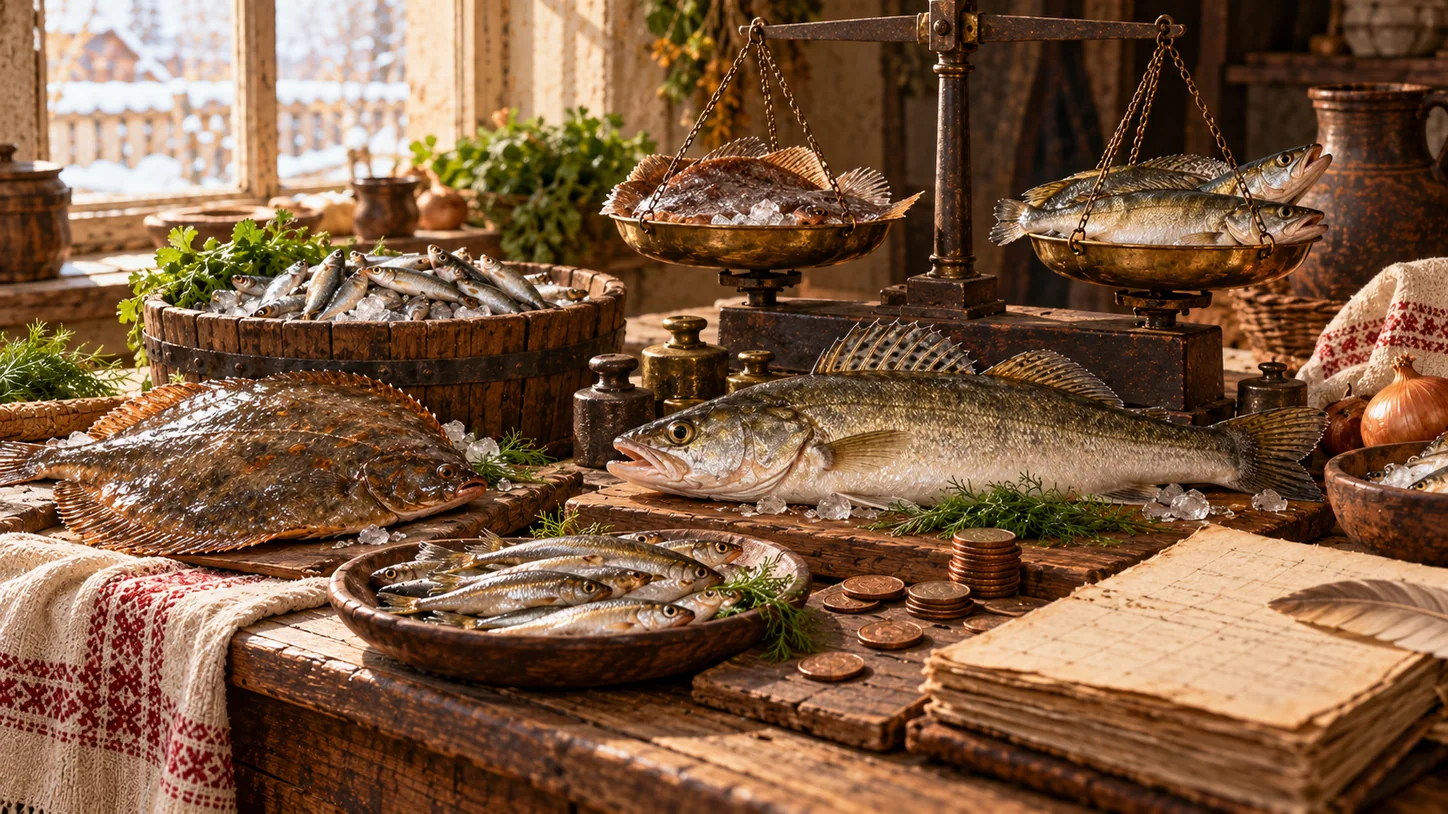
The 1901 edition is not proof of prices specifically in 1901. The principal source is the notes to Section IX, Fish, in the twenty-second revised and enlarged edition. The figures lack a unified table of purchase dates and locations. They permit comparisons within the book but do not establish average prices across all towns and markets.
Which prices actually appear in print
Molokhovets gives prices selectively in explanatory notes, not for every fish. The digital text of Section IX records: salakushka — 7 kopecks per Russian pound; small and large flounder — 9 and 12 kopecks respectively; salted smelts — 7–8, frozen smelts — 10 kopecks; pike-perch — 18 kopecks per pound in its note.
This is a selection of four kinds from one section, not a reconstructed complete price list. Names and sums follow the published digital text; missing prices are not supplied by conjecture.
Flounder: size mattered
The note Flounder, or Sole distinguishes large and small fish. Large fish costs 12 kopecks per pound and small fish 9. Advice on cleaning, frying and processing follows.
Price could thus depend on more than the species name. Even within one group, the author gives two amounts, warning against assertions that a particular fish always cost a fixed sum.
These two numbers cannot establish retail markups or whether small fish were equally available in different cities. Dated advertisements or market reports tied to particular locations would be needed.
Salakushka: small fish with a precise price
Under salakushka, Molokhovets notes that about fifteen fish make a pound and that the pound costs 7 kopecks. She then discusses frying, stewing with cabbage and pickling. This connects size, purchasing and preparation rather than offering a purely encyclopedic description.
The count indicates a small fish, but it should not automatically be equated with every modern product sold under a similar name. Historical trade terminology could vary regionally.
For kitchen history, the important point is how the same section combines market information with advice about what to do with the purchase at home.
Smelts: frozen and salted fish sold differently
The note says smelts were brought to St. Petersburg frozen and that those from Belozersk were considered especially tasty. The book gives 10 kopecks per pound for fresh-frozen smelts and 7–8 for salted ones.
This reveals transportation, two product states and two prices, not merely a recipe name. The difference cannot be explained by one cause: quality, seasonality, preservation and trading conditions are not fully discussed.
The author recommends smelts for fasting-day fish soups and frying. The price annotation thus belongs within culinary choice.
Pike-perch: 18 kopecks and the puzzling reading '0–12'
The pike-perch note calls fish from Gdov the best and gives 18 kopecks per pound. In the same line concerning frozen fish the digital text has an unclear '0–12'. It cannot automatically be corrected to 10–12 or another amount without checking the printed copy.
Only the unambiguous 18 kopecks is used in this comparison; the uncertain figure remains a question for source verification. Such care matters more than a neat table based on conjectural corrections.
Molokhovets then lists many uses for pike-perch, including ukha, aspic, mayonnaise, puddings, pies and fried dishes. No. 1259, boiled pike-perch with croutons and potatoes, illustrates the transition from market note to actual dish.
Why kopeck comparisons are not income comparisons
The pike-perch named in the book costs more than salakushka and small flounder within the cited entries. This says nothing by itself about the share of a particular family's expenditure. Income, number of diners, other local food prices, fish kind and quality and purchase date would all be needed.
A pound of purchased fish is not a pound of prepared fillet: head, scales and bones may be used separately or discarded. The general fish note discusses cleaning and cutting. Prices per pound cannot automatically establish the cost of one cooked portion.
This selection cannot be turned into either a ranking of the cheapest fish in 1901 or a modern rouble equivalent without a new methodology.
Why the history of the book matters
The Russian State Library catalogue identifies the 1901 edition as the twenty-second, revised and enlarged. The book had existed for decades, and its content changed across editions.
Not every market annotation can confidently be treated as an eyewitness report specifically from 1901. The internal dates of individual price changes are not supplied. Without systematic comparison of successive printed editions, the date when each amount appeared remains open.
This does not diminish the source. It defines the subject precisely: prices preserved in the 1901 edition, not necessarily trade statistics for that calendar year.
How to make the comparison more precise
A reliable continuation would need several independent documents: archived fish-shop price lists, city market reports, trade advertisements and particular household budgets. Only after comparing dates, weight units and purchase locations could persistent price differences be discussed.
Section IX raises questions about Belozersk smelts, supply routes, frozen and salted products and size-dependent prices. One cookbook cannot answer them all, but it is a useful starting point.
For what happened after buying the fish, see the studies of kitchen utensils and multiple dishes from one ingredient. The story of salt production and preservation adds further trade context.
Original recipes and historical sources
Elena Molokhovets, A Gift to Young Housewives, 1901 edition. Original source links are retained below.
- Section IX: Fish — Historical Fish Notes and the Complete English Recipe Index · Russian original
- No. 1259 — Boiled Zander with Croutons and Potatoes · Russian original
- Russian State Library: 22nd edition (1901), catalogue record
- Historical Russian Dinner Menus, Month by Month · Russian original
- Historical Russian Cooking Measures and Weights · Russian original
Related reading
- Fish Kettles, Sauté Pans and Waffle Irons in the 1901 Kitchen
- One Ingredient, Several Dishes: Thrift in Molokhovets’ Cookbook
- From Lake Baskunchak to the Pickle Barrel: Salt in 1901
- How Dinner Was Planned in 1901: Time, Preparations and Kitchen Labour
- The Cost of Dinner and Food Expenditure: Molokhovets and Workers' Budgets
- Buying Fish in St. Petersburg Around 1900: Sennaya Market
- What Did a Russian Dinner Look Like in 1901?
Do not transfer historical fish-processing methods into the modern kitchen. Some storage and handling instructions in Molokhovets's notes do not meet current safety requirements; they are considered here exclusively as historical evidence.