Lanspik and Fish Mayonnaise: Why Molokhovets Meant More Than a Sauce
What lanspik, mousse and fish mayonnaise meant in 1901: comparing a historical cold fish dish with a separate Provençal sauce.
Elena Molokhovets's 1901 book contains a dish that may surprise modern readers: Fish Mayonnaise. No. 1468 does not simply instruct the cook to spread familiar thick sauce over fish. It proposes fish aspic, whipping part of it into mousse, coating the fish, chilling the mould and serving a separate sauce. Why did a familiar word describe a different presentation?
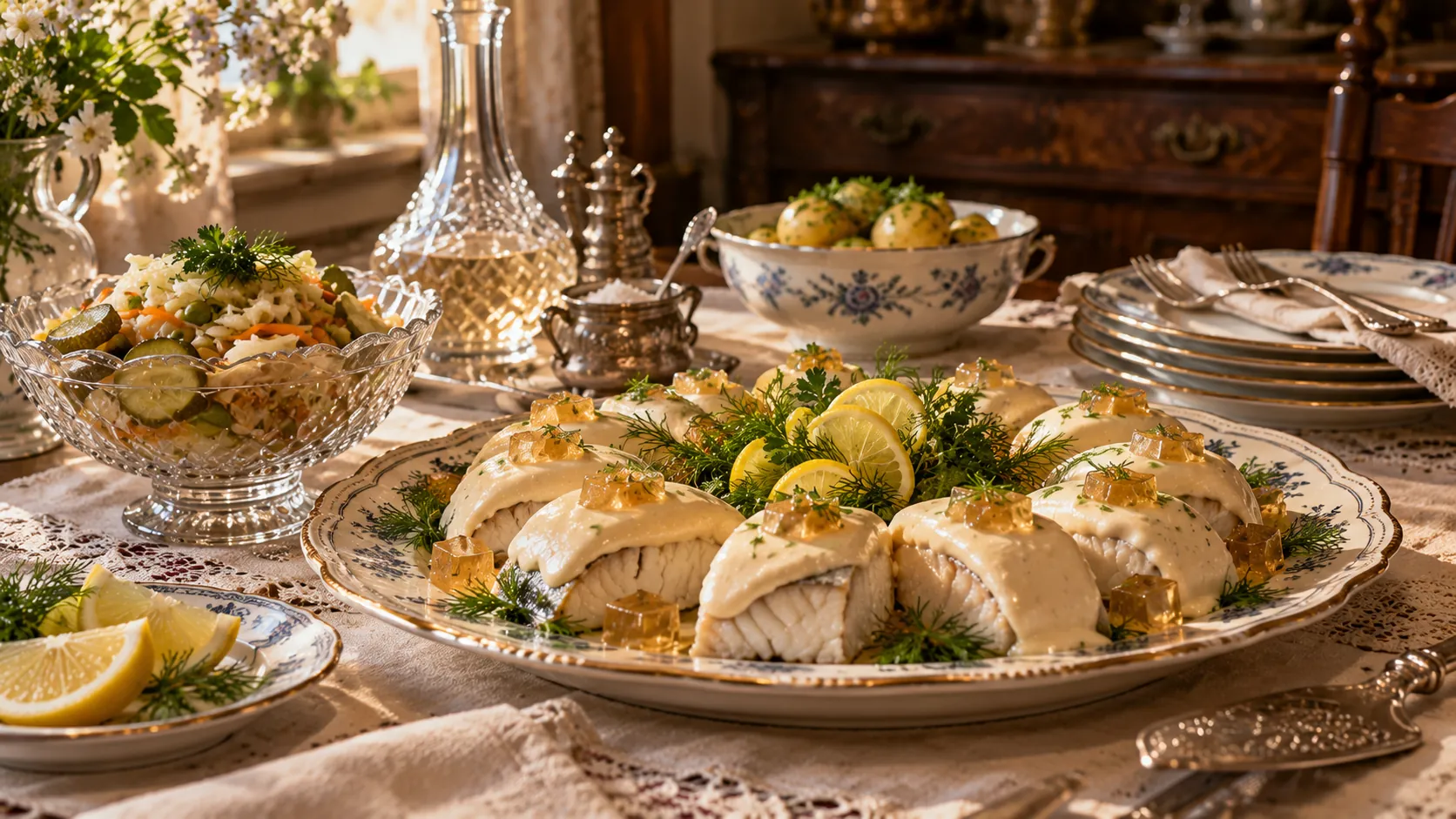
Mayonnaise as a dish and a sauce existed side by side. No. 1468 concerns cold fish with aspic and mousse, while No. 480 is a separate Provençal sauce of yolks, mustard, vegetable oil and vinegar. They must not be confused, but it would also be wrong to say that such a sauce was unknown.
Lanspik: stock that set when cold
The most reliable starting point is the note to Section XII. Molokhovets defines lanspik as a clear sticky meat or fish stock that sets and is used for aspics, mayonnaises and decorating cold dishes. It is not a particular seasoning but a base capable of forming a jelly.
For the meat version the author discusses veal parts rich in gelling substances or sheet gelatin added to stock. For fish, small fish, especially ruffe, and isinglass are mentioned. Isinglass is a gelling substance traditionally obtained from fish swim bladders, not household glue.
Some lanspik remained transparent for pouring over or decorating a dish. The rest was used for mousse. The same section describes this distinction and explains the unusual construction of historical mayonnaise.
Why the stock was clarified
Molokhovets pays considerable attention to clarification. For meat stock she proposes a clarifying mixture of prepared meat or egg whites followed by straining. Pressed fish roe is mentioned for clarifying fish aspic.
These details show a labour-intensive historical culinary technique rather than an ordinary household method for making meat jelly. The dish had to set and look neat. The note describes testing a small portion on ice, straining through a cloth and using burnt sugar for a golden shade.
These instructions should not be converted mechanically into a modern procedure. Historical temperature and sanitation conditions differ from today's; raw ingredients and prolonged cooling require independent safety assessment.
Molokhovets's mousse was not a dessert foam
Modern readers may imagine chocolate or fruit mousse. In the note on mayonnaises in Section XII, mousse refers to fish or meat stock whipped on ice with Provençal oil and vinegar until pale and thick.
It coats fish, poultry or game. The author explains that the prepared coating should set on the dish, with herbs and coloured aspic decorations placed over it. The mousse relates to texture, cold serving and visual presentation.
In No. 1467 individual fish pieces are dipped in mousse, while No. 1468 sets the fish in a ring mould. The assembly differs despite the common principle.
No. 1467: fish with salad and green sauce
Fish Mayonnaise with Salad and Green Sauce begins with fish cooked separately and cooled. Fish bones, scales, small fish and gelling ingredients make the lanspik. Mousse is then prepared and used to coat the fish slices arranged on a dish.
The author separately describes a sauce of olives, anchovies, gherkins, capers, yolks, mustard and aromatic herbs. Beans, asparagus, potatoes, cauliflower, cucumbers and beetroot appear in the garnish. The result is an entire cold composition, not a piece of fish with a spoonful of prepared sauce.
This helps explain why mayonnaise appeared in the culinary index alongside aspics and other cold dishes. The recipe describes the construction of a whole dish.
No. 1468: a ring mould with sauce in the centre
The shorter Fish Mayonnaise entry refers to the preceding recipe and the general note. Fish is lightly fried, lanspik reduced, whipped into foam and poured into a ring mould containing the fish. Once chilled, it is turned onto a dish.
A recess remains in the centre for a mixed sauce, with salad around the edges. Alternatives are listed separately: mixed sauce No. 478, mustard sauce No. 479, Provençal sauce No. 480 or tartar sauce No. 461.
This is the principal clue to the old meaning: if Provençal sauce can accompany fish mayonnaise separately, the name of the fish dish cannot be reduced to the name of that sauce.
Whole fish and cold presentation to guests
Neighboring No. 1469 concerns mayonnaise of whole pike, pike-perch, trout and similar fish. The author describes cooking the whole fish, cooling it and carefully transferring it to a dish or prepared board. Lanspik and mousse are prepared from fish stock with small fish and gelling ingredients.
No. 1470 uses whole stuffed fried fish for a large number of diners. In both, appearance after cooling and decoration matters as well as the base.
These recipes do not prove that every household owned such moulds, fish kettles or supplies of ice, or that the dishes were made daily. They show possibilities offered by the author to a particular readership.
Was a sauce resembling modern mayonnaise already known?
Yes. In No. 480, Cold Provençal Sauce for Fish in the Manner of Mousse, yolks are worked with mustard and oil and vinegar are added gradually until thick. Its name and place in the book distinguish it from fish mayonnaise.
Provençal oil here denotes vegetable oil, not dairy fat or a mixture of spices. Mixed and mustard cold sauces also appear separately. The claim that mayonnaise once meant only fish and that the sauce did not exist contradicts the edition itself.
Alexey Alexeyev's 2017 article A Salad, but Not That One also discusses historical ambiguities of culinary words and sources for stories about Olivier. Our focus remains on what Molokhovets's recipes directly establish.
Lanspik reveals the organization of the kitchen
The description includes several independent operations: boiling and reducing stock, clarification, straining, chilling on ice, whipping mousse, preparing moulds, arranging fish, preparing salad and separate sauces. Serving took much more work than the title mayonnaise suggests.
Cold is a technological condition: without it a set coating and shape are difficult to obtain. Our studies of kitchens without refrigerators and table setting complement this theme, emphasizing equipment and the order of operations.
Blancmange is another parallel: gelling substances and moulds are used there for dessert, here for a cold fish dish. Similar techniques do not imply identical composition or flavour.
Reading historical mayonnaise accurately
Lanspik is a stock that sets, mousse is a specially whipped portion of it, and fish mayonnaise is a finished cold dish with coating and garnish. The same book includes a separate oil-and-yolk Provençal sauce. These concepts must be distinguished.
The recipe does not make modern mayonnaise inauthentic. It shows that a word could designate an elaborate dish in one period while a technically related sauce had its own name.
Read the note to Section XII alongside Nos. 1467, 1468 and 480. The difference becomes clear without legends or rewriting the historical source.
Original recipes and historical sources
Elena Molokhovets, A Gift to Young Housewives, 1901 edition. Original source links are retained below.
- No. 1468 — Cold Fish Mayonnaise in a Ring Mould · Russian original
- No. 480 — Cold Provençal Sauce for Fish, Whipped Like a Mousse · Russian original
- Section XII: Aspics and Cold Dishes — Lanspik, Jellied Meat and Fish, Vinaigrettes and Marinades · Russian original
- Glossary: isinglass (in Russian)
- No. 1467 — Cold Fish Mayonnaise with Salad and Green Sauce · Russian original
- No. 478 — Mixed Cold Sauce for Fish, Aspics and Mayonnaise Dishes · Russian original
- No. 479 — Cold Mustard Sauce with Capers for Fish, Aspic or Vinaigrette · Russian original
- No. 461 — Tartar Sauce with Horseradish · Russian original
- No. 1469 — Cold Mayonnaise of Whole Pike, Zander or Trout · Russian original
- No. 1470 — Cold Mayonnaise of Whole Stuffed Roast Fish · Russian original
- Alexey Alexeyev, A Salad, but Not That One (2017)
- No. 1463 — Cold Game Mayonnaise · Russian original
- Glossary: lanspik (in Russian)
- Forgotten dishes collection (in Russian)
Related reading
- How Food Was Preserved Without Refrigerators in 1901
- How a Dinner Table Was Set in Russia in 1901
- Blancmange, Oblatki and Puddings: Forgotten Desserts of 1901
- Studen, Jellied Fish and the Cold Table in 1901
- From Isinglass to Gelatin: Setting Aspic in 1901
- Why Molokhovets Baked Hot Appetizers in Shells
- Chukhonian, Russian and Provençal Butter: What the Names Meant
Historical technique is not a substitute for modern safety. Historical processing of fish, raw yolks, isinglass, ice cooling and setting stock is presented for analysis. Do not reproduce old temperature regimes or storage methods without scientifically validated modern guidance.