Why Molokhovets Baked Hot Appetizers in Shells
Fish, mushrooms, eggs, veal with herring: hot dishes that Molokhovets recommended baking in individual shells and serving with soup in 1901.
Among the 1901 recipes are unusual titles: minced fish in shells, eggs broken into shells, and minced mushrooms in shells. These are not fillings inside river crayfish. They are small individual vessels in which dishes were baked and served with soup. What did these dishes consist of, and why could the same vessel accommodate such different ingredients?
Shells were vessels for small hot dishes. Section IV places Nos. 370–374 together, describing fillings sprinkled with rusks or cheese and baked in the oven. The material or origin of the vessel is not specified for each entry; it is important not to supply details absent from the source.
A shell is not a crayfish shell
Molokhovets uses the words for a shell-shaped vessel and a crayfish shell in different contexts. Crayfish soup No. 62 explicitly describes stuffing shells remaining from crayfish. But in No. 372, Eggs Broken into Shells, a whole raw egg is placed in each vessel, with cheese and rusks, for brief baking.
It would therefore be incorrect to suppose that Nos. 370–374 used the empty shells of small river crayfish. Judging by their purpose, the shells served as individual baking vessels, but the available texts do not establish what material each was made from. Special kitchen utensils may have been used; their precise construction requires further evidence.
Neighboring No. 368 offers a choice between small tin moulds and shells. These are alternative vessels for baking small items rather than obligatory parts of the food.
Minced fish: an appetizer for fish soup
No. 371 begins with fish cooked with leek or shallot and boiled mushrooms. It is finely chopped, combined with sour cream, yolks, rusks and seasonings, divided among the shells, sprinkled with rusks and baked.
The author specifies that these little pies are served with fish soup. For economy she permits fish already cooked in the soup to be used. Two dishes therefore share one base: liquid soup and a separate hot appetizer.
Our story about several dishes from one ingredient discusses this principle in more detail. Here the individual vessel takes the place of a familiar pastry shell and determines the portion shape.
An egg in a shell: an unusual breakfast or appetizer
No. 372 contains no minced meat. Molokhovets suggests greasing the shells with herring butter or butter made with sardelki (small preserved fish, not sausages), breaking an egg into each, sprinkling with cheese and rusks and placing them in a hot oven for a few minutes.
The Russian name vypusknye refers to breaking the egg directly into the serving vessel. This is not a boiled egg or a filled pie but a baked individual portion with a cheese topping.
Two features matter historically: the same vessel accommodates different bases, and fish-flavoured butter could be used in an egg dish. The source does not establish a cooking time and temperature sufficient by modern safety standards.
Dried mushrooms were also served in shells
Minced mushrooms No. 373 are characteristic of historical cookery. Dried mushrooms are prepared, boiled with root vegetables, minced and combined with onion, sour cream, yolks, rusks and stock.
The mixture is placed in shells, sprinkled with rusks and baked. The recipe resembles fish appetizer No. 371 in construction but has a different principal ingredient. The vessel and final oven heating link the entries into a small group.
This does not mean that all minced mushroom dishes were served this way. Molokhovets includes other dried-mushroom dishes; here we are studying a specific presentation.
Veal with herring: an unfamiliar combination today
No. 374 combines cooked veal with soaked, boned herring, onion, sour cream, yolks and rusks. The surface is sprinkled with cheese and baked.
The unfamiliar combination of meat and salted fish is a recipe in its own right. We cannot invent claims that every guest liked the flavour or call it a secret delicacy of the era. The source establishes the composition and proposed preparation only.
The recipe is also interesting from the household economy perspective: using cooked veal echoes the leftover-roast pies No. 368. In both cases a previously prepared ingredient is given a new presentation.
How the veal-brain dish was decorated
In No. 370 the author describes a prepared filling in shells under a layer of rusks, with an optional decorative border of choux or puff pastry and a piece of cauliflower or crayfish tail in the centre.
The shell could thus serve not merely as a vessel but as part of the appearance. Pastry formed a frame while filling and decoration remained visible. Here the author's use of the word little pies is particularly understandable.
This example is presented as evidence of historical serving arrangements. Animal offal demands special safety precautions; old preparation and baking methods must not be applied today without modern validation.
These appetizers appear in the book's menus
The shells do not occur only in individual recipe titles. The first-category November menu mentions minced fish in shells No. 371 among its little pies and hot appetizers. This indicates the place the author assigned them in a more elaborate dinner.
The word author matters: a first-category menu is a proposed relatively expensive dinner, not evidence that all Russian households served fish in shells. Compare the study of four dinner categories.
Section IV also includes puff pastry pies with crayfish filling No. 324. Here the shell really is made of pastry. The comparison distinguishes a fish appetizer from an appetizer in a shell-shaped vessel.
What shells tell us about kitchen culture
Nos. 370–374 reveal several features of cooking in 1901. Meat, fish, mushrooms and eggs could all be prepared in individual portions, sprinkled with cheese or rusks, decorated with pastry and served with soup.
The book does not tell us how often these dishes appeared in actual homes, who made the shells, or what materials each particular example used. That silence should not be replaced with attractive but undocumented details.
The strongest evidence is the sequence of recipes, their ingredients and their place in historical menus. Together they explain why names that seem strange today formed a practical group of dishes for the householder.
Original recipes and historical sources
Elena Molokhovets, A Gift to Young Housewives, 1901 edition. Original source links are retained below.
- Section IV: Accompaniments to Soup — Croutons, Quenelles, Dumplings and Little Pies · Russian original
- No. 62 — Crayfish Soup · Russian original
- No. 372 — Eggs Baked in Shells · Russian original
- No. 368 — Small Pies Made from Leftover Roast · Russian original
- No. 371 — Fish Filling Baked in Shells · Russian original
- No. 373 — Mushroom Filling Baked in Shells · Russian original
- No. 374 — Veal and Herring Filling Baked in Shells · Russian original
- No. 370 — Brains Served in Shells · Russian original
- November · Class I Dinner Menu (1901) · Russian original
- No. 324 — Book-Shaped Puff Pies with Crayfish Filling · Russian original
- Forgotten dishes collection (in Russian)
Related reading
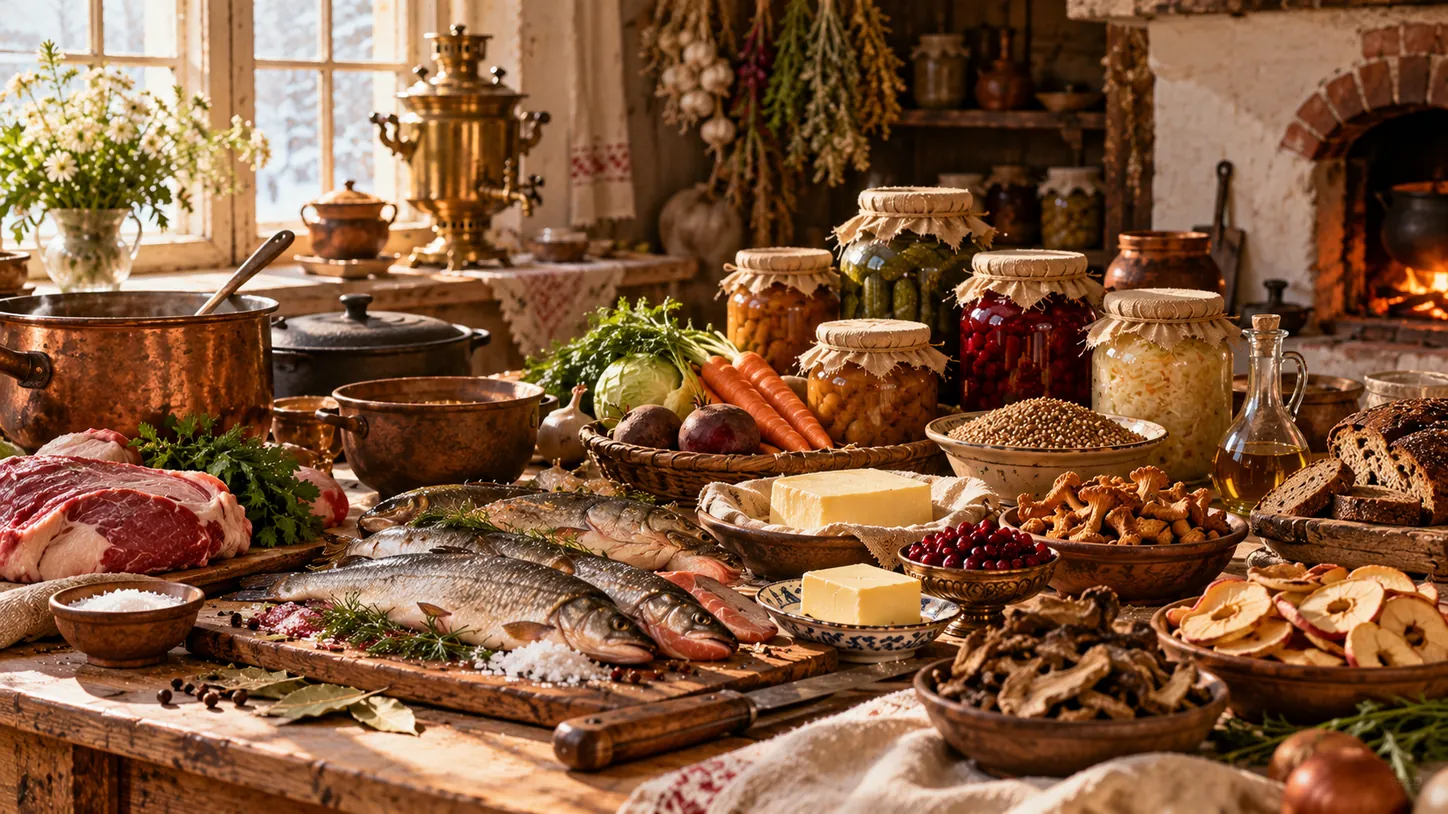
Historical description, not a modern recipe. Old methods for eggs, animal offal, fish and mushrooms may not meet current food-safety requirements. The illustration depicts a general kitchen still life, not the construction of an unidentified shell-shaped vessel. Use safe modern methods and cookware for practical cooking.