Chukhonian, Russian and Provençal Butter: What the Names Meant
A historical glossary of Chukhonian dairy butter, Russian clarified butter, Provençal olive oil and compound spreads.
Three historic terms for fat occur close together in Elena Molokhovets' 1901 cookbook: Chukhonskoye maslo, Russkoye maslo and Provanskoye maslo. To a modern reader they may sound like regional varieties of butter. In fact, the recipes distinguish churned dairy butter, clarified butter for frying and olive oil for cold sauces. Their different uses show why old food words cannot always be translated literally.
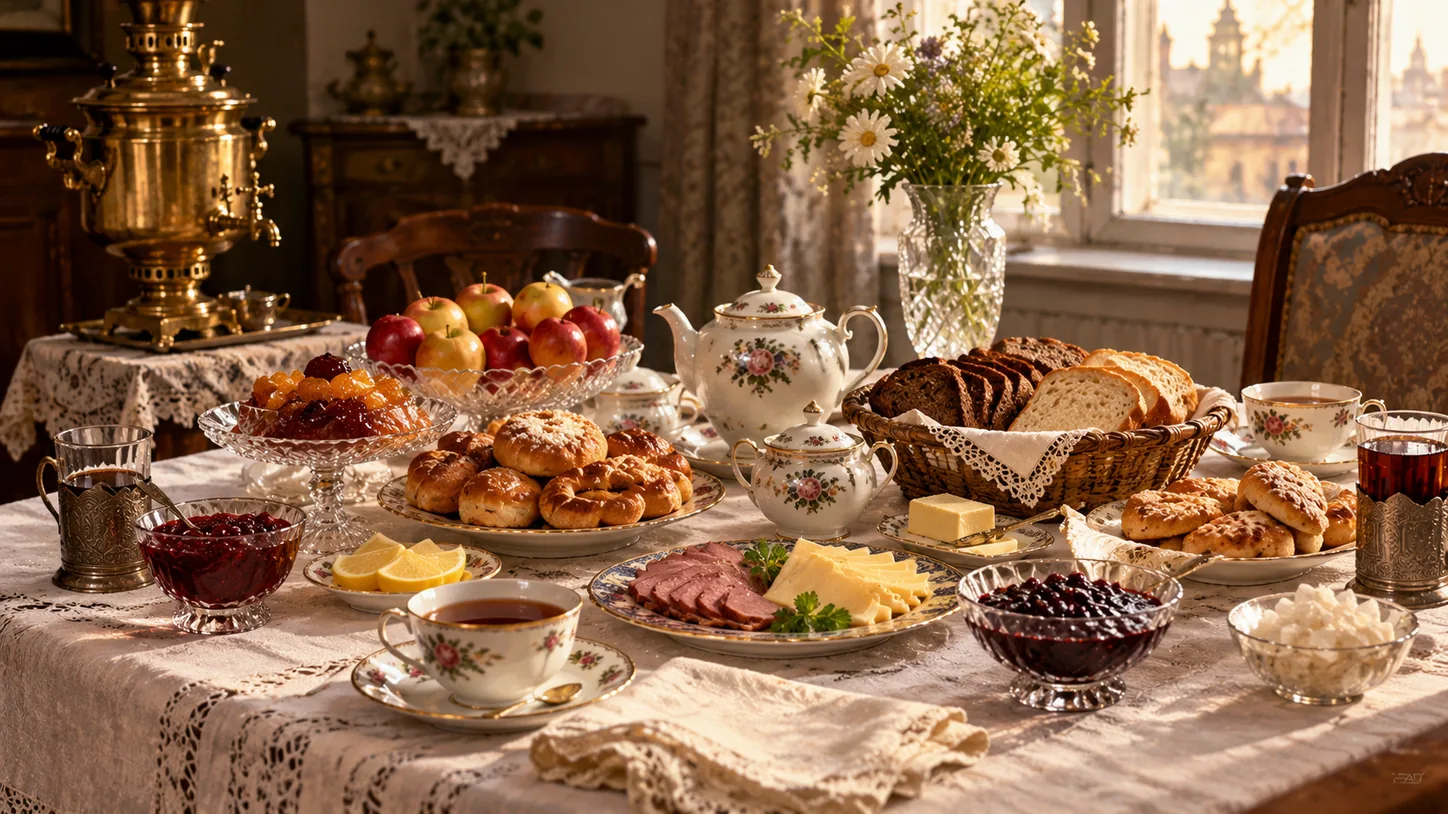
Three words do not mean three interchangeable fats
Recipe No. 3616 describes butter served with tea and breakfast. No. 3643 makes “Russian butter” by further processing “Chukhonian” butter for frying. No. 480, by contrast, needs Provençal oil for a cold sauce. The Brockhaus and Efron entry published in 1898 explicitly identifies Provençal oil as edible olive oil.
Chukhonskoye: butter that was churned
Molokhovets begins Section XLVIII, “Cream Butter and Other Fats,” with the preparation of butter from sour cream, its washing and salting. The term chukhonskoye in this context denotes such dairy butter. In No. 3616 she separately describes cream butter churned from raw or boiled cream and intended for the breakfast or tea table.
Although the old adjective has a geographical resonance, it does not establish that every portion of such butter was imported from Finland. What matters for reading this source is the distinction between butter that is churned, washed and served, and butter that undergoes further melting and clarification.
In No. 3621, the author even remarks on keeping a reworked butter looking like chukhonskoye rather than “Russian.” Texture, appearance and preparation were therefore part of the distinction.
“Russian butter”: melted and clarified for frying
No. 3643, “Russian Butter,” starts with its intended use: frying. Molokhovets takes Chukhonian dairy butter, melts it with water, cools it, drains the aqueous portion and repeats the process. She then describes salting and storing the prepared fat.
The procedure is about processing milk fat for a different culinary purpose, not about a different oil-bearing plant or the substitution of any available animal fat. The closest familiar modern comparison is clarified butter, but that does not prove an identical composition or process in every detail. We compare uses and historical steps, not claim exact modern product equivalence.
“Provençal oil”: olive oil, not flavored butter
The 1898 encyclopedic entry identifies Provanskoye maslo as an edible olive oil. Readers should not imagine dairy butter blended with Provençal herbs.
The clearest application is Provençal cold sauce No. 480. Molokhovets gradually combines the oil with egg yolks, mustard and vinegar until the mixture thickens. Olive oil also appears in fish mayonnaise No. 1467, in a dish made with cold sauce and a fish mousse.
This complements our Russian historical study of aspic and fish mayonnaise. Choosing the right historical interpretation of “oil” affects the composition of the dish, not merely a dictionary entry.
Butter mixed with herring, game or cheese
Section XLVIII includes another category: compound spreads. In No. 3632, butter is blended with prepared salted herring or anchovies, onion and apple, then offered as an appetizer or with fresh potatoes. No. 3633 is made with hazel grouse and intended for breakfast or evening tea.
There is also Parmesan butter No. 3630, combining grated cheese and dairy butter, and anchovy butter No. 3631, made with finely pounded fish. In these entries, “butter” can mean a prepared spread rather than the underlying fat alone.
Searching a historical recipe collection for a single word therefore produces culinary categories that differ greatly: frying fat, dairy butter, olive oil and ready-to-serve mixtures.
A separate frying fat made from beef or goose
In No. 3644, “Frying Fat,” the author discusses beef fat and fat skimmed from stock. In No. 3645, for doughnuts and fried pastries, goose or pork fat may be mixed with Russian butter.
These passages undermine the idea that one “universal fat” was used for all early-twentieth-century frying. Molokhovets distinguished fats by source, culinary purpose and sometimes price. Period advice on reusing or “repairing” fat is historical evidence, not proof that it is safe to do so.
Why old storage advice can be hazardous
The butter section includes attempts to “preserve” and “repair” deteriorated products. In No. 3624 there is paper treated with raw egg and salt. No. 3625 refers to saltpetre and even pieces of glass during hot-weather transport. No. 3626 proposes a salicylic-acid solution.
These are striking documents of past household beliefs, but not acceptable modern preservation techniques. Contaminants, physical fragments and bacterial spoilage present risks that cannot be corrected by appealing to an old shelf-life claim. The author also proposes washing rancid butter in No. 3620; reducing an unpleasant odor does not establish that food is safe.
The puzzle of “Cheap Butter with Bread”
Recipe No. 3641 is titled “Cheap Butter with Bread,” but the accessible body of the recipe describes processing boiled potatoes with hot water; bread does not appear among the listed steps. The discrepancy between title and text should be preserved, not silently replaced with a plausible modern mixture.
There may have been an editorial mistake, a missing passage or variation between editions, but the available page does not establish the cause. Comparing the original printed witness is necessary before declaring a correction. The example reinforces the rule: do not assign an old dish to a modern product category on the title alone.
Three names, three main applications
Chukhonian butter is churned dairy butter suitable for the table; Russian butter is further processed milk fat used especially in frying; and Provençal oil means olive oil, important in certain cold sauces. Compound spreads with fish, cheese or game belong to another group.
These distinctions preserve the practical meaning of culinary terminology. They neither prove that all households could afford the products nor imply that the historic methods are safe to reproduce. The most reliable approach is to consult the original Section XLVIII and the relevant recipe passages.
Original records
Related recipes include herring butter No. 3632, hazel-grouse butter No. 3633, frying fat No. 3644 and cheap “butter” No. 3641. See also the English history of milk and cheese and the Russian study of herring.