From Milk Crocks to Cheese Dairies: Dairy Production in 1901
A historical study of household milk storage, cream, homemade cheese, rennet cheeses and dairy cooperatives in nineteenth-century Russia.
Milk was everyday food, a raw material for cream, butter and curd, and a commodity that was difficult to keep fresh long enough to sell. In the 1901 edition of Elena Molokhovets' A Gift to Young Housewives, advice on preserving milk and judging its quality appears beside instructions for homemade cheeses. Beyond the household, peasant cheesemaking cooperatives and training schools had already emerged. This is the journey from a milk crock to a cheese dairy.
The 1901 cookbook as a starting point
Section XLVIII brings together butter, cheeses, milk and cream. Among its relevant passages are No. 3664, “Preserving Milk”, No. 3666, “Preserving Cream”, No. 3648, “White Homemade Cheese” and No. 3651, “Swiss Cheese.” The recipes belong to an account of domestic work, not a uniform national history of food consumption.
Milk in a crock: freshness depended on the household
In No. 3664, Molokhovets starts with clean vessels: remnants of old milk might spoil a fresh batch. She recommends glass or earthenware containers and a cool, partly dark cellar, separated from strongly smelling foods. These details show what householders worried about—spoilage and the absorption of unwanted odors.
The book does not tell us how many families possessed a separate cellar, underfloor store or icehouse. The advice of a household manual is not a statistical description of everybody in the Russian Empire. Access to ice and adequate storage space varied considerably.
Separating cream: waiting, ice and later machinery
Recipe No. 3666 begins by putting freshly drawn milk on ice and skimming the cream the following day. This records the domestic method of allowing the fat-rich layer to rise. Mechanical separators later became common in more organized dairy production, so the nineteenth-century dairy industry cannot be reduced to leaving milk in a crock.
The Brockhaus and Efron dictionary article “Dairy” describes dedicated rooms for settling milk, washing equipment and making butter. Domestic and more industrialized procedures existed side by side. It is also important not to conflate fresh cream, sour cream and tvorog (fresh curd cheese), which Molokhovets uses for different purposes.
No. 3666 also describes an obsolete preparation of cream for transport in stoppered bottles. Do not reproduce this procedure. Heating sealed containers and relying on the storage periods given in an old cookbook do not meet modern safety requirements.
A drop on a fingernail: historical tests of quality
Recipe No. 3665 proposes judging milk by a drop placed on the fingernail, its color and the sensation of fat between the fingers. Such observations reflect a consumer's concern about watered-down or poor-quality milk. They cannot reliably measure its composition or microbiological safety, and are interesting only as historical testimony.
Homemade cheese: sour milk, linen and a press
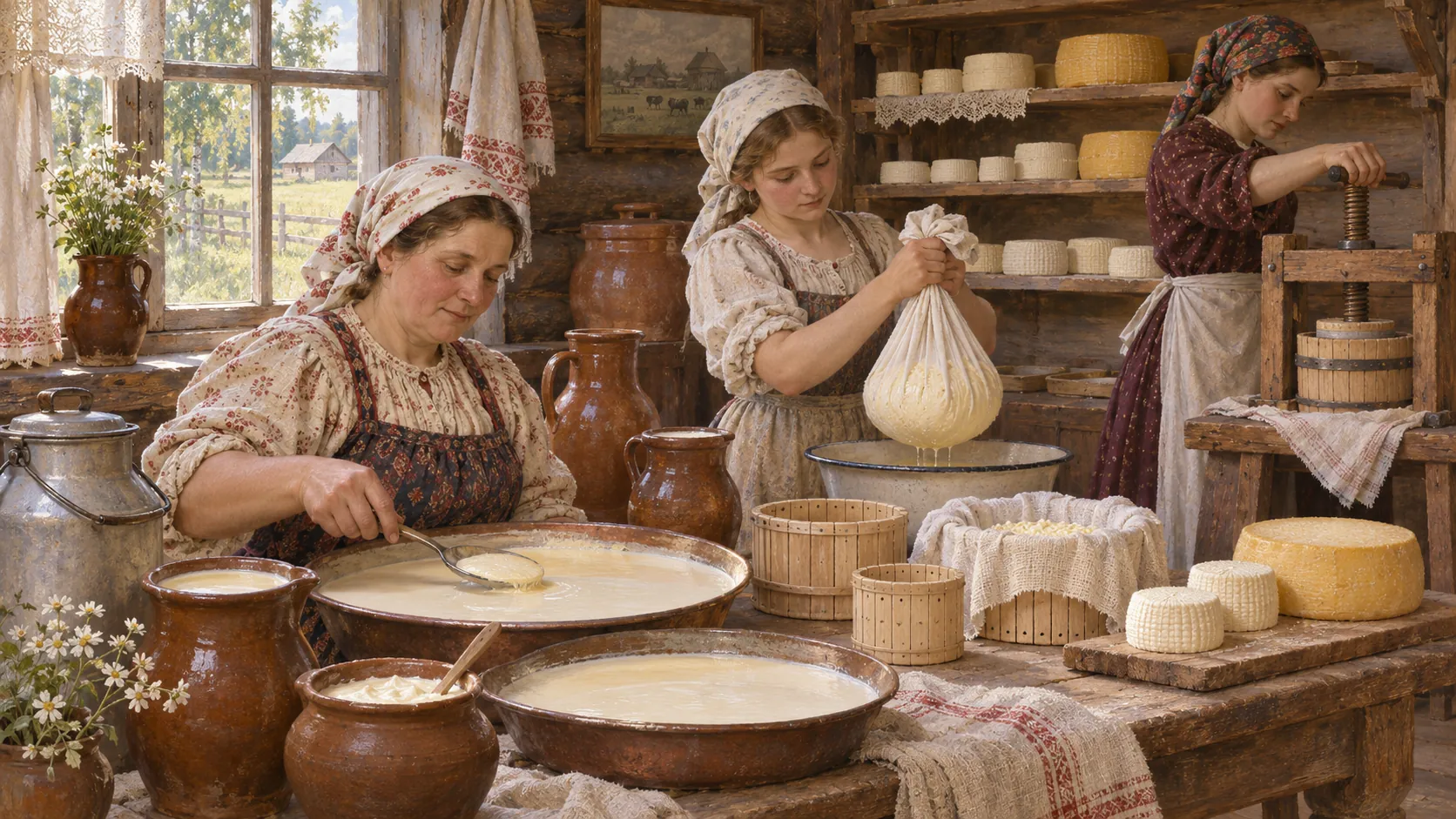
In No. 3648, “White Homemade Cheese from Tvorog and Sour Cream,” milk is allowed to sour, whey is drained through a linen bag, and the mass is pressed and shaped into small cheeses. Molokhovets discusses salt, caraway, drying and storage. Behind a familiar word lies a lengthy series of jobs and materials: vessels, cloth, a place for draining and a press.
No. 3649 describes a similar cheese made without sour cream, from soured milk alone, with caraway added. The book estimates how much curd can be obtained from one vedro of sour milk. That is household arithmetic—how much raw material yields how much food—but its estimates are not universal rates for all milk.
Swiss cheese and rennet: a different technology
In No. 3651, “Swiss Cheese,” Molokhovets introduces podpushka, a historically prepared rennet coagulating agent. Once the whey has been separated, the recipe describes a perforated form, pressing, salting and ripening. This is not the same process as merely draining soured milk. Molokhovets calls May and June favorable months for such cheesemaking.
The surrounding chapter includes Stilton, No. 3658, and cream cheese for tea or breakfast, No. 3659. The latter was intended for relatively prompt serving; Stilton required far more elaborate processing. The 1901 encyclopedic account of cheeses and cheesemaking likewise distinguishes rennet-set and acid-set, hard and soft cheeses. “Cheese” around 1900 was neither a single recipe nor a single product.
Names can also deceive: “Mushroom Cheese,” No. 3656, is a spread made with mushrooms, liver and butter; “Hare Cheese,” No. 3662, is a meat dish. A search for the Russian word syr cannot simply classify every result as dairy cheesemaking.
1866: making cheese through a peasant cooperative
In the second half of the nineteenth century, Nikolai Vasilyevich Vereshchagin drew on European experience to support peasant cheesemaking cooperatives. One opened in the village of Otrokovichi, Tver Governorate, in 1866. Milk from several farms could be processed together, creating a product for further sale. Such a cooperative needed rules for collecting milk, equipment, skilled workers and access to a market.
This was not the “first cheese made in Russia”: cheesemaking already existed, including on estates. Vereshchagin's contribution was to develop the cooperative model and professional education. A dairy school began operating in Edimonovo, Tver Governorate, in 1871, as described by the Great Russian Encyclopedia and the history of the Russian butter and cheese research institute.
Why fresh milk and mature cheese traveled differently
Fresh milk demanded prompt transport and cooling. Properly made and matured cheeses could withstand longer journeys, although they required their own storage conditions. The sale of a perishable daily drink was therefore different from the marketing of hard cheese.
Cooperatives turned local milk into a product capable of reaching wider markets; that did not mean cheese had become everyday food for everyone. The institute's history quotes a report from the 1894 journal Nasha pishcha suggesting that cheese remained relatively uncommon. Transport refrigeration developed unevenly: a historical study of Russian refrigeration notes ice-cooled railcars purchased in 1899 for exporting butter from Western Siberia. That is evidence of a developing butter trade, not universal chilled delivery of fresh milk.
Not one dairy menu for the whole empire
Milk enters Molokhovets' porridges, soups and doughs; cream enters sauces and desserts; sour cream is used in dressings; tvorog appears in fillings and cheese pancakes; and cheese can be served as a separate appetizer. The range illustrates what was possible in certain households, not what every person routinely ate. Prices, ownership of cows and access to cooling have to be studied through other evidence.
For butter varieties and their culinary meanings, continue with the Russian study of cream butter, “Russian butter” and “Provençal oil.”
Read the original sources
Also examine homemade cheese No. 3648, caraway cheese No. 3649, Stilton No. 3658, cream cheese No. 3659, milk quality No. 3665 and cream storage No. 3666.