From Isinglass to Gelatin: Setting Aspic in 1901
A history of sturgeon isinglass and gelatin, their manufacture, price, and uses in fish aspic, sweets and culinary stock.
In Molokhovets' recipes for jellied fish, cold pâtés and fruit jelly, modern readers encounter unfamiliar words: “fish glue,” “white gelatin” and lanspik. One of these materials was made from fish swim bladders; another could be factory-produced from animal tissues. By the beginning of the twentieth century they did not simply replace one another: they coexisted. The 1901 cookbook, read alongside contemporary encyclopedias, offers a history of ingredients, industry and the transparent jelly on the table.
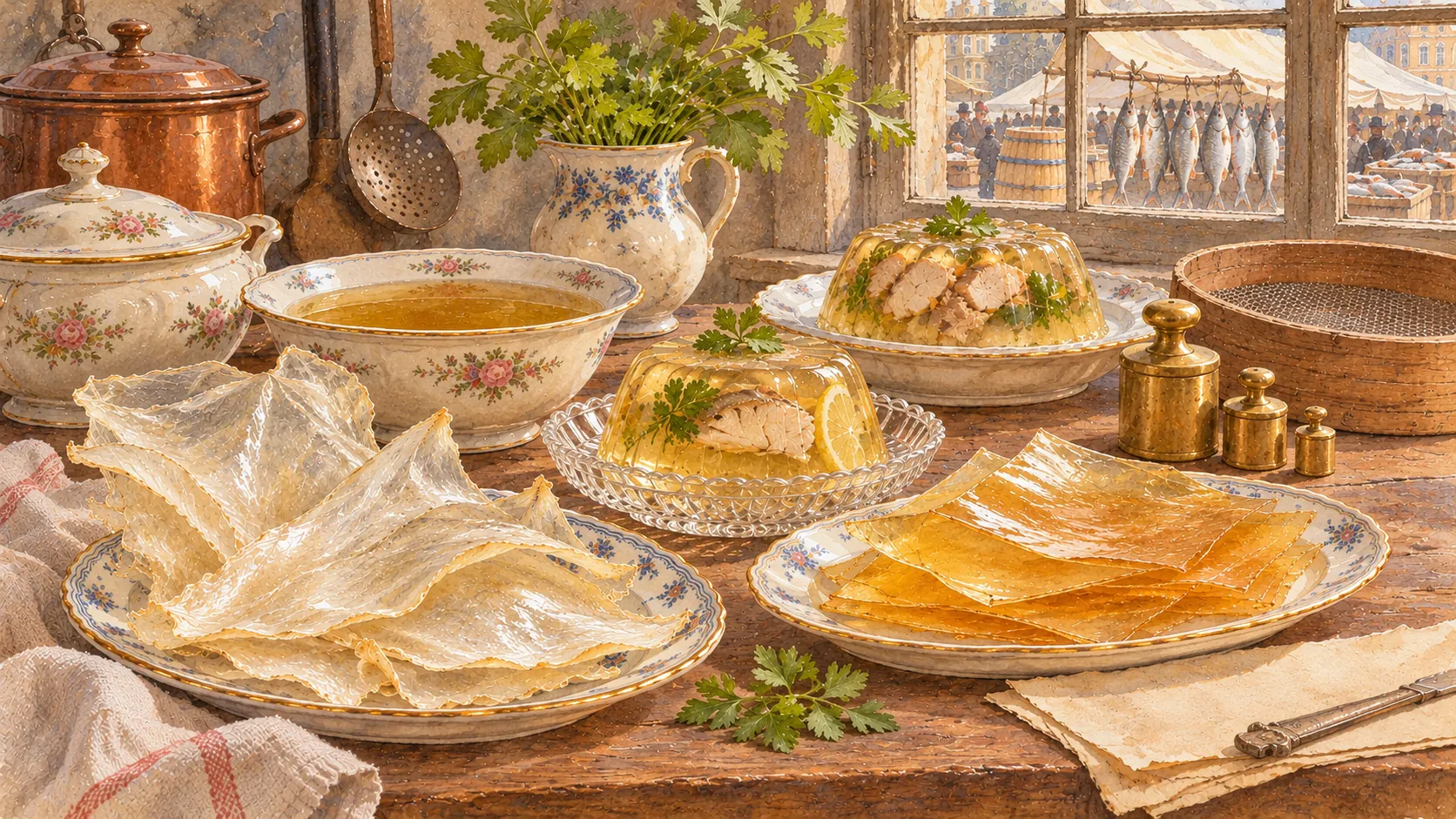
The main historical sources
The general introduction to Section XII of Molokhovets describes meat and fish aspic, ways of thickening and clarifying it, and the setting of cold dishes. The Brockhaus and Efron article on fish glue and its article on gelatin explain sources, trade and manufacture during the late nineteenth century. These sources should be kept distinct: a household manual records culinary choices, whereas an encyclopedia outlines products and commercial technologies.
Why “fish glue” was not a carpenter's adhesive
Historic edible fish glue, called isinglass in international commerce, was generally prepared from the swim bladders of large fish. The Russian sturgeon variety was especially valued. Brockhaus and Efron mention beluga sturgeon, common sturgeon, ship sturgeon and stellate sturgeon. Suitable inner membranes were cleaned, separated, stretched and dried. The resulting thin plates could be translucent and somewhat pearly.
Here “glue” refers to an animal protein material with gelling properties, able to produce a transparent solution that sets as it cools. It does not mean ordinary glue sold for repairing furniture. Yet the historical word is no guarantee that every unidentified packet so labeled was edible: the commodity had technical as well as culinary applications.
The encyclopedia describes uses ranging from clarifying beverages and making sweets to bonding other materials. Its several markets make fish glue a subject of industrial and trade history, not merely a curious word in an old recipe.
Sturgeon fishing and an expensive export commodity
Sturgeons were caught in the Volga and Caspian basins. After processing, their swim bladders became a separate product that could be dried, packed and shipped away from the fishing grounds. The same encyclopedia discusses foreign grades and notes the particularly high value attached to Russian sturgeon isinglass.
For the late nineteenth century, it reports an indicative price of 100–120 rubles per pood for sturgeon fish glue, and a figure of 4,012 poods exported in 1896. These are historical trade figures for a particular product and period. They do not give the price of one sheet bought from a St. Petersburg shop or show that ordinary families purchased this expensive material daily.
After export, the product could receive further processing: the encyclopedia describes rolling prepared plates into thin bands and cutting them for packing. Between the sturgeon fishery and a domestic dish lay stages of manufacturing and commerce.
Gelatin: a similar result, a different manufacturing system
The 1894 encyclopedic article on gelatin describes extraction from certain animal tissues using hot water or weak acid solutions. Bones, skins, connective tissues, scales and fish swim bladders could all be sources. A key technical challenge was obtaining a liquid that would set on cooling, then clarifying and drying the product.
The finished gelatin could be sold as transparent thin sheets. The encyclopedia discusses expanding factory production from bones and says that the material had initially been imported to Russia from France and Germany; Russian enterprises, including ones in St. Petersburg, were operating by the time it was written.
The article's date matters: if manufacturing already existed when the source appeared in 1894, its beginning must not casually be assigned to 1901. The high cost of sturgeon isinglass encouraged interest in other gelling materials, but there was no single moment when all older products vanished.
What Molokhovets used in 1901
The introduction to Section XII explains lanspik, a clear setting stock for aspics, cold dishes and decoration. A meat-based preparation could acquire natural gelling strength from cooking calf's heads or feet. If the base was ordinary chicken or beef stock, gelatin might be added.
In No. 1452, “Jellied Fish,” fish bones, heads and scales are used to strengthen the stock, and fish glue appears as a possible addition. The author gives more than one combination of raw materials, not one exclusively correct fish for aspic.
No. 1454, “A Kind of Aspic from Eel and Crayfish,” refers to both fish glue and sheet gelatin. No. 1444, “Aspic from Suckling Pig,” recognizes the natural gelling quality of meat stock but allows some gelatin. The recipes document coexistence rather than a simple transition from one product to another.
By contrast, No. 1443, “Studen,” is based on reducing stock made from calf's feet or head with meat. Not every cold dish that sets required purchased gelatin sheets.
Clarity was part of presentation
For an impressive aspic, the cook needed not only a stock that would set but also one that looked clear. Molokhovets describes removing fat, clarifying with egg whites or finely divided meat, and straining liquid through cloth. Sometimes burnt sugar provided a golden tint.
This care explains the attention devoted to molds and decoration with herbs, eggs and crayfish tails. Transparent lanspik displayed the arrangement of ingredients inside. Our study of the historical cold table examines the serving arrangements, whereas the present article focuses on where the gelling material came from.
Setting and sanitation are different matters. A cooled stock is not safe to store for a long time simply because it holds its shape. References to icehouses and cooling in 1901 are evidence of historical practice, not current standards for prepared meat or fish.
Beyond aspic: fruit jelly, sweets and clarified drinks
The Brockhaus and Efron article on jelly discusses fruit and berry syrups that could be set with isinglass or gelatin. Other jellies, including those made with suitable acidic apples or other fruits rich in pectin, could set without an animal gelling addition.
Encyclopedic accounts also mention gelatinous proteins used to clarify wine and beer and in certain confectionery products. This does not mean that every historical marmalade or jam contained animal gelatin. Methods and ingredients differed, as our study of berry preserves illustrates.
One raw material could therefore connect fishing, factories, beverage merchants, confectioners and the household kitchen. Its meaning changed with its place in this chain of production and use.
Why “fish glue” and “gelatin” cannot simply be swapped
Both materials could produce a gel, but historically they belonged to different commercial categories. Isinglass from cleaned swim bladders was a distinctive animal product traded internationally. Gelatin could be made from a wider range of tissues, and factory processing allowed products to be sold in increasingly consistent sheets.
Even if modern chemistry considers isinglass a form of collagen-derived gelatin, the historical trade names do not prove identical sources, grades, prices or properties. It is equally wrong to suppose every historic “fish glue” was suitable for food or that every material labeled “gelatin” had the same purity.
The cookbook shows practical alternatives; the encyclopedias explain production and trade. Together they illuminate a real historical transition without turning it into a modern recipe conversion table.
What these sources cannot tell us
The 1901 recipes establish which gelling terms and techniques Molokhovets recommended to her readers. The late-nineteenth-century encyclopedias document raw materials, trade significance, selected price information and industrial developments. They do not reveal how much fish glue one town's shops sold, which gelatin brand a particular family purchased or how quickly factories displaced older products in every region.
Commercial figures in the source refer to specific goods and years, not to total consumption. Nor should old accounts of animal processing, purity and storage be used as a modern food-handling standard. Safe aspic requires certified food-grade gelling ingredients and contemporary hygienic handling.
Read the historical evidence
Original recipes: jellied fish No. 1452, eel and crayfish No. 1454, pig aspic No. 1444 and meat studen No. 1443. Compare the story of crayfish butter and the Russian study of lanspik and fish mayonnaise.