Summer Berries for Winter: The Art of Jam-Making in 1901
Jam and syrup recipes of 1901, specialist preserving books, Petersburg markets, family recollections and food-safety context.
Jam looks like one of the most familiar traditional stores: berries, sugar, a preserving pan and jars. Yet in Elena Molokhovets' 1901 cookbook, that simple name conceals a whole organization of household life. Wild raspberries might arrive in the evening, be covered with sugar and kept for cooking the next day; cranberries might be gathered after the first frosts; some syrups were meant for prompt use, others for the winter table. How did seasons, urban food markets and the price of sugar influence what a housekeeper chose to make?
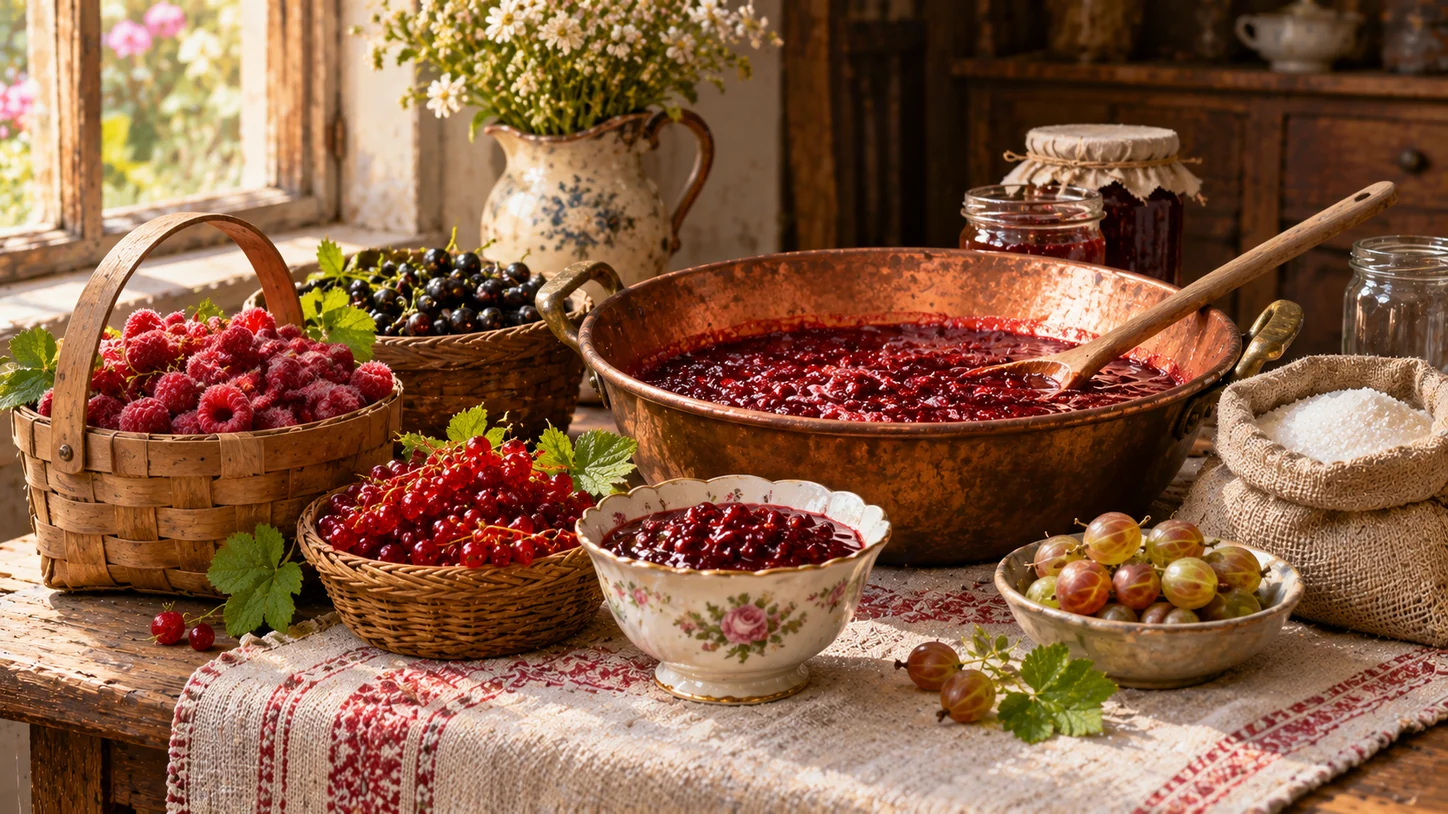
Jam was more than “fruit boiled with sugar”
The cookbooks of A. Makarova (1880) and E. Nanenko (1884) devoted substantial attention to preserves, syrups and fruit pastes; Nanenko even published a separate book on the subject. Molokhovets' Section XLII distinguishes jam, jelly and syrup. A published recipe, however, documents an author's instructions, not proof that every Russian family preserved berries in the same way.
The berry season began before cooking
At the beginning of a harvest, a housekeeper had to decide which berries to eat immediately, which to preserve and which would make good juice. Molokhovets pays attention to ripeness and quality. In No. 3253, “Raspberries Another Way,” she chooses fresh, not overripe fruit and first sprinkles it with fine sugar.
This choice reflects the berries themselves: fresh raspberries are fragile and do not last long without cooling. Timing, not simply a ratio of sugar, mattered to the old household manual. Advice such as gathering fruit in dry weather describes historical harvest practices, not scientifically established modern food safety.
Our English study of the seasonal table places these choices within summer and winter menus. The present question is narrower: how turning a harvest into sweet stores shaped the day's domestic work.
Wild raspberries arrived in the evening—cooking followed next day
No. 3254, “Wild Raspberries,” is especially revealing. The author says wild raspberries were often brought home in the evening. Rather than leaving them untouched, a portion of sugar was added and the berries placed on ice; the syrup and remaining work followed the next day.
Molokhovets explains the practice in terms of preserving the fruit's shape and allowing the housekeeper to postpone the final cooking until morning. One recipe contains evidence of a practical schedule: fresh fruit arriving from elsewhere, the need for a cool location and a shortage of time.
The reference to ice is significant. It does not show that every household had an icehouse. The recommendation assumes resources that were available to some, not necessarily to all.
Berries in the city: baskets, markets and buyers
Urban households did not necessarily pick fruit in their own gardens. In Markets of St. Petersburg: Late Nineteenth to Early Twentieth Century, historian L. Protsay describes seasonal stalls selling apples and berries and peasant traders bringing raspberries, lingonberries and cranberries. Jam-making could depend on going to the market at just the right time, not merely on harvesting a private plot.
The account cannot establish the exact retail price of a Russian pound of raspberries in 1901, or prove that everyone bought fruit in one place. Markets varied in location, assortment and operating periods. The book surveys a broader time span.
As in our study of vegetable trade, the important connection is a sequence of people: grower or gatherer, carrier, seller and housekeeper, who might need to act quickly after purchase.
When jam-making became a separate craft
In 1884, Euphrosinia Nanenko published a work whose long title described Kiev and Moscow sugar, honey, syrup and dried preserves, fruit paste, marmalade, jelly, fruit drinks and candied fruit. The Presidential Library catalogue identifies her as a Kiev maker of preserves and presents the work as the result of ten years of experience and observation.
That such a book existed shows jam-making could be treated as specialized knowledge worthy of systematic instruction. It does not prove that all women were expected to produce preserves or that Nanenko and Molokhovets used precisely the same technology.
They are independent writers with their own recommendations. Comparing the two can be illuminating without declaring either the only authentic method.
How much sugar did preserving require?
In No. 3252, “Raspberries in the Kiev Manner, Without Water,” one Russian pound of berries is paired with one and a half pounds of sugar. No. 3284, “Cloudberry Jam,” gives the same ratio. For cleaned rosehips, No. 3297 specifies two pounds of sugar per pound of fruit.
Those are different mass ratios: the first two use 1.5 times the weight of fruit in sugar, and the third uses twice the weight. Taste, fruit properties, the desired consistency and authorial preference may all have played a role. The text does not establish one universal rule for every berry.
Sugar was a purchased commodity, so the numbers also reflect the supplies needed for preserving. Yet the cost of one batch cannot be calculated without prices for berries and sugar in the same town and season, losses during preparation, containers and labor. The larger industrial story is explored in our history of beet sugar and sugarloaves.
The preserving pan, syrup and keeping berries whole
Molokhovets offers several methods. In No. 3260, “Strawberries Another Way,” granulated sugar is dissolved in water before fruit is added. In No. 3294, sugar is measured in lumps and a thicker jam is made for use in airy fruit pies. In No. 3252, by contrast, raspberries are sprinkled with sugar without added water.
Makarova's Russian Cookbook (1880) includes a substantial section on jam and syrup, with attention to syrup thickness, copper preserving pans and keeping fruit intact. The similarities show a recognizable collection of practices in the era; they do not prove that the two authors' recipes were completely identical.
Copper pans and historic utensils are discussed here as period objects, not as a recommendation to use unlined or otherwise unsafe copper cookware or follow obsolete storage methods.
Why syrup was not simply liquid jam
In No. 3321, “Strawberry Syrup,” Molokhovets recommends using the pulp left after extracting juice as a filling for pies. One harvest could yield more than one ingredient or dish.
No. 3323 is explicitly labeled a syrup “for prompt use.” No. 3322, prepared in the “Parisian manner,” emphasizes maintaining color and aroma during comparatively short heating. These differences concern expected use and desired properties, not modern scientifically tested shelf lives.
Late-season berries had their place as well. Cranberry Syrup No. 3325 is associated with December, when cranberries have been exposed to frost, while Lingonberry Syrup No. 3339 follows another method. The seasonal calendar continued to matter even within the seemingly uniform category “sweet preserves.”
A family household: evidence from a museum
The Ulyanov House Museum preserves small glass dishes for homemade jam from the second half of the nineteenth century. Its account describes Maria Alexandrovna making jams, jellies, fruit paste and dried fruit from produce grown in the family garden.
Particularly revealing is her daughter Anna's recollection: children were told which berries could be eaten immediately and which were reserved for preserves. This was not a rule followed by every Russian family, but a particular account of dividing a harvest and organizing family life between garden and kitchen.
Museum objects and family memories complement the cookbook. One source tells us how a writer advised a reader to prepare jam; the other shows how one household allocated its seasonal fruit.
In winter, jam returned to the table in another form
In No. 1552, “Rice Pudding with Raspberry Jam,” preserved berries form part of a layered sweet dish. No. 1686, “Omelette with Jam,” adds thick raspberry or blackcurrant jam to a cooked omelette. No. 1637 serves jam separately with thin pancakes.
Preserves had several household roles: supplies for the months after the berry harvest, sweets for tea and ingredients for new dishes. An Arzamas history of Russian tea-drinking also discusses jam among refreshments at the tea table. This is worth reading beside our English study of evening tea, while remembering that not every household could offer an elaborate assortment of sweets.
Another recipe, No. 1868, “Doughnuts with Jam,”, links the historic text to a separate modern editorial adaptation. The adaptation explicitly changes aspects of the old procedure rather than masquerading as the exact 1901 method.
What the sources cannot tell us: prices and safety
We know some of the sugar quantities proposed by authors and a few accounts of city berry markets. But we cannot simply calculate the cost of a jar in a specific family's pantry in 1901. Fruit prices, preparation losses, containers, fuel and labor are not all known. Combining figures from unrelated locations and decades creates an illusion of precision.
It is equally important not to copy old methods of keeping food for months. Tying jars with paper, leaving syrup in a cellar or storing fruit on ice were practices of their period, not guarantees against spoilage. Safe home canning and storage require current tested methods with validated acidity, processing time, temperature and hygiene.
We have already covered these issues in our study of preserving food without refrigeration. The present history emphasizes another fact: jam was at once a response to seasonality, an expense in sugar, a form of domestic labor and part of family life.
Summer harvest and a winter reminder of it
Two seasonal stories met in a preserving pan: freshly gathered raspberries and sugar purchased in advance. The housekeeper's time, suitable cookware, somewhere cool to hold ingredients and plans for the winter table all mattered. Molokhovets' recipes, specialist preserving books, St. Petersburg markets and a museum family's recollections reveal different parts of this process.
Everyday history becomes especially tangible in small choices: which berries children could eat immediately, which should be covered with sugar in the evening, and which should become a later treat. These are more informative than attractive but unverified claims about the cost or universal abundance of preserves in 1901.
Original recipes and independent sources
Original recipes: raspberries without water No. 3252, strawberries No. 3260, cloudberries No. 3284, thick jam No. 3294, strawberry syrup No. 3321 and cranberry syrup No. 3325. Further independent reading: Makarova's 1880 preserves chapter, L. Protsay on Petersburg markets, and the history of Russian tea. Related English research: sugar production and seasonal stores.