From Sugarloaves to Beet Sugar: Russian Kitchens in 1901
From early sugar refining and sugar beet manufacture to household recipes with lumps, granules, syrups and caramel.
Sugar appears in many forms in Elena Molokhovets' cookbook: lumps and grains, flavored with vanilla or coffee, turned into a dark sauce coloring, or boiled with berries. Behind that familiar word lies a much larger history. Russian refineries processed imported cane sugar in the eighteenth century, beet-sugar manufacture developed in the nineteenth, and merchants still sold large conical sugarloaves. How did an industrial commodity become a small piece beside a samovar?
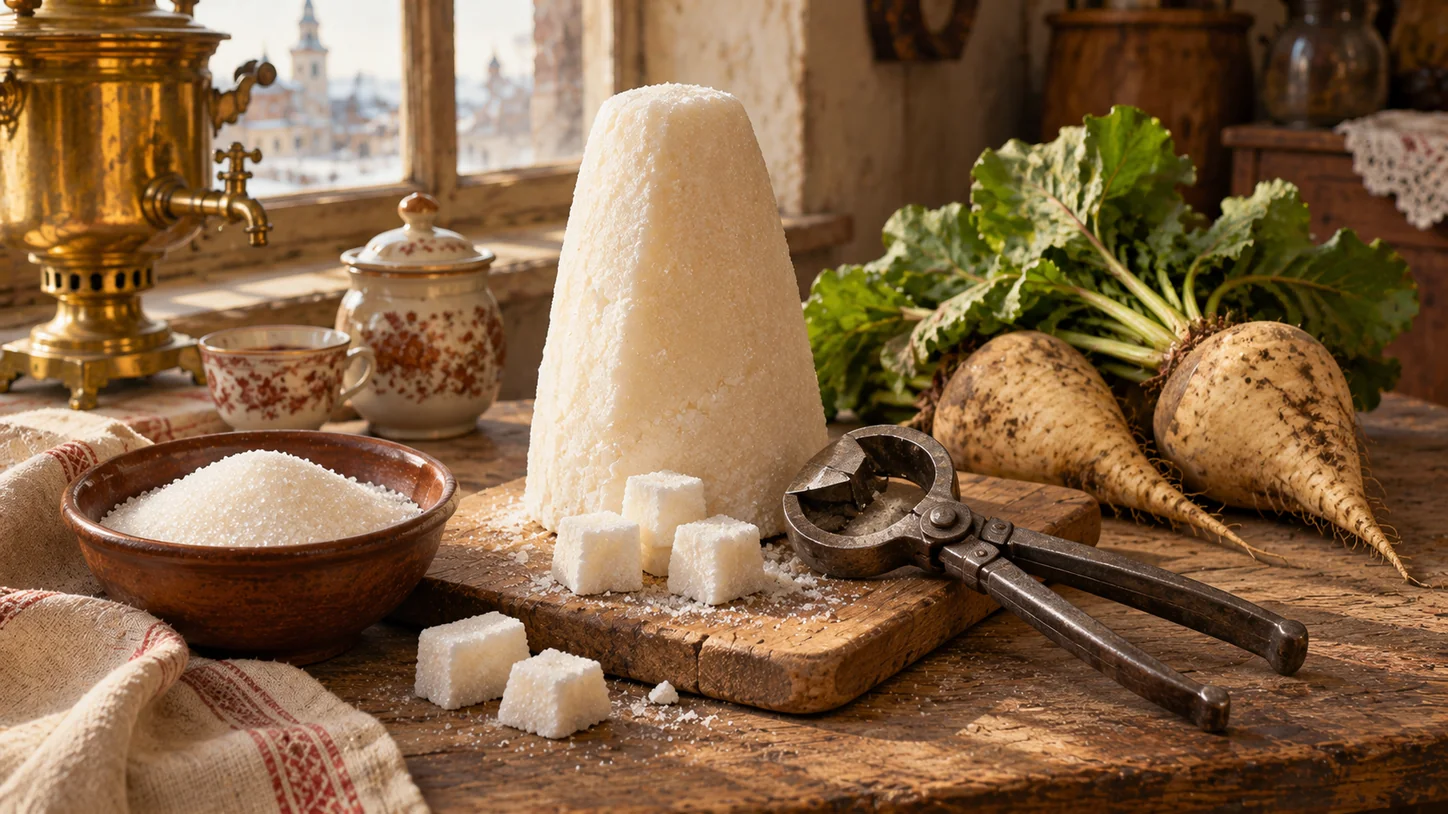
Two different industrial histories
Early Russian refining enterprises processed imported raw cane sugar. From 1802 domestic sugar-beet production began to develop. But words such as “lump sugar” and “granulated sugar” in a 1901 recipe usually refer to the form in which the product reached the kitchen, not to the plant from which it originated. Without bills and trade records, a particular lump cannot be assigned to a particular factory.
Imported cane sugar and early refining
According to the Russian sugar industry's historical survey, a St. Petersburg refinery run by Pavel Vestov processed imported raw cane sugar in the early eighteenth century. This is a useful distinction: refining could take place inside Russia while the sugar cane itself was grown far away.
Refining involved further cleaning raw sugar and making a salable product. The supply system, imports, machinery and government policies changed over time. The early history does not mean that a particular recipe in the 1901 book necessarily used cane sugar: by then the country's industry had been transformed.
1802: sugar beet becomes an industrial crop
Industry accounts associate Russia's first beet-sugar factory with Yakov Esipov and Yegor Blankenagel. It started operations at Alyabyevo in Tula Governorate, in the area of today's Oryol region, in 1802. In its first season, it reportedly produced 300 poods of sugar—small compared with later production.
Beet processing meant far more than exchanging one plant for another. It required fields, factories, fuel, machinery, workers, carriers and a distribution network. Beets had to be processed promptly after harvest, making production closely tied to the agricultural calendar.
During the nineteenth century, factories adopted steam power and improved methods of extracting and refining sugar juice. The Brockhaus and Efron encyclopedic account of beet and cane sugar provides technical context. It would be inaccurate, however, to imagine every refinery used identical equipment.
Large-scale production by 1901
Beet sugar expanded during the nineteenth century as reliance on imported cane sugar declined. The industry's historical account names 387 operating beet-sugar factories in the 1860–61 campaign, although subsequent consolidation changed the number and scale of establishments.
Brockhaus and Efron retrospectively report Russian sugar exports of approximately 7.8 million poods in 1901. That number refers to foreign trade—not to the quantity Russian families consumed. An export total for a calendar year must not be casually equated with the output of the 1900–01 manufacturing season.
The overall conclusion is clear: around 1901, sugar was already a product of large-scale industry and international trade. National production statistics nevertheless cannot tell us how many kilograms a particular family bought or the cost of one Molokhovets dessert.
Why sugarloaves had to be broken up
The term “sugarloaf” described a real large, solid cone of refined sugar. Merchants divided it for sale, and households used cutters, nippers or tongs to break it into manageable pieces. The St. Petersburg Museum of Bread preserves a late-nineteenth- or early-twentieth-century sugar cutter, constructed as a wooden box with a metal blade and a compartment for pieces. A Yelets museum holds sugar-breaking tongs.
These devices should not be confused with delicate serving tongs: one set of tools broke hard sugar, another picked up already prepared pieces from a bowl. Museum objects illuminate the everyday language of a cookbook better than a vague drawing of “old sugar.”
“In lumps” or “granulated”: two kinds of measurement
In No. 3294, a berry-preserve recipe, Molokhovets measures berries by the glass in relation to sugar “in pieces.” No. 3260, on the other hand, specifies good sakhar-pesok, granulated sugar. In No. 3510, a cranberry drink, lumps can be added by taste.
A glass of sugar lumps and a glass of granulated sugar cannot automatically be taken as the same mass. The geometry, packing density and size of pieces vary. A modern edition should retain the source measure and explain its limits rather than invent precise grams.
Turning sugar into a carrier of aroma
Recipe No. 3055 suggests keeping a vanilla pod with sugar in a tin and topping up the sugar as it is used. No. 3056 proposes grinding vanilla with sugar, sifting, and repeating. Other preparations use rose oil, orange peel, orange-blossom flowers and coffee.
In No. 3058, orange zest is rubbed against lumps of sugar; in No. 3060, sugar is moistened with coffee essence and dried. Sugar thus carried flavor into pastries and drinks as well as sweetness. These procedures connect directly to our study of imported spices and vanilla.
Burnt sugar even colored savory sauces
In No. 391, “Burnt Sugar for Dark Sauces,” sugar lumps are moistened and heated until darkened; hot water is then added to make a concentrated liquid for sauces. Sugar was therefore not restricted to desserts: caramelization affected appearance and flavor in savory dishes.
No. 1741, caramel semolina porridge, uses heated sugar to create a crust. Molten sugar and water can splash and cause severe burns. These historic methods are not modern kitchen safety instructions.
Treacle or syrup in gingerbread
No. 3232, gingerbread with patoka, combines thick sweet syrup with sugar, spices, butter and flour. No. 3233 uses still more patoka while adding sugar separately. The fluid sweetener affects the dough differently from dry granulated sugar.
By contrast, sugar gingerbread, No. 3229, uses sugar with eggs, flour and spices as its principal sweet component. The historical Russian word patoka should not automatically be equated with one modern supermarket syrup: its precise composition cannot be recovered from the word alone.
Jam and fruit syrups as household supplies
In No. 3252, raspberries are left with sugar overnight before making preserves. In No. 3322, “Parisian-Style Strawberry Syrup,” sugar is combined with berry juice and heated briefly with the aim of retaining the color. The cranberry drink No. 3510 varies sugar according to taste.
These uses show different needs for sweetness, thickness and presentation. But a period description of sugar quantity and boiling time does not make a modern preserve safe. Historic instructions for storing jams, juices and syrups without refrigeration cannot be relied on today.
Who could afford sugar?
To say that beet-sugar production became cheaper is easier than to quantify access for a particular household. A careful comparison would require retail prices from the same town and date, wages of the relevant group, household size and the product's form and weight. Granulated sugar, broken refined sugar and whole sugarloaves were not interchangeable units.
A historical archive catalogue describes statistics on beet prices, granulated and refined sugar, provincial manufacture, transportation and exports. The existence of an inventory does not mean we have inspected every original table and calculated a reliable average price for 1901. The same caution applies when comparing cookbook dinner costs with the budgets of working families.
From the refinery to a lump beside the samovar
Molokhovets was not writing a history of the sugar industry. She was teaching readers to flavor sugar with vanilla, add lumps to tea, make caramel, boil syrup and combine patoka with gingerbread dough. Yet precisely such everyday instructions reveal the link between a household and changing nineteenth-century manufacturing.
Sugarloaves, cutters, refined cubes, loose granules and beet factories were elements of one evolving commercial system. Without invoices, however, the sugar in a given recipe cannot be assigned to a specific producer.
Historical sources and recipes
More original recipes: strawberries with granulated sugar No. 3260, berry preserves No. 3294, patoka gingerbread No. 3232, sugar gingerbread No. 3229 and coffee-flavored sugar No. 3060. Explore the Russian tea table and the Russian research on jams and seasonal berries.