Cinnamon, Cardamom and Vanilla: Spices in Molokhovets’ Kitchen
The distinct plants, global trade routes and historical culinary uses of three spices in a Russian cookbook from 1901.
Among Russian flour, cream and sugar in Elena Molokhovets' 1901 cookbook appear three products of very different plants and distant trading networks: cinnamon from tropical tree bark, cardamom from the seeds of a South Indian herb, and vanilla from an American orchid. How did they find their way into these recipes? Can a name reveal where a particular purchase came from? Why did the author suggest not merely adding vanilla, but working it into sugar?
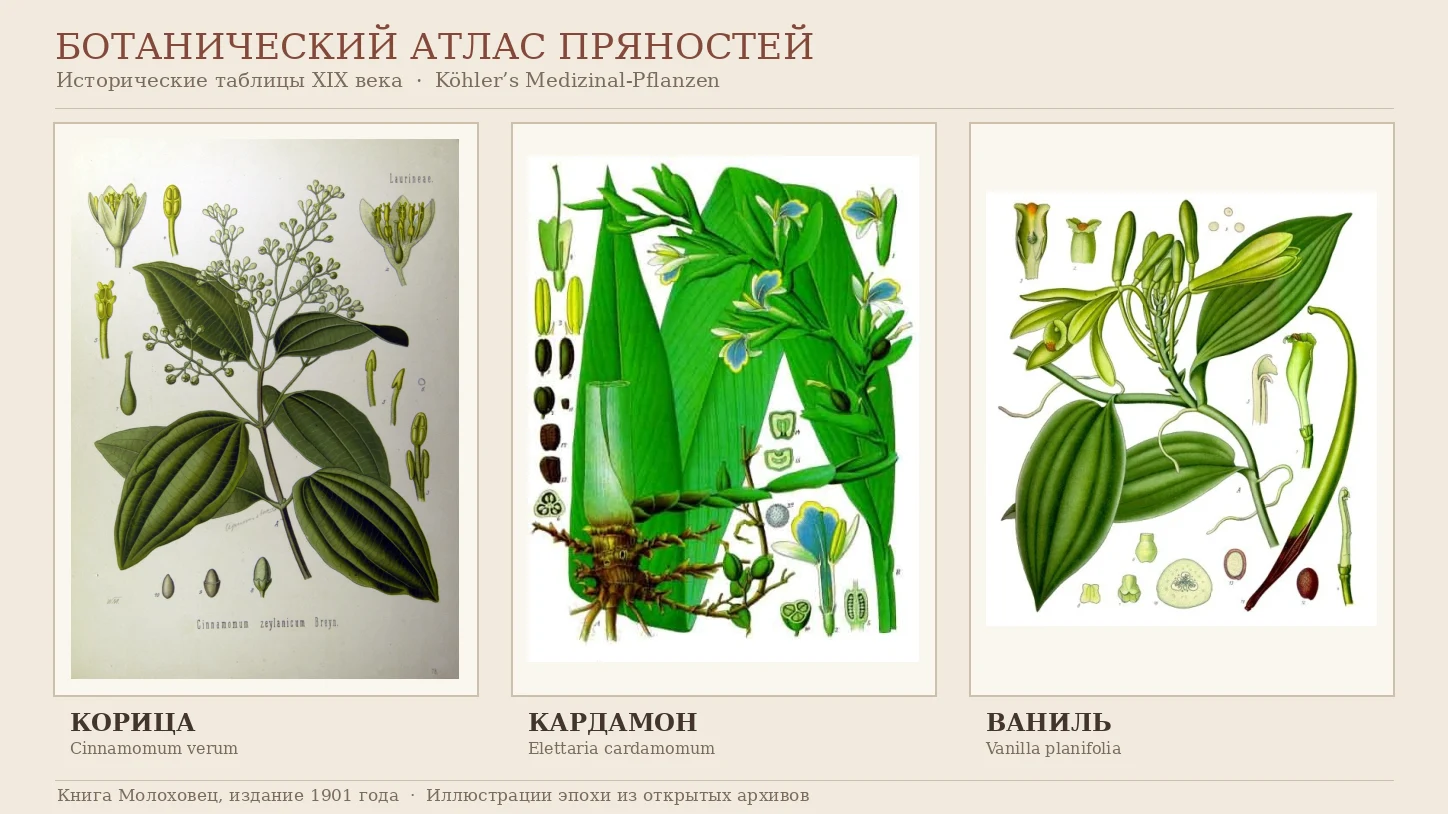
Three aromas, three different parts of plants
Cinnamon is made from the bark of trees in the genus Cinnamomum; true cardamom comes from the seeds inside capsules of Elettaria; and vanilla is obtained from the processed fruits of an orchid in the genus Vanilla.
In No. 1836, “Proportions of Spices,” Molokhovets proposes cardamom or vanilla for flavoring dough. Cinnamon occurs in other recipes, including No. 1805. Neither the species nor the farm supplying each individual purchase is identified by the cookbook.
How much spice did Molokhovets recommend?
For a Russian pound of flour, No. 1836 presents alternatives according to taste: ten cardamom seeds, a little vanilla, lemon oil, zest or almonds. These were alternative ways of flavoring dough, not ingredients that had to be mixed together.
The units tell their own story. Cardamom was counted in grains or seeds, vanilla by a short length of a pod, other flavorings in drops or grated peel. That practical detail disappears if a historical recipe is reduced to an invented modern gram equivalent. Nor can this one recommendation establish how often every household used costly imported spices.
Cinnamon: flavor from the bark of a tree
Commercial cinnamon came from the inner bark of Cinnamomum trees. Trade distinguished Ceylon cinnamon from related aromatic barks, including cassia. A botanical note from the Kew circle (1882) discussed the origin of cassia in southern China; an 1846 account of the Ceylon cinnamon trade illustrates the longstanding significance of source and grade.
In “Cinnamon Tubes,” No. 1805, the spice goes into a thin, sweet batter. In “Cinnamon Rings,” No. 3188, it is ground into the dough, while finished pieces are additionally coated with cinnamon and sugar. One spice therefore appears both inside a pastry and on its surface.
Molokhovets simply writes “cinnamon.” Her recipes do not identify each purchase as true Ceylon cinnamon or cassia. The name in a household cookbook is not a complete botanical or commercial specification.
Cardamom: aromatic capsules from South India
Kew Science places the native range of true cardamom, Elettaria cardamomum, in southwestern India, including the Western Ghats. Its aromatic seeds are held in fruit capsules. The same trade name can also apply to different related plants with different flavors.
Molokhovets names cardamom in the flavoring choices for pastries in No. 1836. It was not confined to sweet baking: No. 3470 includes cardamom in a homemade flavored alcoholic drink, which we mention solely to document a historical use rather than recommend preparing it.
Kew's historical account describes trading associations with the Malabar Coast and the spread of colonial plantations in the nineteenth century. Those facts tell us how the commodity circulated internationally; they do not establish which merchant supplied Molokhovets or a particular Russian household.
Vanilla: an orchid that transformed world trade
Vanilla is neither a grain nor a tree bark nor a legume. Its aromatic “sticks” are processed fruits of Vanilla planifolia, an orchid native to the Americas. Earlier European imports depended strongly on cultivation in Mexico, but nineteenth-century developments changed the supply.
The Smithsonian Gardens and Linnean Society describe how, in 1841, a twelve-year-old enslaved boy named Edmond Albius discovered an effective technique for manually pollinating vanilla flowers on Réunion. His work helped plantations develop beyond the plant's original American range, while he was denied fair reward.
By the time Molokhovets' 1901 edition appeared, vanilla was a product of this transformed global trade. That does not allow us to declare that every vanilla pod in her recipes came from Réunion, Madagascar or Mexico: the cookbook gives no such provenance.
How one pod could flavor a container of sugar
In No. 3055, “A Method of Giving Sugar the Scent of Vanilla,” Molokhovets instructs the reader to place a vanilla pod inside a tin containing sugar, close it and replenish the sugar as it is used. The pod functions as a continuing source of aroma rather than a one-off ingredient.
No. 3056 provides a different approach: break the vanilla into pieces, grind it with sugar, sift and repeat with the remaining fragments. In one case the sugar absorbs aroma while stored; in the other, the plant is ground directly with the sugar. These are different techniques and should not be conflated.
The methods do not prove vanilla was inexpensive. If anything, they show how a small amount of a fragrant substance might be used in several portions of sugar. Without historical purchase prices and quantities, however, the savings cannot be calculated in kopecks.
Vanilla in cream—and an unexpected milk sauce
In No. 1927, a whipped-cream dessert, vanilla can be exchanged for lemon zest as a flavoring. The alternatives show the author's choices between a traded spice and citrus aroma.
More unexpected is No. 488: a milk sauce with vanilla or cinnamon whose title mentions not only pudding but cauliflower. This illustrates how the boundaries between “sweet” and “savory” in an old cookbook can differ from current expectations. Other instances include vanilla biscuits No. 2210 and cream jelly No. 211.
Frequency of mention in a published cookbook should not be confused with the frequency of vanilla in everyday household meals.
Different routes into European trade
The international cinnamon trade was connected to Indian Ocean routes and European colonial companies; cardamom to South Indian regions, Malabar merchants and later plantations; vanilla to the Americas and, after the development of effective manual pollination, plantations on Indian Ocean islands.
These are separate histories of plants and trade that converged on one cookbook page. They should not be reduced to a single mythical “great spice route.” Networks, eras, intermediaries and places of cultivation differed. Indeed, crops could come to be grown far from their original native ranges.
Our Russian-language study of Chinese tea and Kyakhta illustrates a related lesson: commercial designations do not automatically reveal the exact journey of one purchase. The same caution applies to “Ceylon” cinnamon, Malabar cardamom and “Bourbon” vanilla.
Why a modern substitute is not always exact
Cardamom seeds, cinnamon powder and a section of vanilla pod were measured and handled differently. “Cinnamon” may refer to more than one species; “cardamom” may include related plants; and “vanilla” in 1901 was not necessarily identical to today's packet of synthetic vanillin. Automatically substituting powder for every historical term can change a recipe's original meaning.
The best editorial practice is to retain the historical word and explain it, rather than silently revise the text. We take a similar approach to old coffee substitutes.
What the evidence does not establish
Molokhovets records possible ingredients, not a complete list of merchants, purchase prices or consumed quantities. Historical botanical drawings depict plants, not specific St. Petersburg shipments. Scientific accounts show cultivation and global trade, not what a particular Russian family bought.
We cannot assert that vanilla was affordable to “every housewife,” that cardamom belonged to one fixed luxury price category or that all cinnamon came from a single region. Such claims would require dated Russian trade catalogues, price lists and household accounts. The research is valuable because it connects botanical origins, global commerce and specific recipes without erasing the limits of any source.
Read the sources and recipes
Further recipe evidence: ground vanilla sugar No. 3056, cinnamon rings No. 3188, whipped cream No. 1927, and milk sauce No. 488.
Botanical sources: Kew on cardamom; Smithsonian Gardens on vanilla; Linnean Society on Edmond Albius; a historical note on cassia (1882); and The Cinnamon Trade of Ceylon (1846). Continue with the sugar industry's history.