Studen, Jellied Fish and the Cold Table in 1901
Explore lanspik, translucent aspics, meat studen, fish molds, sauces and the historical arrangement of a cold table.
Jellied fish with crayfish tails, meat studen served with horseradish and sliced herring on a separate plate all appear in Molokhovets' cookbook. But a “cold table” was neither one culinary technique nor one arrangement for serving food. The 1901 edition includes cold dishes for dinner and breakfast, and also a separate appetizer table. By comparing these sections, we can distinguish clear lanspik, fish aspic, meat studen, sauces and the way guests were served.
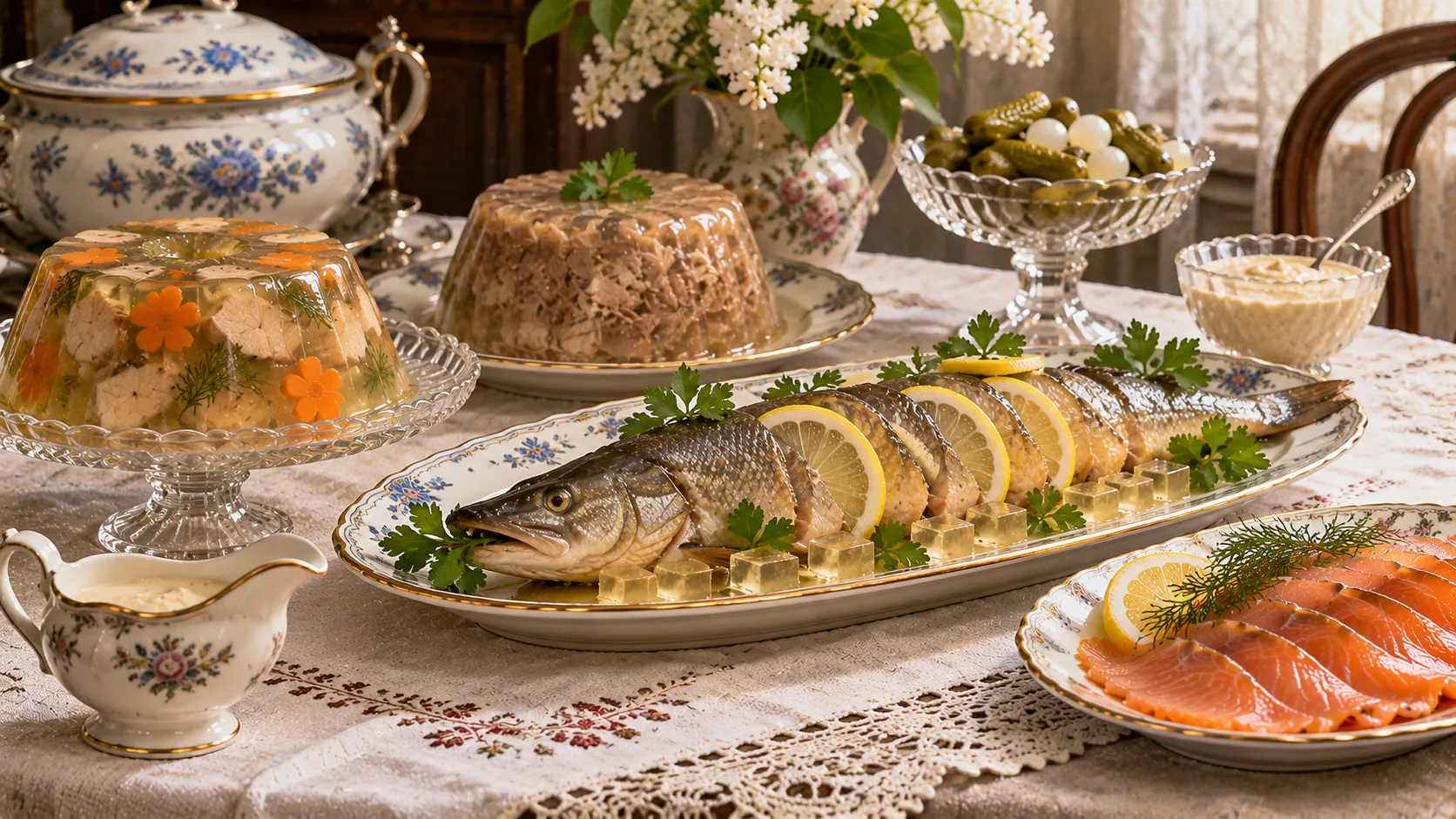
Two distinct subjects within one cookbook
Section XII, “Aspics, Mayonnaises and Other Cold Dishes for Dinner and Breakfast,” explains preparation and decoration. Section XXXVII, “Setting the Table and Serving Dishes,” describes how to arrange an appetizer table. A shared serving temperature does not mean that every dish in aspic necessarily appeared on the appetizer table.
A cold dish and an appetizer table were different things
The title of Section XII explicitly assigns jellied dishes and other cold foods to dinner and breakfast. It is not simply a catalogue of everything that “had to be eaten before soup.” The dishes could form part of a dinner or be served separately at another meal.
At the beginning of Section XXXVII, Molokhovets instead suggests a special table near the dining-room door or in an adjoining room. Small plates hold cheese, fish, ham, corned meat, game, sausages, herring and caviar, with separate bread, butter, forks and napkins. This text concerns presenting food to guests, not making gelatinous stocks.
The distinction matters. A carefully layered jellied fish dish might require prolonged cooking and a special mold, while sliced herring with dressing was a different kind of domestic task. Reducing both to the modern English word “appetizer” loses the structure of the original book.
What was lanspik?
The general note before the aspic recipes describes lanspik as a clear, gelatinous, setting meat or fish broth. Molokhovets uses it for aspic, certain cold “mayonnaises” and decoration. For a mold serving six to eight diners she estimates approximately four glasses of prepared lanspik.
The meat version may set naturally when calf's head or feet are cooked. When ordinary chicken or beef stock forms the base, the cook might add sheets of gelatin. Fish lanspik draws on fish heads, bones, scales, small fish and sometimes isinglass. Not every historical aspic was made entirely without a purchased gelling ingredient.
Clarity mattered as much as setting. The note describes clarification with minced meat or egg whites, straining through cloth and sometimes using burnt sugar for a golden tint. Lanspik was therefore a deliberately prepared visual part of a cold dish, not simply fish soup left to cool by accident.
Jellied fish: mold, transparency and decoration
No. 1452, “Jellied Fish,” allows a range of species, including pike, pike-perch, tench, trout and sturgeon. Cooked fish is freed from bones, cut into even pieces and covered with separately prepared and strained fish stock. The options are broader than the single fish a modern recipe title might suggest.
No. 1453, “Jellied Ruffe,” introduces crayfish tails into the mold. Molokhovets recommends a smooth ring mold: rows of fish fillet and crayfish tails are covered with lanspik; after the dish sets, a garnish of cucumber, crayfish and herbs can occupy the center. The mold shapes both the gel and its final presentation.
In No. 1454, “A Kind of Aspic from Eel and Crayfish,” the combination differs and the stock requires special clarification. Neighboring recipes therefore illustrate multiple techniques and decorative plans, not one universal “traditional jellied fish.” Historic handling of eel should not be treated as a safe modern procedure.
Studen: related to aspic, not its exact duplicate
In No. 1443, “Studen,” calf's head or feet are boiled with roots and spices. Meat is separated from the bones, combined with strained stock and chilled in molds. After turning it out onto a dish, Molokhovets suggests mustard, vinegar or horseradish.
Another independent recipe, No. 4137, also titled “Studen,” boils the legs and head, then arranges the cooked meat and pours the strained stock over it. The repetition is valuable: the book treats studen chiefly as a meat-and-stock dish, which may look quite different from a transparent decorative fish aspic with precisely placed pieces.
However, an absolute rule that “studen never uses an added gelling agent and aspic always does” would be wrong. No. 1444, “Aspic from Suckling Pig,” recognizes the natural setting quality of meat stock and allows a small gelatin addition for reliability. The properties depended on the animal material and the particular recipe.
A historical review in Nauka i Zhizn discusses earlier studen recipes in Vasily Levshin's 1816 cookbook. This establishes that a relevant culinary tradition predates the 1901 edition, not that it was practiced identically in every governorate.
Why cold dishes came with horseradish, mustard and vinegar
Sauces often appear at the end of Molokhovets' aspic recipes as a distinct accompaniment. No. 1447, “Hare Aspic,” suggests a ring mold and pouring a mixed or mustard sauce into its center. Meat studen No. 1443 is served with mustard, vinegar or horseradish.
No. 479, “Cold Mustard Sauce with Capers,” is intended for fish, aspic, mayonnaise and vinaigrette. It includes Sarepta mustard, egg yolks, Provençal oil, vinegar and optionally capers or olives. “Provençal oil” here means olive oil, as explored in our English study of historic butter and oil terms.
Flavor, acidity, sharpness and visual design were planned together. Yet the range of sauces in a cookbook does not prove that every household always paired aspic with one particular condiment.
Cold fish for breakfast need not be elaborate
No. 1456, “Cold Fish,” is striking in its simplicity. Cooked fish left from dinner could be carefully sliced and served at breakfast with mustard sauce. The entry shows a domestic possibility for using leftovers, not how often it happened.
No. 1472, “Whole Cold Fish for Breakfast,” is considerably more decorative: the fish is dressed with crayfish, herbs and clear lanspik. No. 1473 allows a simpler serving with parsley and a separate sauce.
The section thus ranges from uncomplicated cold fish to elaborate molded presentations. Treating it solely as a catalogue of luxurious formal-dinner centerpieces would erase much of its variety.
Herring on an appetizer table: a different scale of work
No. 1481, “Herring with Provençal Oil and Vinegar, Served as an Appetizer,” refers the reader to No. 1219 in the fish section. There the herring is soaked, cleaned, sliced and dressed or garnished with ingredients such as potato, beetroot, onion and capers.
The cross-reference matters: herring is simultaneously a fish product and a prepared appetizer. It does not need to be jellied to belong to the broader collection of cold dishes. Section XXXVII again places herring among foods displayed on a separate appetizer table.
Thinking in terms of product, recipe and serving occasion is more useful than treating all “cold foods” as one technology. A dish can appear in different parts of a cookbook for different editorial reasons.
What the book establishes, and what it cannot
Molokhovets specifies molds, clear stocks, decorations, sauces and forms of service. From these passages we can distinguish studen, jellied fish, cold fish for breakfast and simple sliced appetizers.
The book cannot tell us how often industrial workers or peasants ate aspic, what proportion of families had an icehouse, or how much a formal jellied dish cost in every province. It is evidence of culinary recommendations rather than a census of ordinary diets.
Equally importantly, historic cooling and storage instructions cannot be adopted today. Raw egg, fish, meat and large molds require current food-safety rules for handling, rapid cooling and refrigeration.
Original sources and related reading
Compare studen No. 1443, studen No. 4137, jellied ruffe No. 1453, pig aspic No. 1444, cold fish No. 1456 and mustard sauce No. 479. Continue with the history of fish glue and gelatin, table service and crayfish in cold dishes.