Crayfish in 1901: From Tail Meat to Red Crayfish Butter
The trade and culinary uses of crayfish tails, shells and crayfish butter, with 1901 recipes and period market evidence.
Crayfish in the 1901 edition of Elena Molokhovets' A Gift to Young Housewives were not confined to a plate of whole boiled animals with dill. The meat from their tails entered sauces, soups, puddings and fillings; empty shells served as small molds, and finely worked shells gave butter its distinctive red color. Behind the recipes lay another history: freshwater fishing, dealers in live crayfish, costly transport, storage and the labor of a well-equipped kitchen.
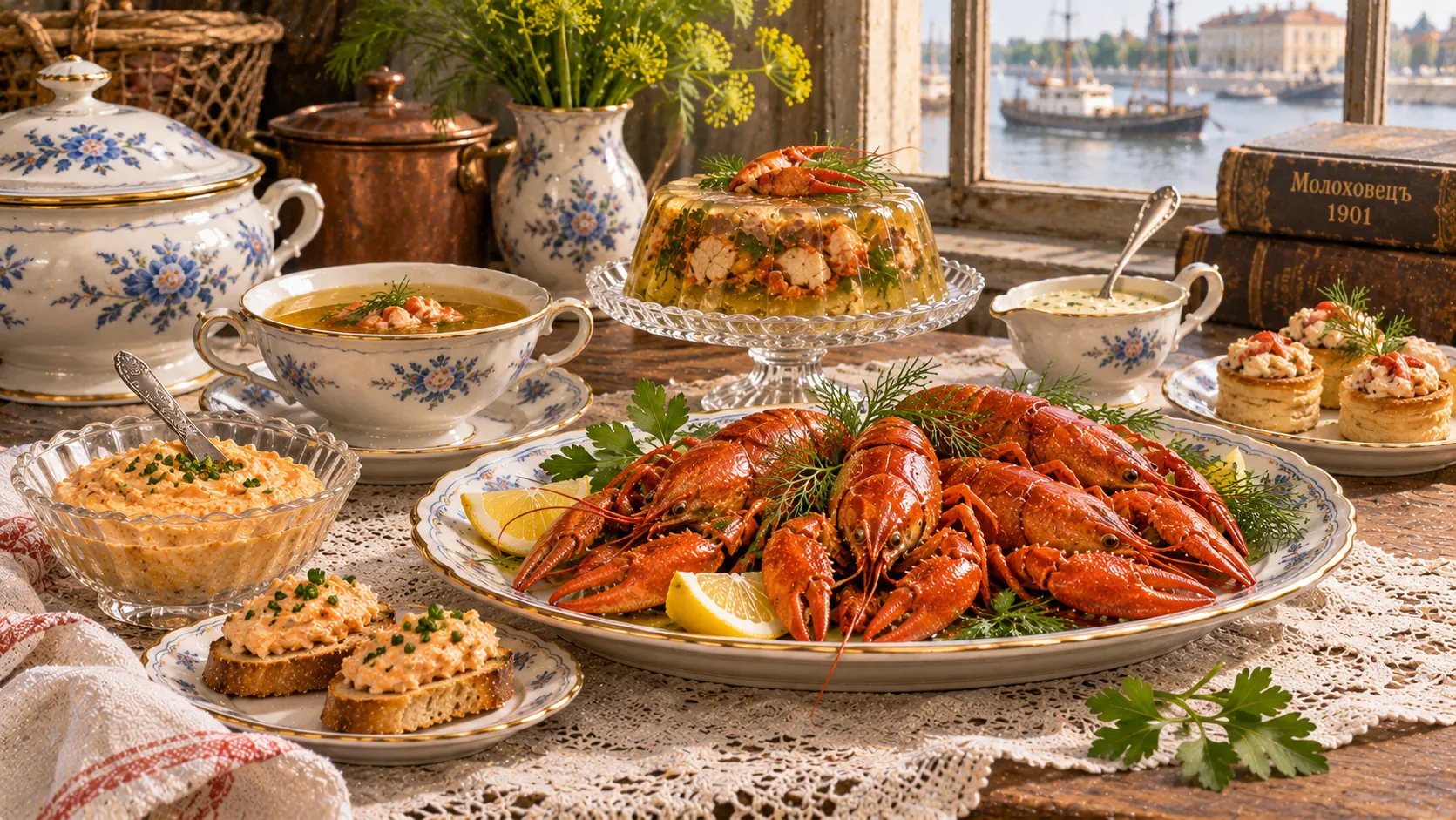
Where to find crayfish in the book
Section IX, “Fish,” includes Nos. 1329–1342, ranging from whole boiled crayfish to flavored butter and stuffed shells. Crayfish Soup No. 62 and Crayfish Sauce No. 431 demonstrate their use in other chapters. No. 4089 concerns attempts to prepare a store of crayfish tails.
From river to St. Petersburg: crayfish as a commodity
Late-nineteenth-century St. Petersburg had a notable trade in live crayfish. The writer Anatoly Bakhtiarov described dealers traveling to provincial fishing grounds and Finland, with baskets packed with moss for the journey. Such transport did not guarantee that every animal survived; live catches required care and losses could occur.
A historical study of crayfish commerce based on period newspapers gives striking examples. In 1887, two large St. Petersburg firms were reportedly bringing as many as 50,000 crayfish each from Finland every week. Other shipments came from Lakes Ladoga, the Volkhov and Narva rivers and Pskov Governorate.
These are reports for a particular market and period, not statistics for every fishing region of the Russian Empire. Their value is in documenting the scale and organization of a particular trade, not in proving an identical weekly volume for all later years.
Demand also extended beyond Petersburg. By the late nineteenth century, suppliers in some areas were trading with European markets, especially after outbreaks of crayfish disease affected Western Europe. The chain from catch to city customer involved middlemen and transport methods absent from the domestic recipes.
Whole crayfish: a comparatively simple dish
No. 1329, “Whole Boiled Crayfish,” describes crayfish flavored with dill and served in a pile on a dish with herbs. No. 1330, “Crayfish in the French Manner,” adds roots, parsley, onions, pepper and wine. Two neighboring recipes thus offer contrasting seasonings and modes of presentation.
Both historic recipes assume live crayfish. This is a feature of the period source, not contemporary guidance for handling animals or cooking shellfish. The times and conditions described in old recipes do not establish modern food safety.
The book also contains crayfish with sour cream No. 1331 and crayfish with sauce No. 1332. A boiled crayfish could therefore be a finished dish or the starting point for something more elaborate.
What were “crayfish necks”?
The Russian culinary term rakovye sheyki, literally “crayfish necks,” refers to the edible meat from the tail section. In Molokhovets it is treated separately from claws, legs and shells, each of which might have a different culinary role. No. 1335 uses some prepared tail meat in a filling and keeps other pieces intact for serving. No. 1778 combines it with rice and crayfish butter.
The quantities in some recipes show how demanding preparation could be. Crayfish Soufflé No. 1337 specifies forty crayfish, together with pike-perch and cream. Crayfish-and-Rice Pudding No. 1338 likewise uses forty animals, rice, eggs and butter. These represent options for a household with access to ingredients and substantial kitchen labor, not evidence of universal daily meals.
The shell as a kitchen implement
No. 1340, “Crayfish Backs, That Is, Shells,” explains the term in its title. The shells were treated as small containers that could be filled with prepared mixtures. Other parts could provide flavor for additional dishes.
In Crayfish Soup No. 62, cleaned shell sections serve as little molds for stuffing, while other portions contribute to the stock. The process involved several separate tasks: extracting meat, reserving selected shells and using other materials for the soup's flavor.
Elsewhere in the cookbook, “shells” used for hot appetizers may refer to a different serving vessel or to mollusk shells. These historical meanings should not automatically be conflated with crayfish carapaces. Our Russian study of appetizers in shells explores that distinction.
Why crayfish butter was red
No. 1341, “Crayfish Butter,” describes treating prepared crayfish shells with dairy butter until the fat takes on a deep reddish color, then separating the flavored butter. This was neither oil extracted from crayfish meat nor a new kind of dairy fat: ordinary butter was transformed through contact with the shells.
Crustacean shells contain natural colored pigments, notably carotenoids such as astaxanthin. Heat changes their appearance, and fat can carry some of the colored material. This helps explain the historic color without validating the old processing times or methods as safe modern practice.
The recipe also suggests that shells used for the butter might have further culinary uses in stock or sauce. That reflects the aim of obtaining several useful components from an expensive ingredient.
How crayfish butter connected different dishes
Its uses extended far beyond the crayfish chapter. In No. 431, “Crayfish Sauce,” the product is associated with a prepared sauce served with chicken, pike, pike-perch and other foods. No. 472, “Crayfish Sauce for Pâtés,” includes crayfish butter, mushrooms, asparagus and tail meat in a creamy setting.
In No. 1338, tail meat, butter made from the shells and rice appear within one dish. These are not duplicate recipes: one starting material supports sauces, soup, grain preparations and more elaborate entrees.
The cookbook forms a network of techniques. Crayfish butter points to soups; soups point to filled shells; fish dishes point to crayfish sauces. Following these connections reveals more than reading any single recipe in isolation.
Crayfish at the cold table
No. 1453, “Jellied Ruffe,” arranges pieces of fish with crayfish tails and clear lanspik in a mold. After setting, the center may be filled with cucumber, more tail meat and herbs. No. 1454 combines crayfish and eel, with fish glue or gelatin helping the stock set.
These recipes connect crayfish to the history of the cold table and aspic. The tail meat contributes to flavor and design rather than appearing only as a separate dish of boiled crayfish.
Preserving tail meat was difficult
No. 1339 gives historical approaches to preparing cooked crayfish tails for later use. Molokhovets explicitly notes that keeping them for a long time was difficult. No. 4089 describes another old method and links prepared tails to soups and sauces.
This is evidence of the challenge posed by a perishable product, not a safe modern preservation guide. Storing shellfish under fat, using vinegar or relying on period drying practices does not establish protection against spoilage. Current chilling, storage and cooking standards must be assessed independently.
What the book establishes and what remains uncertain
Molokhovets records which parts of crayfish were used, how different dishes related to one another, how the shells could serve as kitchen aids and what storage problems concerned the housekeeper. Period journalism adds information about commercial routes into St. Petersburg.
Neither source reveals the consumption of the average family, how often rural people made crayfish butter or the total catch across all governorates. Newspaper figures concerning prices and numbers refer to specific years and markets. A cautious history distinguishes those accounts from nationwide statistics.
Crayfish in this cookbook were more than a delicacy. They provide a link between rivers, merchants, domestic workers, elaborate sauces and the presentation of the finished meal.
Explore the original recipes
Other recipes: boiled crayfish No. 1329, French-style crayfish No. 1330, tail meat No. 1339, shells No. 1340, rice pudding No. 1338 and historical stored tails No. 4089. Compare fish glue and gelatin, aspic and the cold table and historic cooking fats.