From Parisian Butter to Provençal Oil: Fats in Molokhovets's Kitchen
Why Parisian butter later became Vologda butter, how Russian clarified butter differed from Provençal olive oil, and how dairies worked around 1901.
What connects a Vologda dairy, Greek olives and a saucepan in which a householder melted butter? In Molokhovets's 1901 book, maslo denotes more than one product: butter, Chukhon butter, clarified Russian butter and olive oil explicitly called Provençal. The household section even explains how to alter a fat's taste or obtain a substitute. We compare the recipes with dairy and oil trading history without replacing old terms with modern brands.
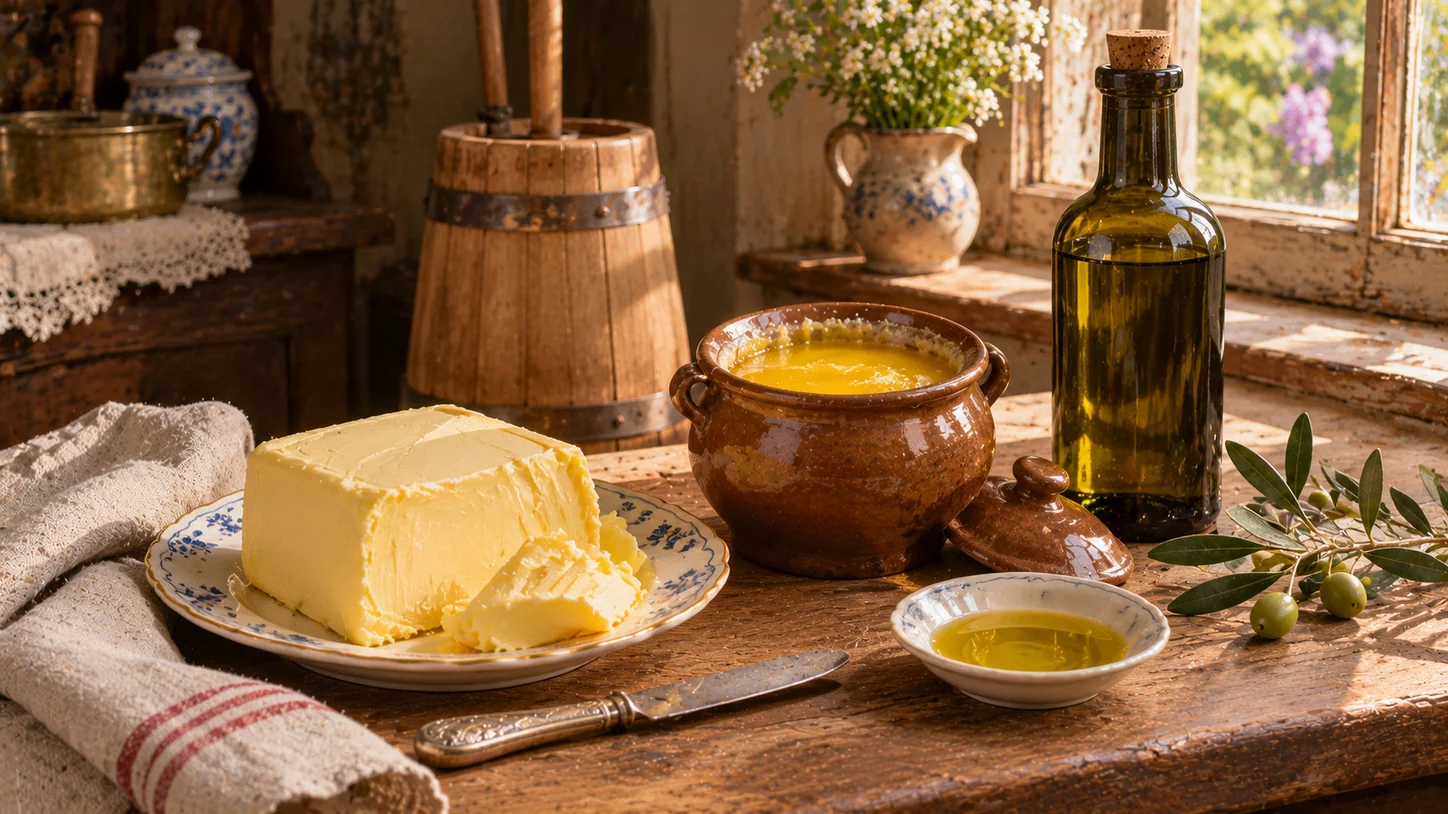
Three principal distinctions: Parisian butter No. 3629 involves dairy cream and heating; Russian butter No. 3643 involves repeated melting of milk fat; Provençal oil No. 3590 is olive oil. They differed in raw materials, production and culinary use, not just labels.
One Russian word, three different products
Modern shops usually separate butter and olive oil. Molokhovets's manual discusses both: Section XLVII contains fasting-day oils from seeds and olives; Section XLVIII covers butter, its processing and prepared appetizer mixtures.
No. 442, Polish Sauce, calls for fresh Chukhon butter browned with rusks. No. 480, Provençal Sauce, gradually incorporates olive oil into yolks, mustard and vinegar. These are different physical techniques and sources of fat.
Historical names should be interpreted through composition, production and culinary function rather than matched directly to a modern supermarket product.
How milk became butter
Butter was obtained from the fatty portion of milk. Before widespread industrial equipment, cream was skimmed after settling and churned manually. Separators and new cooling methods subsequently changed the organization of production.
The history of the Vologda enterprise founded by the Buman couple describes its dairy operating near Vologda in the early 1870s and using a cream separator in 1881, an important sign of the transition toward mechanized processing.
Butter did not necessarily have one flavour. Cream preparation, freshness, temperature and handling affected the product. Chukhon is a historical commercial and technological designation, not an automatic equivalent of a modern fat percentage or brand.
Parisian butter, later named Vologda butter
No. 3629 suggests chilling milk in an icehouse, heating almost to boiling, cooling and churning. It also mentions the colour of winter butter. This is not a precise industrial specification, but it confirms that the author knew the term Parisian butter.
The Vologda Archive 100×100 project connects its development with Nikolai Vereshchagin. After encountering Normandy butter in Paris in 1870, he experimented with heated cream and established production in Vologda province. By the 1870s the enterprise offered butter with a distinctive nutty flavour.
The familiar name Vologda butter was officially adopted in 1939. Before then it was called Parisian, and in foreign trade also Petersburg butter. Calling it Vologda butter in Molokhovets's own text would be an anachronism. The resemblance of No. 3629 to Vereshchagin's production does not prove an unchanged factory formula.
Siberian butter: how railways changed trade
By the late nineteenth century dairying developed far beyond Vologda. Research from the Institute of History, Siberian Branch of the Russian Academy of Sciences, shows expansion of industrial butter production in Western Siberia after factories appeared and the Trans-Siberian railway advanced. New routes facilitated shipments to other regions and external markets.
The researchers date an early Siberian butter factory to 1894. Railways alone did not provide every village producer with direct export access: intermediaries, cooperatives, buyers and quality requirements also mattered.
Archival records document producer associations, but the Union of Siberian Butter-Making Cooperatives was founded only in 1907. It cannot be depicted as already operating in 1901.
Why clarified butter was called Russian butter
In No. 3643, Chukhon butter is melted, cooled, separated from water and processed again. The product is intended for frying and storage in pots or tubs.
This belongs to the history of clarified dairy fat, but is not necessarily identical to modern standardized clarified butter. Names and methods changed.
The final promise of storage for several years after household treatment is not a validated modern shelf life. The technique is historical evidence, not a recommendation for preparation or storage.
Provençal oil: olive oil, not necessarily from Provence
No. 3590 explicitly identifies Provençal oil in a footnote as olive oil. Molokhovets mentions olives of the Greek Archipelago, Adriatic and Mediterranean regions, Greece, Dalmatia and southern France. The name does not require production in a single French province.
The finest kind is called huile vierge and associated with olives that are not overripe. This is a historical commercial and culinary description, not today's extra-virgin classification criteria.
In herring No. 1219 it is combined with vinegar and vegetables, and in sauce No. 480 it provides the fat for an emulsion with yolk and mustard. Neither recipe establishes the origin of the particular oil used in a household.
What Molokhovets says about fasting-day oil prices
Section XLVII prints approximate prices per Russian pound: Provençal oil 60 kopecks, poppy-seed oil 40, sunflower oil 22. These are figures within the 1901 edition, not a representative average retail price across Russia.
They indicate the author's relative price hierarchy. Even using the same weight unit, the number of purchases made by a family cannot be inferred without local trade records, dates, grades and income data.
These oils also differed in plant source, flavour and use. Sunflower and poppy-seed oils are recommended for frying fish and dressing fasting-day soups, while olive oil is also used for salads and cold sauces.
How hemp oil was made to resemble Provençal oil
No. 3600 describes an imitation of Provençal oil made from hemp oil. The historical purpose is changing the smell and appearance of a more accessible plant oil, not transforming hemp into olives.
Mustard oil No. 3593 and sunflower oil No. 3596 also receive attention. Fasting-day cooking could use a variety of oils depending on local production and trade.
No. 3600 must not be used for misrepresenting oil origin or as a modern safe refining process. Names, colour and smell do not prove composition.
Fats for porridge, fish, sauce and bread were not interchangeable
In Polish sauce No. 442 butter is browned with rusks; Provençal sauce No. 480 gradually combines oil with mustard, egg and vinegar; herring No. 1219 is served with olive oil. Physical properties and flavours determine different techniques.
No. 3660 works fresh butter with curd cheese for tea or breakfast. Half-puff pastry No. 1376 requires repeated brushing with soft butter and chilling the dough, a different technological purpose.
Which fat matters as much as how much fat. Substitution can substantially change the result even though both products are called maslo in Russian.
Why household storage advice requires particular caution
No. 3624 proposes complicated packaging and preservation; No. 3618 and neighboring recipes describe attempts to restore spoiled butter using water, carrot juice and other methods. They reveal historical attitudes to freshness, not current safe practice.
No. 3626 proposes treating packaging with salicylic acid solution. This should not be recommended for home food storage. Historical texts do not provide modern microbiological validation, and changing odour or colour does not eliminate hazards.
No. 3591 suggests leaving olive oil with a cloth covering rather than a tight stopper. This too is historical evidence, not proof of quality preservation. Follow current product labelling and safe storage guidance.
What one cookbook page cannot establish
The cookbook distinguishes dairy butter, clarified butter and olive oil. Vologda archival and museum materials show industrial dairy development, while Siberian research traces factories and railway shipments. Together they illuminate economic and culinary history.
They do not prove that a particular householder bought Vologda butter or oil from a particular Mediterranean port, or establish general affordability from one printed price without retail, wage, grade and packaging data.
The historical designations should be kept distinct: Parisian in Molokhovets, Vologda as a later official name, Provençal as olive oil and Russian as a way of processing milk fat.
Three fats, three histories of labour and trade
Butter leads to dairy farming, churns, separators and railway distribution. Russian butter recalls household processing for cooking and preservation. Provençal oil reveals Mediterranean olive trade alongside more accessible local vegetable oils.
The most interesting feature is the householder's practical choice: brown butter for sauce, serve olive oil with herring or use another oil in a fasting-day soup. Such decisions reveal the larger history of production and everyday life. The related study of crayfish butter explores another historical use of the word.
Original recipes and historical sources
Elena Molokhovets, A Gift to Young Housewives, 1901 edition. Original source links are retained below.
- No. 3629 — Parisian Butter · Russian original
- No. 3643 — Russian Clarified Butter · Russian original
- No. 3590 — Provençal Olive Oil · Russian original
- Section XLVII: Vegetable oils (in Russian)
- Section XLVIII: Butter, cheese, milk and eggs (in Russian)
- No. 442 — Polish Sauce: Browned Butter with Breadcrumbs · Russian original
- No. 480 — Cold Provençal Sauce for Fish, Whipped Like a Mousse · Russian original
- History of the Buman dairy enterprise in Vologda
- Vologda Archive 100×100: the history of Parisian, Petersburg and Vologda butter
- Institute of History, Siberian Branch of the Russian Academy of Sciences: Siberian butter production
- Russian archives: Union of Siberian Butter-Making Cooperatives (1907–1920)
- No. 1219 — Herring with Olive Oil and Vinegar: Five Appetizer Variations · Russian original
- No. 3592 — Poppy-Seed Oil · Russian original
- No. 3596 — Sunflower Oil · Russian original
- No. 3600 — Making Hempseed Oil Resemble Olive Oil · Russian original
- No. 3593 — Mustard Oil · Russian original
- No. 3660 — Butter-and-Tvorog Cheese for Tea or Breakfast · Russian original
- No. 1376 — Butter-Laminated Half-Puff Yeast Dough · Russian original
- No. 3624 — Long-Term Storage of Butter · Russian original
- No. 3618 — Restoring Spoiled Finnish-Style Butter · Russian original
- No. 3626 — A Third Butter-Preservation Method Using Salicylic Acid · Russian original
- No. 3591 — Historical Method for Keeping Olive Oil Fresh for over a Year · Russian original
- Vologda archival exhibition on butter and lace
- Historical account of Vereshchagin's butter-making techniques
Related reading
Historical storage and refining methods are not practical instructions. Do not attempt to restore rancid butter, store it in brine or use packaging treated with salicylic acid. These are not validated modern food-safety techniques. Discard spoiled or questionable butter.