Cocoa, Chocolate and Russian Factories Around 1901
How home chocolate making and industrial confectionery coexisted in Russia around 1901, with historic recipes and museum sources.
One of the most unexpected passages in Elena Molokhovets' A Gift to Young Housewives is a recipe for making chocolate itself from cocoa beans. In the 1901 edition, a short instruction for brewing cocoa stands beside hot chocolate made with milk and egg yolks, followed by a procedure involving a roaster, a heated iron mortar and molds for chocolate bars. Russian factories were already producing chocolate and selling it in urban confectionery shops. For the housekeeper, then, did “chocolate” mean a drink, a bar or a baking ingredient—and why did a complicated domestic method survive alongside industry?
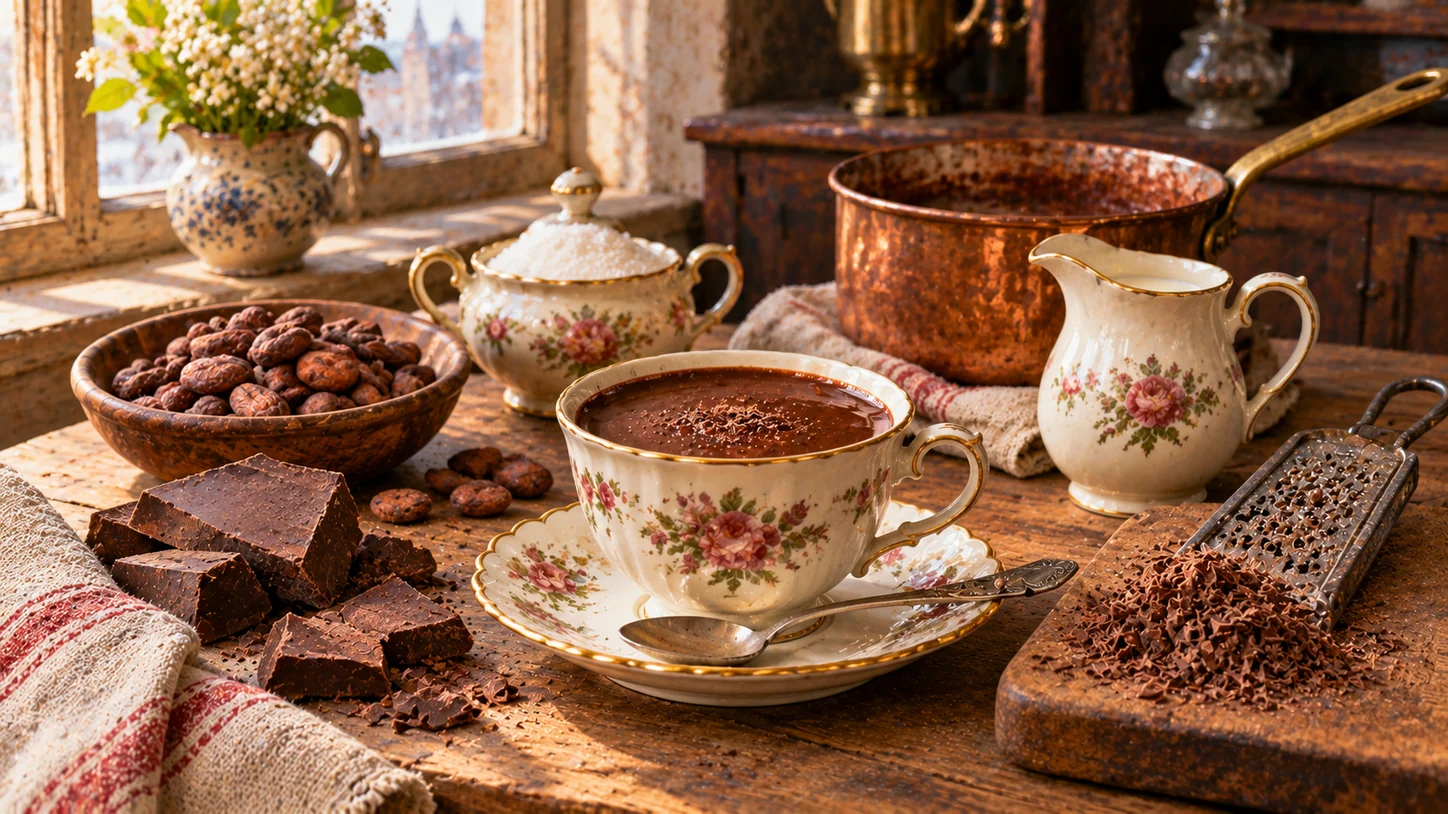
Cocoa and chocolate were not one recipe
No. 3496, “Cocoa,” uses a spoonful of cocoa and sugar; No. 3497, “Chocolate,” begins with prepared chocolate grated or broken and heated with milk; No. 3499 explains how the chocolate mass itself was to be made from roasted cocoa beans. The book distinguishes a powder for a drink, a ready-made solid product and ingredients for making chocolate at home.
The cocoa bean: from a tropical tree to a merchant's kitchen
Chocolate begins with the seeds of Theobroma cacao. The Royal Botanic Gardens, Kew describes the plant's native range in Central and northern South America; it later came to be cultivated in other tropical regions. A 1901 Russian cookbook was therefore connected to international trade even where the recipe named no specific plantation.
In No. 3499, Molokhovets writes about selecting fresh cocoa beans. The word “cocoa” does not identify the origin of one consignment: the recipe cannot tell us where the beans were grown, when they reached Russia or which intermediaries handled them.
The history of a species and the journey of one purchased batch are different questions. Botany establishes the origin of a plant; a commercial route must be established through invoices, customs records or period advertisements.
1828 and a new technology: cocoa powder apart from cocoa butter
According to a Smithsonian history of chocolate, in 1828 Coenraad van Houten developed pressing technology that separated much of the cocoa butter from the cocoa mass. The remaining material could be made into powder for beverages and baking. This helped transform chocolate products during the nineteenth century.
Modern shop labels should not be applied to period recipes without explanation. Molokhovets uses cocoa as a drink ingredient, grated chocolate from a prepared bar, and whole beans for making a chocolate mass. These demanded different work and equipment.
During industrial development chocolate gradually ceased to be exclusively a beverage prepared from beans by hand. But the existence of cocoa powder and factory bars does not prove they were equally accessible to urban and rural households.
A teaspoon of cocoa and two of sugar
In No. 3496, Molokhovets proposes a heaped teaspoon of cocoa and two teaspoons of fine sugar per cup. The mixture is brewed with hot water to about half the cup, then completed with milk. Another method boils the cocoa directly in milk.
This is a notably brief domestic recipe. There is no need to roast or grind whole beans. Its proportions represent one author's suggestion, not the average amount of sugar or cocoa consumed across Russia.
When interpreting the recipe today, old references to raw milk must not be followed uncritically. Contemporary preparation should rely on pasteurized milk and modern hygiene and heating recommendations.
Chocolate in a cup: grating a ready-made bar
No. 3497, “Chocolate,” starts from a different product. For one historical bottle of milk—equivalent to three cups under the book's conventions—the recipe uses from one eighth to one quarter of a Russian pound of chocolate. It is grated or broken into pieces, mixed with milk and served; sugar is provided separately. Thick whipped cream could be added.
Here ready-made solid chocolate is an ingredient for a hot drink. A bar was not necessarily intended to be eaten straight from its wrapper: it might serve as a semi-finished domestic product.
No. 3498, “Chocolate Another Way,” introduces two or three egg yolks beaten with sugar. The mixture is heated and whisked without boiling. It is closer to a rich dessert than a simple cocoa-and-water beverage, although the exact taste and modern nutritional content cannot be reconstructed from a short historic description.
A domestic chocolate workshop: roaster, mortar and molds
No. 3499, “A Method for Making Chocolate Itself,” gives a detailed process for cocoa beans: roast, cool, remove the skins and grind. Molokhovets then advises prolonged working in an iron mortar warmed from below until the powder becomes a smooth, oily mass.
Fine sifted sugar is added next. The recipe calls for equal weights of cocoa material and sugar—one and a half Russian pounds each. Vanilla, cardamom or cinnamon may provide aroma. The finished mass is placed in shallow tin molds, allowed to dry and wrapped in paper.
This is neither an industrial process specification nor a modern safe procedure for treating raw cocoa. Heating an iron mortar from an old-style stove, prolonged cooling and drying cannot be recommended for home reproduction on this evidence alone. As a document of how a housekeeper understood the making of solid chocolate, however, the account is unusually revealing.
Modern chocolate manufacture uses other processes and controls, from fermenting the beans to conching and tempering the mass. The comparison clarifies how unlike present-day factory production the 1901 home method could be.
Why domestic and factory chocolate coexisted in 1901
The history of Russian chocolate manufacturing is documented by museums and industrial records. The Museum of Chocolate and Cocoa and related museum accounts describe Ferdinand Einem's small Moscow production beginning in 1851 and a factory operating on Sofiyskaya Embankment by 1867. The business later expanded its production and commercial network.
By the end of the nineteenth century, the Abrikosov confectionery enterprise was also an important producer, selling a wide range of sweets, including chocolate, through shops in major cities. Museums note the role of advertising, decorated packages and different kinds of confectionery.
Molokhovets' domestic recipe does not contradict these developments. A cookbook could preserve a method for making a product even after manufactured versions appeared for sale. Her suggestion that homemade chocolate would be cheaper, though, is not proof of cost savings for every family. To calculate that, one would need comparable prices of beans, sugar, fuel, labor, equipment and purchased chocolate.
Boxes, labels and a new culture of purchase
Historic chocolate packages are more than attractive decoration. The Museum of Chocolate and Cocoa treats pre-revolutionary wrappers as evidence of advertising, competition and ideas about customers. The Russian History Museum in the United States holds boxes from the Abrikosov company's pre-revolutionary sweets.
A shopper could encounter chocolate not only as an ingredient for a hot cup but as a decorated industrial commodity: a bar, confection or gift. A surviving box, however, cannot tell us what every customer purchased or which sweet sold most often in a particular town.
The packaging itself points to a change in commerce. Factories sold recognizable products with labels and producer identities, rather than solely an unbranded ingredient.
Grated chocolate in cakes, icing and gingerbread
In Molokhovets, chocolate is not limited to drinking. Chocolate Cake No. 2134 combines grated chocolate with almonds, rye rusks, eggs and flavorings. Chocolate Biscuits No. 2177 also require chocolate, while Chocolate Icing No. 2065 mixes it with sugar and egg white.
In No. 3224, “Chocolate Gingerbread,” chocolate chiefly enters a sweet outer coating. No. 3240 uses the same name for small products based on whipped egg whites, sugar and chocolate. These are different preparations concealed by a similar title.
Our English history of honey, syrup and gingerbread helps explain this variety: a prized ingredient might enter the dough, provide flavor or become a coating after baking.
An unexpected pairing: rice cutlets with chocolate sauce
In No. 1773, “Rice Cutlets with Chocolate Sauce,” a sweet rice mixture is shaped and fried, then served with a sauce of chocolate, milk, sugar and egg yolks. Molokhovets even proposes placing some jam inside each cutlet. The form suggests a cutlet, but the ingredients make this a sweet dish.
There is another version, No. 2685, in which rice is combined with almonds and rosewater, fried in nut oil and served with a sauce including chocolate. These are different recipes, not one repeated entry.
Such pairings remind us that we cannot read old dish names through present-day boundaries between dessert, side dish and main course. The Russian study of imported rice explores this ingredient further.
Chocolate was also served cold: mousse, blancmange and ice cream
Chocolate Mousse No. 2000 combines chocolate with milk or cream and sugar, then cools and whips it. Chocolate Blancmange No. 2004 uses almond milk, chocolate and a setting ingredient. Both turn the same imported product into desserts by very different techniques.
Chocolate Ice Cream No. 1957 is particularly detailed: chocolate is combined with milk and an egg mixture, cooled first and then frozen using ice and salt. Making a frozen dessert before home refrigerators could require significant equipment and advance preparation.
Again, the recipes do not establish how often such foods were actually eaten. They record possibilities proposed to the author's readers, not an everyday menu for the entire empire.
What the evidence does not tell us
The 1901 book preserves culinary techniques, names and habits. Museum records establish the existence of chocolate factories and advertising. Botanical evidence identifies the cocoa plant's origins. None reconstructs the supply chain of one packet of cocoa bought by a specific housekeeper.
Likewise, we should not pronounce homemade chocolate cheaper merely because the author thought so: comparisons would require the same year, location, quality, unit weight and costs of labor and equipment. Factory turnover, national chocolate output and household consumption are also different quantities.
Keeping these distinctions clear enriches the history. Manufacturing statistics need not replace customers' experiences, and recipes need not become legends of universal luxury or widespread affordability.
From bean to cup and factory box
Four neighboring recipes cover almost the full range: cocoa powder, a ready-made bar, a thick hot drink and the preparation of chocolate from whole beans. Meanwhile factories with increasingly specialized equipment, shops and advertising were active. In the kitchen, chocolate found its way into icing, cakes, rice desserts and ice cream.
This is not a story about one “first chocolate in Russia,” but an example of tropical materials entering urban trade and domestic culinary language. Products and factories changed, while older methods of preparation continued to be recorded in cookbooks.
Original recipes and historical sources
Drinks: cocoa No. 3496, hot chocolate No. 3497 and chocolate with egg yolks No. 3498. Desserts: cake No. 2134, biscuits No. 2177, gingerbread No. 3224, rice cutlets No. 1773 and ice cream No. 1957. Botanical reference: Kew on Theobroma cacao. Related English research: coffee substitutes, the tea table and sugar production.