When Coffee Was Not Made From Coffee: Chicory, Rye and Acorns
Historic coffee, mixed coffee and bean-free substitutes from Molokhovets in 1901, with equipment and recipe links.
Open Elena Molokhovets' 1901 cookbook at recipe No. 3500 and you will find recognizable coffee—with chicory added. The entries that follow offer “coffee” made from rye, acorns, beetroot and even beans. Why did one word describe such different drinks? And why would a household need a coffee roaster, a grinder and a flannel bag? Eight neighboring recipes reveal old culinary vocabulary without requiring guesses about what “all Russians” drank.
One name, three categories of product
Ordinary coffee with chicory, No. 3500, includes actual imported coffee beans. Mixed coffee, No. 3504, combines them with roasted plant products. Rye coffee No. 3502 and acorn coffee No. 3503 contain no coffee beans at all. These are not merely different commercial grades of a single botanical substance.
Real coffee: what happened to the beans at home
For No. 3500, “Coffee,” Molokhovets recommends a quarter of a Russian pound of chicory for each pound of coffee beans. She describes roasting the beans in a closed roasting device, constantly shaking it, then cooling and grinding them. The resulting coffee is to be kept in a tightly closed container, with small amounts ground as needed.
A significant detail is that the domestic process might begin before the coffee was roasted. Modern categories such as pre-ground coffee or beans intended for an automatic machine hide some of the work described in the early-twentieth-century book.
The source also discusses the addition of butter or sugar during roasting. These notes have historical value, but they are not validated modern procedures or standards for temperature and doneness.
Chicory: mixed with coffee or served as a separate drink
Botanically, chicory and coffee are different: a chicory drink uses the processed root of a plant rather than coffee seeds. The recipe uses one quarter-pound of chicory for each pound of beans—chicory is therefore 20% of the combined dry mixture by mass. That arithmetic describes Molokhovets' recipe, not the average proportion used by every shopkeeper.
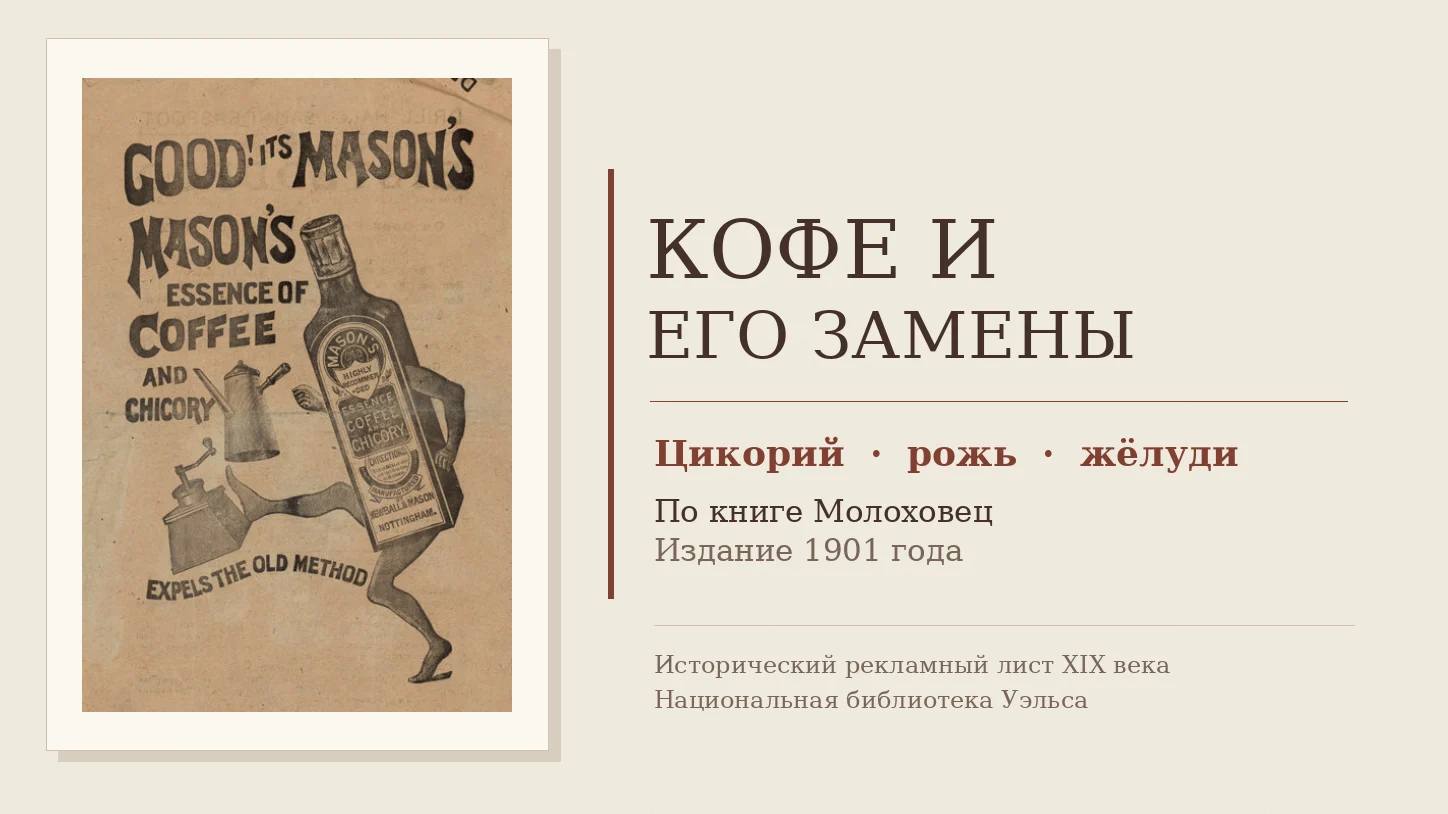
Chicory mixtures were known far beyond Russia. A nineteenth-century British advertisement for coffee and chicory illustrates the availability of a marketed product under that name. It would be an error to assign the British advertisement Russian prices or claim the pictured brand supplied Molokhovets.
An article in Nauka i Zhizn discusses the history of root chicory, including a factory in the Vyborg region operating from 1796 and products sold in St. Petersburg. Such evidence shows the tradition predates 1901, but does not measure chicory consumption in that particular year.
Sunflower seeds instead of chicory
Recipe No. 3501 proposes adding half a pound or a whole pound of powder made from roasted sunflower seeds to a pound of coffee beans. Molokhovets considered it tastier than chicory.
It remains a drink made with genuine coffee: the beans are not eliminated. Calling it simply “sunflower coffee” without explaining the mixture could misleadingly imply that it contained only seeds. Nor do these author's proportions establish its popularity across the empire.
Rye coffee: a familiar grain in an unfamiliar role
In No. 3502, “Rye Coffee,” there are no coffee beans. The grain is selected, washed, dried, roasted, ground and brewed. An alternative method involves soaking and boiling the rye before roasting. The sequence—from grain and water to drying, roasting, grinding and brewing—is the important historical detail.
Molokhovets suggests two to three teaspoons of rye powder per cup, rather than one teaspoon of her coffee mixture. That does not prove equal chemical strength or caffeine content; it simply records different brewing proportions. The fact that rye was widely known as a food grain does not prove that every peasant drank this particular substitute.
Acorn coffee: a forest product after several stages
No. 3503, “Coffee from Acorns,” takes a different path. The acorns are shelled and cut, treated with hot water, dried, roasted, cooled and ground before becoming a beverage. The starting material is a forest fruit rather than a cultivated cereal.
Acorn-based coffee substitutes appeared elsewhere in Europe. Historian Hanna Hodacs' 2023 study in the Journal of Global History analyzes experiments with substitutes for tea and coffee in eighteenth-century Sweden, including acorns and grains. It establishes that similar experiments existed earlier outside Russia, not that acorn coffee was common in Russian households in 1901.
Historic methods of processing collected acorns are not modern safe preparation directions; plant identification, processing and food-safety standards must be independently verified.
Beetroot and beans: drinks without coffee beans
Recipe No. 3506, “Beet Coffee,” describes cutting beetroot into pieces, drying and roasting them. Roasting a sweet root could produce flavors unlike an ordinary vegetable broth, but the drink's composition was not that of botanical coffee.
No. 3505, “Coffee from Ordinary Beans,” begins by boiling and repeatedly rinsing beans, then drying and roasting them. The author suggests first breaking up the hard material in a mortar to protect the coffee grinder. Thus different substitutes required different kitchen techniques.
Molokhovets also ascribes health benefits to bean coffee for certain complaints. That assertion is a period belief, not medical evidence.
Mixed coffee: five parts coffee, three parts substitutes
No. 3504 combines five pounds of ordinary ground coffee with one pound each of roasted rye, beetroot and acorns. Of eight pounds of the combined dry mixture, five are genuine coffee: 62.5% coffee by mass.
This recipe complicates a simple division between “real” and “fake” coffee. The book explicitly identifies a middle category consisting of beans and substantial amounts of roasted local plants. It should not automatically be called fraudulent: the composition is openly stated in the recipe. Deliberate misrepresentation by a merchant would require independent trade evidence.
Rye dough turned into a coffee substitute
The most unexpected entry is No. 3507, “Exceptionally Nourishing Coffee from Rye Flour.” First a dough is made from rye flour, milk and eggs. It is rolled thinly, baked, dried further, ground and finally brewed as a hot drink.
Here “coffee” describes the method of making a dry brewing powder and serving the resulting beverage, not its botanical origin. “Exceptionally nourishing” was Molokhovets' evaluation, not a laboratory analysis of nutritional value.
A stored powder made from dough containing eggs and milk raises food-safety concerns. The old instructions should not be reproduced without modern controls over drying, storage and microbiological hazards.
Roaster, grinder and coffee pot
In the kitchen equipment list, item 49 includes a coffee roaster and grinder, with the reminder that freshly ground coffee is preferable. The listed price is 1 ruble 20 kopecks.
Elsewhere, in the dining and tea equipment list, Molokhovets describes a coffee pot with an inserted strainer, giving six spoonfuls of ground coffee and one of chicory for four large cups. Its price begins at 2 rubles. These figures are book-list prices, not evidence of market averages across every town in Russia.
They do, however, show the equipment and costs the author expected certain readers to consider. Our Russian study of kitchen utensils places such objects in a broader household context.
Why were so many substitutes proposed?
A Culture.ru overview connects the spread of coffee in Russia to both European and eastern influences, while chicory and plant substitutes sometimes offered a similar style of drink at different costs. Research into European coffee substitutes adds availability, trade policy and use of local plants as possible motives.
None is necessarily universal. One customer might favor chicory to save money, another because of taste, a third because beans were unavailable. A cookbook recipe cannot identify the reason a particular family chose a beverage.
One shelf of the book, a whole world of ingredients
Eight entries show why the word “coffee” in a historical recipe is not always self-explanatory. Alongside roasted beans stand chicory mixtures, sunflower-seed additions, grain and acorn blends, and drinks made entirely from roasted local foods.
Together with the roaster, grinder and coffee pot, they reveal the work behind a cup. The book does not say which alternatives were most common or what they cost in every town. For that we would need trade records and family budgets, not just culinary recommendations.
For another imported hot drink and its trade routes, read the Russian historical study of Chinese tea. The study of cocoa and chocolate factories provides another related story.
Original recipes and research
Other recipes: sunflower-seed coffee No. 3501, mixed coffee No. 3504, bean coffee No. 3505, beet coffee No. 3506, rye-flour coffee No. 3507. Further context: chicory history, Hodacs' research, and the nineteenth-century British coffee-and-chicory advertisement.