Honey, Patoka and Russian Gingerbread in 1901
Explore 23 gingerbread recipes from Molokhovets, nineteenth-century syrup production and historic gingerbread crafts.
Elena Molokhovets devotes an entire section of her 1901 cookbook to pryaniki, Russian spiced cakes or gingerbread. Some use honey, some crystalline sugar, others a thick syrup called patoka. Why were these not treated as the same pastry? What role did a carved wooden gingerbread board play in the baker's craft? The recipes can be read alongside the history of syrup manufacturing and museum objects from the nineteenth century.
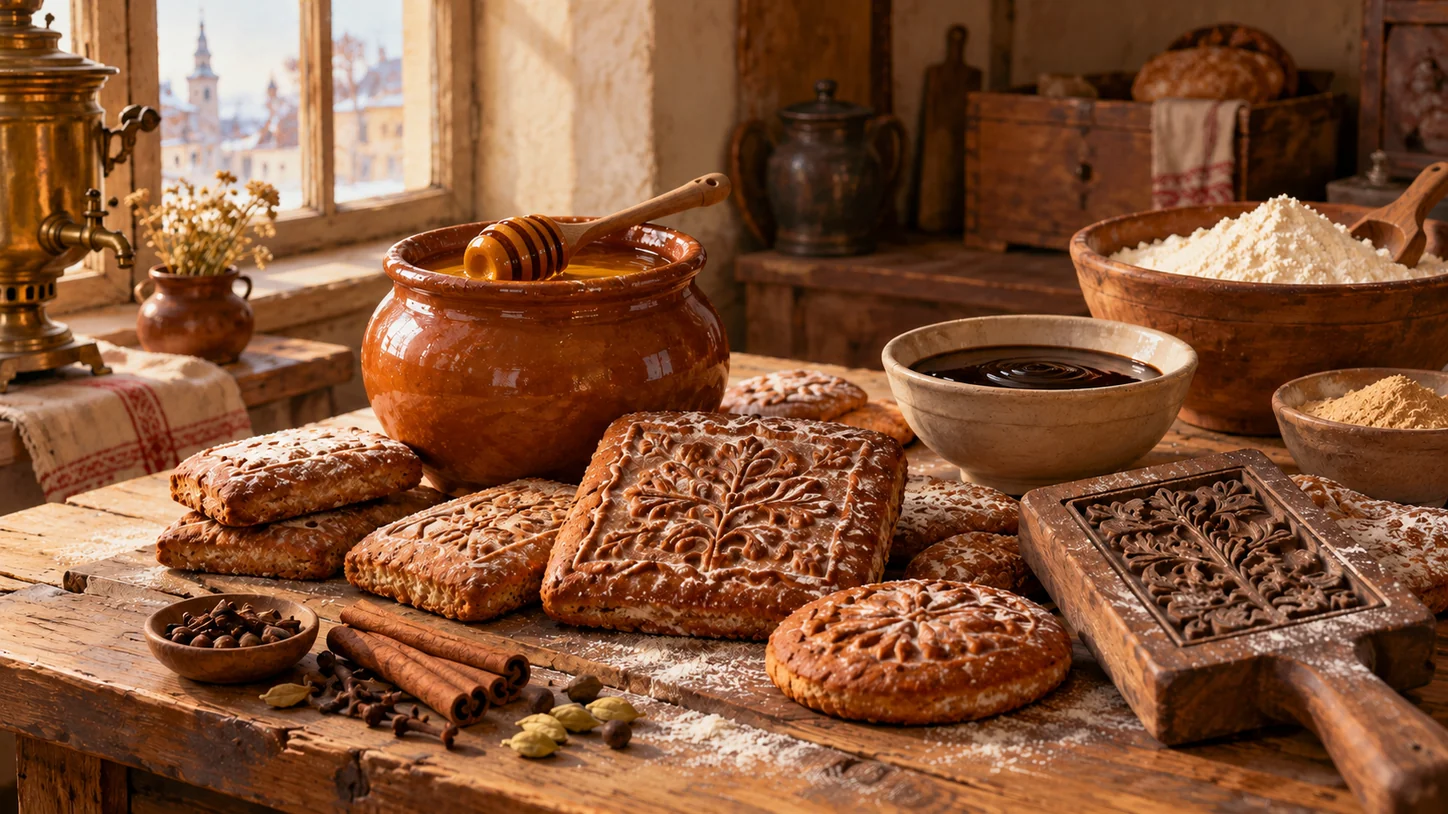
Honey, sugar and patoka were not interchangeable
Bee honey, granulated sugar and patoka differ in consistency, composition and behavior in dough. In honey gingerbread No. 3242 honey is beaten before the dough is assembled; in sugar gingerbread No. 3229 sugar is worked with eggs; and in patoka gingerbread No. 3232 thick syrup enters a spiced dough. These are distinct techniques, though their names cannot identify the manufacturer of the ingredients.
Twenty-three gingerbread recipes, many approaches
Section XLI, “Pryaniki,” contains 23 recipes. Their titles refer to rye and granular wheat flour, rosewater, chocolate, Toruń-style cakes, honey, sugar, syrup and berries. Preparation and decoration vary. Looking for one “authentic Russian gingerbread” across this section would be misleading.
In No. 3222, hot honey and spices are used to scald rye flour. No. 3229 combines eggs, sugar and granular wheat flour. No. 3232 uses patoka and potash. Potash was a historical substance used in certain doughs, but the old procedure should not be adopted in contemporary home baking without carefully verified food-grade ingredients and safe methods.
Some cakes were small, everyday pastries, while others could function as decorated festive objects. The presence of a recipe is not a measure of how frequently households of different means actually baked it.
Honey gingerbread: long beating
In No. 3242, “Honey Pryaniki,” Molokhovets calls for boiling two Russian pounds of honey, allowing it to cool and beating it with a wooden paddle for at least three-quarters of an hour. Flour, egg yolks, almonds and lemon zest follow, with whipped whites added closer to baking.
Another preparation, No. 3230, includes cardamom, cinnamon, almonds and many eggs. No. 3231 is titled “Pryaniki Without Spices,” though it too is based on honey. Honey was not merely a sweetener sprinkled into ordinary dough: the original recipes gave it a central structural role and special handling. These timings, however, are period practice, not independently verified modern cooking standards.
What did patoka mean around 1900?
Recipe No. 3232 uses three Russian pounds of patoka and one pound of sugar. No. 3233 uses five pounds of patoka and one and a half pounds of sugar. Here the syrup is a major component of the dough, not a coloring added by the spoonful.
The word patoka cannot automatically be translated as one specific modern supermarket syrup. The Brockhaus and Efron encyclopedic account describes concentrated sweet syrups produced by sugar refining or by converting starch. “Black patoka” could also refer to molasses, a by-product of sugar production. The recipe itself does not specify a factory, chemical composition or exact source for a purchased batch.
We can therefore describe patoka's role and physical form, but cannot assert that Molokhovets always meant starch glucose syrup or always meant beet molasses.
Industrial syrup making in the nineteenth century
The historical account of the Russian starch producers' association connects early industrial glucose-syrup manufacture to Konstantin Kirchhoff's 1811 discovery that acid could convert starch into glucose. During the nineteenth century, starch syrups became a separate branch of food processing.
This does not imply that every homemade pryanik was baked with the same factory-made syrup. Rather, it indicates a changing range of sweet products available by 1901. Our history of sugar manufacturing and sugarloaves explores a related industrial transformation. Patoka belonged to a distinct technical history that cannot be reduced to “melted sugar.”
Why would a baker need a carved wooden board?
Not all of Molokhovets' pryaniki required carving or molds. In professional gingerbread-making, however, a carved board could impress a raised design on the dough. The State Russian Museum holds a composite gingerbread board from the first half of the nineteenth century, ornamented with birds, fish and flowers.
The museum explains a festive practice in which a large relief-decorated gingerbread could be divided into pieces and distributed to guests when a gathering ended. Such cakes were sometimes known as razgonnye, or dismissal gingerbreads. This is evidence associated with a museum object, not a property of every honey cake in Molokhovets.
The Tula Gingerbread Museum also preserves molds, documents and photographs concerning the confectioners' craft around the nineteenth and early twentieth centuries. Domestic recipes and urban craft traditions can illuminate one another without being collapsed into a single production technique.
Stars, horses and cakes for the Christmas tree
No. 3233, another patoka gingerbread recipe, suggests cutting the dough into stars, horses, cockerels and deer. Finished pieces might be decorated with white icing if intended for the Christmas tree. This is a direct reference to festive uses of gingerbread in the 1901 source.
Other recipes in the same section call for plain pieces, rolled balls or dough baked in paper cases. Decorated festive gingerbread existed alongside simpler household baking. An ornate mold cannot by itself tell us how widespread elaborate decoration was among Russian families.
“Honey” did not always mean a bee product
An unexpected title appears in Section XLVI, which covers kvass, beer and mead: No. 3552, “Sugar Honey.” Its starting ingredients are water and sugar, followed by fermentation; bee honey is not specified at the outset. By contrast, No. 3553, “Excellent Honey,” explicitly uses bee honey.
In that section, the Russian word med can designate a prepared fermented drink, not only honey as produced by bees. The historical distinction is easy to lose if a catalogue automatically treats every “honey” title as an ingredient. Old fermentation instructions are included for terminological history and should not be taken as safe modern methods.
Similar sweetness, different chemistry and methods
Bee honey is a product of beekeeping; granulated sugar is crystallized sucrose; and patoka is a thick syrup that historically could have different production origins. Similar sweetness does not make them technologically identical. Moisture, viscosity, composition of sugars and interactions with flour influence dough.
Molokhovets specifies different ratios for different cakes. We cannot assume replacing honey with patoka one-for-one would reproduce their texture and taste. Nor does one household recipe establish a national level of consumption. Comparing the price of a pound of honey with a finished cake would require accounting for flour, spices, fuel, labor and baked weight, as our study of historical family budgets also emphasizes.
Food, gift and commercial product
A pryanik might represent the work of a beekeeper, flour miller, syrup manufacturer, spice merchant, woodcarver and baker. Historical evidence for each link comes from different kinds of documents, not a single evocative picture.
The bread could be food, a marketed product, a gift or a festive decoration. Museum boards and the Christmas-tree figures in No. 3233 support the claim that such customs existed, while recipes with honey, sugar and patoka show diversity in food preparation.
What the evidence still cannot establish
The cookbook has no complete provincial statistics for honey, patoka or gingerbread sales. A museum description does not reveal the private recipe of a board's first owner. An encyclopedia explains categories of syrup production, but not the exact chemical composition of the patoka in Molokhovets' recipe No. 3232.
Household accounts, trade price lists, confectioners' records and supply documents would be needed to reconstruct patterns of consumption. Distinguishing evidence, interpretation and gaps is a central part of a trustworthy historical library.
Read the source material
Recipes: honey gingerbread No. 3242, spiced honey gingerbread No. 3230, sugar gingerbread No. 3229, patoka gingerbread No. 3232, and shaped patoka cakes No. 3233. Related English research: sugar production, flour and mills and spices.