From Forest Gathering to the City Market: Mushrooms in Russia around 1901
Mushroom gathering in Kargopol and Sudislavl, trade in dried porcini and saffron milk caps, adulteration and preserves in Molokhovets's 1901 book.
In 1901 a householder might buy dried porcini for sauce, salted saffron milk caps for an appetizer or fresh porcini for a pie. Between the forest and the kitchen lay a trading chain: gathering, village drying, buyers, sorting, winter shipments and city markets. Mushrooms commanded different prices and expensive grades were even adulterated. Historical accounts of gathering alongside Molokhovets's cookbook show how a forest product became a winter reserve and a versatile ingredient.
Do not confuse household guidance with trade statistics. Section LI contains preservation recipes ranging from salted saffron milk caps to porcini powder. Historical accounts collected by Yevgeny Zhirnov and the St. Petersburg chronicler Anatoly Bakhtiarov describe production, grades and prices. They concern different places and years; recipes cannot establish uniform purchasing or preparation across Russia.
People gathered mushrooms for more than their own tables
Forest gathering could provide peasants with cash earnings. An excerpt from Anatoly Bakhtiarov's Belly of Petersburg describes mushroom gathering among the occupations of inhabitants of Shlisselburg district. In rainy years gathering mushrooms and milk caps began in the second half of August, with people carrying baskets along country roads to the forest.
This income had constraints. The same account mentions renting rights to gather mushrooms and berries in particular forests: access could be paid for in money or a certain number of working days. This differs considerably from the idea that anyone could simply enter any forest.
Gatherer, buyer and shopkeeper received different shares of income. Abundance could lower autumn prices and a poor harvest raise them, but figures for one district do not establish a Russian-wide rate.
Sudislavl, Kargopol and the Yaroslavl cap
Ethnographer Sergei Maksimov wrote about mushroom trading in Kostroma province in 1871. In the Kommersant historical account, Sudislavl was a recognized centre for buying and selling dried porcini; high-quality Sudislavl mushrooms competed with the Yaroslavl cap from Poshekhonye district. Kargopol in Olonets province was renowned for saffron milk caps.
According to the same study, by the late nineteenth century up to five thousand poods of saffron milk caps were shipped annually from Kargopol district. Buyers purchased them by grade and shipped them to destinations including St. Petersburg. Mushrooms became a product with regional names and different prices, not an undifferentiated forest harvest.
Up to five thousand poods is an estimate for one district and period, not a constant quantity for every season. Weather affected harvests, so the figure is not an exact annual shipment schedule.
How dried mushrooms reached the St. Petersburg customer
Fresh mushrooms had to be used promptly or processed. Drying and salting allowed long-distance transport and sale after the season. Kargopol saffron milk caps and different grades of dried porcini reached St. Petersburg.
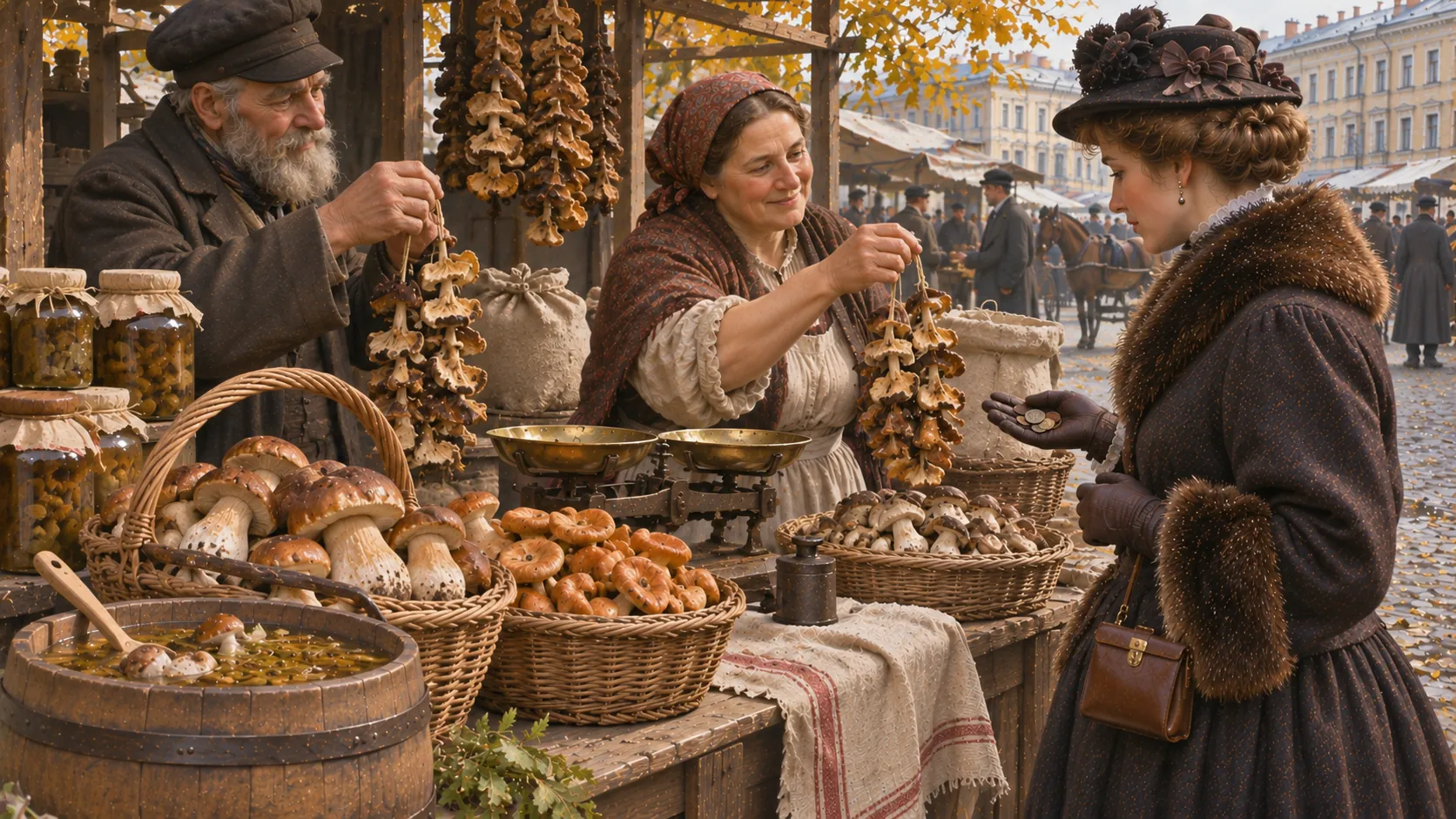
A surviving publication of an 1893 photograph of the city's mushroom market from Nasha Pishcha shows large strings of dried mushrooms and traders near open stalls. This authentic evidence does not establish prices or trace an individual consignment.
Goods could reach urban wholesalers and shopkeepers. The related study of vegetable trade examines St. Petersburg retail arrangements, but mushroom supply routes must be established independently rather than copied from another product.
Drying mushrooms: household technique and commercial grade
In No. 3932, Molokhovets describes thinly sliced porcini dried in the sun or oven. No. 3933 separates caps and stems, strings them separately and dries them. These are different ways of preparing ingredients later used in soups, sauces and fillings.
Drying was also an industry. A 1910 account by village teacher Vasily Royev, cited in the historical study, describes special drying buildings called obabochnitsy in Kargopol district. This evidence postdates 1901; it illuminates regional practice but does not establish exactly the same conditions nine years earlier.
Drying reduced bulk while preserving mushroom flavour for stock. No. 3939 describes powder made from dried porcini to flavour broth and sauce.
Perenizka: adulteration of expensive porcini
The market distinguished expensive grades of porcini from cheaper mushrooms or stems. Bakhtiarov describes perenizka, a deceptive stringing practice in which cheaper and more valuable pieces were mixed to appear homogeneous.
A historical survey of adulteration explains the importance of cap shape, underside colour and a grade's reputation to buyers. Consumers were purchasing a product with quality, origin and price, not just dried mushrooms. This evidence does not establish that deception was universal or that every inexpensive string was adulterated.
Saffron milk caps and milk mushrooms in tubs
No. 3923 describes salted saffron milk caps arranged in layers under a weight. No. 3946 for salted milk mushrooms and woolly milk caps calls for preliminary soaking with water changes. The differences are visible in the original texts and should not be merged into one modern preservation method.
No. 3928 selects very small saffron milk caps that fit through a bottle neck, showing the role of size in storage and serving. Selected small mushrooms were valued separately from larger ones.
Historical salt and vinegar quantities, sealing methods and storage claims do not guarantee modern safety. Old preservation techniques for wild mushrooms must not be repeated at home without validated methods.
Why mushrooms mattered in soups, sauces and pies
No. 713, a sauce of dried porcini, uses both the rehydrated mushrooms and their stock, which can also contribute to borscht, shchi or soup. This illustrates economical organization. In shchi No. 162 mushrooms provide the stock; in No. 2394 fresh porcini fill little pies; No. 2475 offers cooked dried mushrooms as an appetizer. Even vinegret No. 2609 combines salted milk mushrooms, saffron milk caps and boiled porcini.
The same forest product thus appears in fresh, salted and dried forms in several parts of a meal.
Mushroom trading differed between Moscow and St. Petersburg
Moscow had a famous seasonal mushroom market. Accounts collected by Vera Bokova describe dried, salted and pickled mushrooms sold from barrels and tubs, including strings of dried mushrooms.
That Moscow market must not be presented as a St. Petersburg market. Separate northern supply evidence, commercial grades and the 1893 photograph concern St. Petersburg. Together they show the importance of preservation without proving identical arrangements.
Demand associated with fasting days helps explain seasonal sales but cannot establish each buyer's habits. Geography, income and access varied.
What the evidence establishes
At the turn of the twentieth century mushrooms were gathered both for households and as a commercial product. Regional centres, named grades, intermediaries, quality distinctions and adulteration existed. Molokhovets shows how varied processing methods met kitchen needs.
Accounts of particular places do not constitute complete Russian statistics for 1901. Later figures cannot be projected backward without qualification, and recipes do not confirm modern safety.
A string of dried porcini or a tub of saffron milk caps on the market concealed a chain of rural labour and trade that continued in the saucepan, frying pan and pie.
Original recipes and historical sources
Elena Molokhovets, A Gift to Young Housewives, 1901 edition. Original source links are retained below.
- Section LI: Preserves (in Russian)
- Yevgeny Zhirnov: historical mushroom gathering and trade (2022)
- Anatoly Bakhtiarov, Belly of Petersburg: mushroom gathering
- Historical photograph of the St. Petersburg mushroom market (1893)
- No. 3932 — Dried Porcini Mushrooms · Russian original
- No. 3933 — Dried Porcini Mushrooms, Another Method · Russian original
- No. 3939 — Porcini Mushroom Powder · Russian original
- Historical account of mushroom adulteration
- No. 3923 — Salted Saffron Milk Cap Mushrooms · Russian original
- No. 3946 — Salted Milk Caps and Woolly Milk Caps · Russian original
- No. 3928 — Pickled Saffron Milk Caps in Bottles · Russian original
- No. 713 — A Very Tasty Sauce of Dried Porcini · Russian original
- No. 162 — Shchi with Mushrooms · Russian original
- No. 2394 — Small Pies with Fresh Mushrooms · Russian original
- No. 2475 — Fried Dried Porcini as an Appetizer · Russian original
- No. 2609 — Vinaigrette of Salted Milk Caps, Saffron Milk Caps and Porcini · Russian original
- Vera Bokova, Everyday Life in Nineteenth-Century Moscow
- Mushrooms in Traditional Russian Cooking · Russian original
Related reading
Historical mushroom preservation is not modern safety guidance. Never eat wild mushrooms without reliable identification. The 1901 salting, pickling, drying and oil-storage methods do not guarantee protection from toxins or harmful microorganisms. Use validated identification, processing and storage guidance rather than historical times and quantities.