From Buckwheat Field to City Stall: Porridge and Grechneviki around 1901
How buckwheat was grown and processed, what whole and fine groats meant, what Molokhovets cooked and what Moscow grechneviki were.
Buckwheat porridge is easy to picture on a domestic table. Around 1901 buckwheat had several lives: it was grown, hulled in groat mills, sold as groats and flour, then turned into crumbly porridge, pancakes, pie filling or hot street food. Molokhovets describes many preparations. Historical evidence about trade and Moscow grechneviki shows what lies beyond the recipes.
The sources differ: recipes show kitchen techniques, pre-revolutionary statistics show production and trade, and descriptions of grechneviki concern primarily Moscow street trading. Without separate evidence they should not be presented as established St. Petersburg customs.
Buckwheat is not simply another cereal
Buckwheat belongs to the knotweed family rather than the grasses; seeds provide groats and flour. The modern Great Russian Encyclopedia describes it as a groat and honey-producing crop. Culinary groats therefore include products from different plant families.
A historical essay in Nauka i Zhizn notes buckwheat's association with Russian cuisine although its acreage was not comparable with the principal cereal crops. The 1913 figures cited there show much smaller harvests than rye, wheat and oats. These are 1913 statistics, not exact 1901 yields.
Culinary prominence and agricultural share are different measures. Liking buckwheat porridge does not prove that buckwheat was the most widely planted crop.
From seed to whole groats: what the groat mill did
Seeds are hulled and sometimes heated, crushed or sifted. No. 3602, Scalded Buckwheat Groats, describes treating buckwheat with boiling water, heating, drying and processing the grain. It concerns obtaining an ingredient, not cooking porridge.
Brockhaus and Efron's industrial account separately records groat mills: their recorded number rose from 245 in 1880 to 351 in 1896. These figures cover enterprises of the stated category, not every household processing method.
A householder purchased a product with a particular degree of cleaning and crushing, on which cooking method and consistency depended.
Whole groats, fine groats and flour
No. 378, Firm Crumbly Buckwheat Porridge, explicitly calls coarse whole groats yadritsa. They are sifted and steamed in a pot to produce a crumbly dish. No. 1757 uses fine groats for thin porridge; No. 1769, lemeshka, uses buckwheat flour.
Whole kernels, small groats and flour behave differently in water, affecting texture and cooking. The study of Smolensk groats and green rye discusses historical names in greater detail; here the focus is the path from buckwheat to market and everyday table.
Could buckwheat groats be exported?
Yes, although their exports should not be confused with the scale of cereal grain shipments. Brockhaus and Efron's industry and trade section records approximately 680,000 poods of buckwheat groats exported in 1897 and about 163,000 in 1898.
These adjacent values differ sharply. They establish export trade and its possible fluctuations, not a normal annual volume. Exports of processed groats are not identical to the harvest or consumption in particular provinces.
Processing, storage and transport connected growers to the city kitchen. Exact prices in a particular St. Petersburg shop would require its accounts.
Buckwheat porridge as a dish and an accompaniment
No. 1762 describes firm steamed buckwheat porridge, No. 1765 additions, and No. 1766 Parmesan added to buckwheat. Old buckwheat was not always simple porridge in water.
In No. 1165 porridge fills baked bream; No. 2395 makes it part of a mushroom pie filling. The same ingredient serves several roles across the cookbook. The variety does not establish equal frequency on most urban tables; cheese or generous quantities of butter could change cost considerably.
Moscow grechneviki: porridge to take away
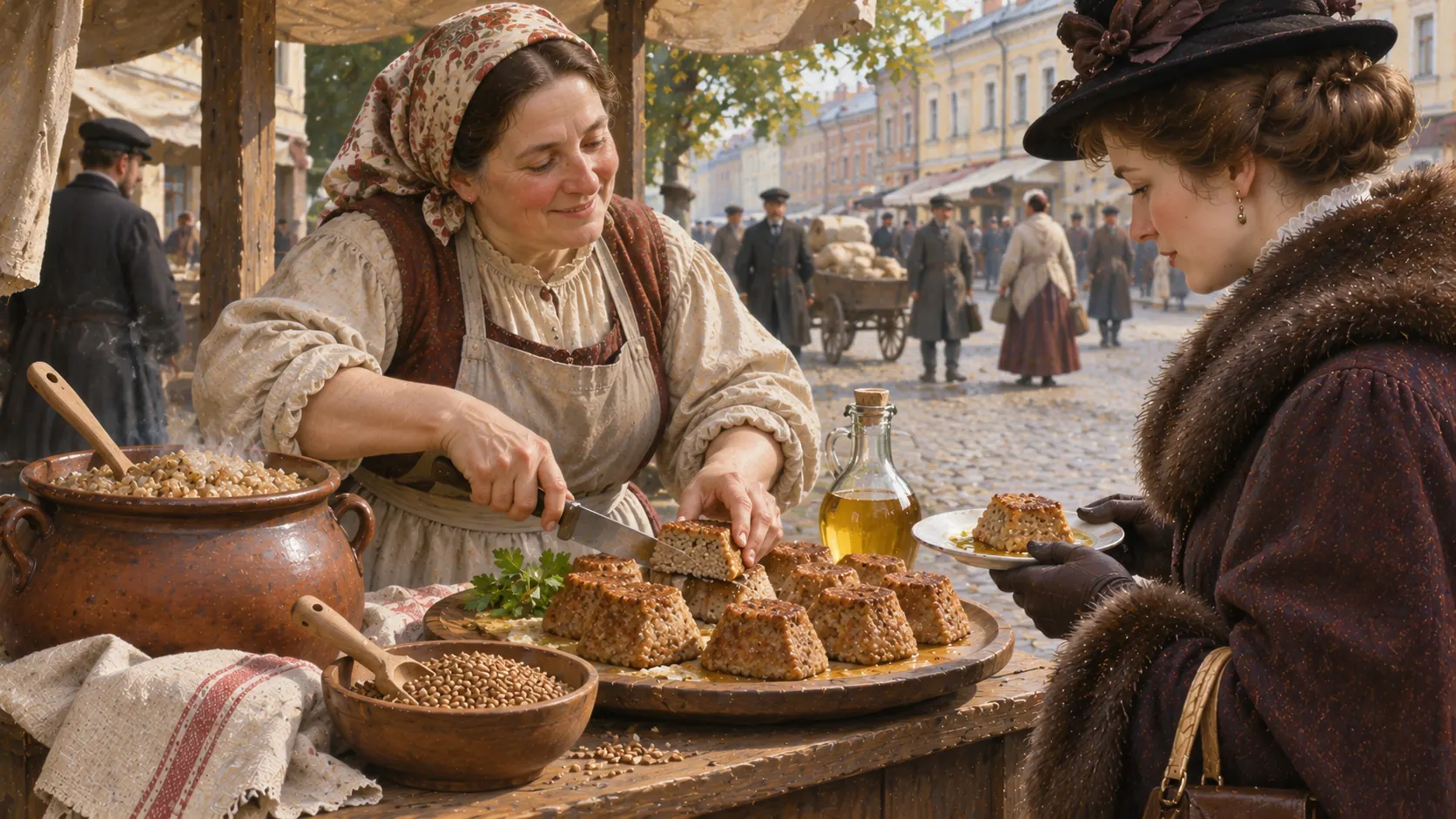
A Kommersant historical survey quotes Ivan Belousov's recollection of nineteenth-century Moscow grechneviki: fried columns of buckwheat mixture cut lengthwise by the seller, dressed with vegetable oil and sprinkled with salt. Vera Bokova likewise describes grechneviki or greshniki as small hot preparations made from buckwheat dough.
This is evidence of Moscow street food, not a separate Molokhovets recipe. No. 2359 describes cooked fine buckwheat groats spread out, cooled, cut and fried in vegetable oil. Its technique is comparable, but does not establish an identical formula for the street product.
Buckwheat pancakes, croutons and pies
No. 1654 uses buckwheat flour alone for pancakes; No. 1656 mixes it with wheat flour. The same seeds yield flour, but the batters differ.
No. 1760 cools and fries porridge as croutons served with borscht and shchi. The groats become a separate soup accompaniment rather than a bowl of porridge.
No. 1400, Pie with Firm Buckwheat Porridge, connects the ingredient to the historical pastry tradition discussed in the related study.
What these sources reveal and where their limits lie
Molokhovets shows whole groats, fine groats and buckwheat flour in specific dishes. Encyclopedia records confirm groat-processing enterprises and exports; Moscow recollections describe one street food.
They cannot establish average peasant consumption, identify grechneviki as Russia's most common street food or prove that St. Petersburg sold them in 1901 exactly as Moscow did in Belousov's recollection.
The differences between field, mill, domestic porridge and street stall reveal a richer history than declaring one dish a universal symbol of the past.
Original recipes and historical sources
Elena Molokhovets, A Gift to Young Housewives, 1901 edition. Original source links are retained below.
- Great Russian Encyclopedia: buckwheat
- Nauka i Zhizn: the history of buckwheat
- No. 3602 — Parboiled Buckwheat Groats · Russian original
- Brockhaus and Efron, Russia: Industry and Trade
- No. 378 — Firm, Fluffy Buckwheat Porridge for Shchi and Borscht · Russian original
- No. 1757 — Thin Fine-Buckwheat Porridge · Russian original
- No. 1769 — Lemeshka: Porridge from Buckwheat Flour · Russian original
- No. 1762 — Steamed Firm Buckwheat Porridge · Russian original
- No. 1765 — Firm Buckwheat Porridge with Assorted Additions · Russian original
- No. 1766 — Fluffy Buckwheat Porridge with Parmesan · Russian original
- No. 1165 — Bream Baked with Buckwheat Kasha · Russian original
- No. 2395 — Small Pies with Firm Buckwheat and Mushrooms · Russian original
- Kommersant: historical groat trade and grechneviki
- Vera Bokova, Everyday Life in Nineteenth-Century Moscow
- No. 2359 — Fried Fine Buckwheat Kasha · Russian original
- No. 1654 — Pure Buckwheat Bliny · Russian original
- No. 1656 — Buckwheat and Wheat Bliny · Russian original
- No. 1760 — Buckwheat-Groat Croutons for Borscht or Shchi · Russian original
- No. 1400 — Pie with Firm Buckwheat Kasha · Russian original
- Culture.ru: the history of street food
Related reading
Historical recipes are material for study. Old measures, heating and storage methods are not exact modern technical instructions. Preparation and storage must follow current food-safety rules.