Fish Pies, Kulebyaka and Pastry Pâtés in 1901
Historic fish pies, filled pastries, kurnik and salmon pâtés as documented in Molokhovets.
Small pies served with broth, a tall chicken kurnik, fish kulebyaka and a cold pâté baked in a pastry case all appear in Elena Molokhovets' 1901 cookbook. Modern readers may picture a soft spread when they hear “pâté,” or a modest filled pastry when they hear “pie.” In this source, however, the names cover foods of different size, construction and place within dinner. The fish versions are especially revealing: their fillings could contain fish, rice, dried mushrooms and viziga, the prepared notochord of sturgeon.
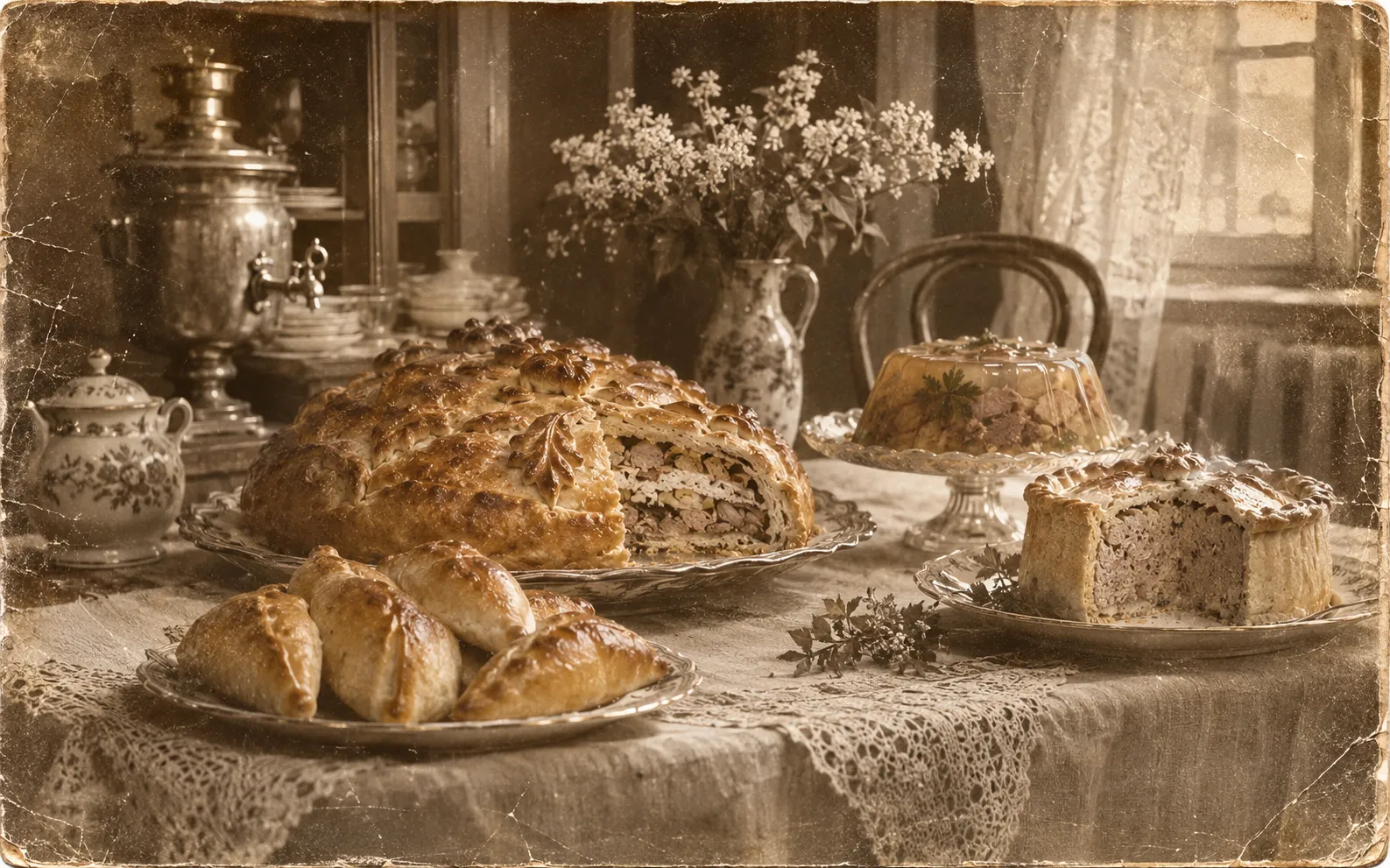
Three sections and several different kinds of food
Section IV, “Accompaniments to Soup,” includes small pastries. Section XI, “Pies and Pâtés,” covers larger baked foods and hot or cold pâtés. The October dinner register for Classes II–III indicates where particular pastries might fit into a proposed meal. These sample menus are not a census of what everyone ate in Russia.
Little pies belonged beside the soup
The first October dinner for Classes II–III offers clear red broth with puff-pastry pies, Nos. 322–330. Neighboring examples include shchi with small cheesecakes and broth accompanied by filled rolls. Pastry was therefore not always dessert or an independent main course; it could be part of the service of a first course.
Section IV describes baking, frying and preparing filled rolls or pancakes. In No. 333, “Little Pies Filled with Beef,” previously cooked beef from the stock is chopped and combined with onion, eggs and dill. One dinner might thus join stock-making to a second preparation that made use of the cooked meat. The text documents a possibility, not a requirement that every broth was served with pies.
What the October menu actually demonstrates
In the same proposed dinner, the first course is followed by fish mayonnaise, pudding from leftover game, roast partridges and a sweet airy pie. The savory little pies belong beside the broth; the sweet pie comes later. This single example illustrates different roles for similarly named baked foods.
Molokhovets arranged sample dinners by class, cost and number of dishes. This fairly elaborate meal should not be called the ordinary daily dinner of a representative Russian family. Our study of four dinner classes explains why these registers must be read as suggestions rather than household statistics.
A large pie required a different organization of work
At the start of Section XI, Molokhovets discusses the shape of large pies, dough, cooked fillings, sealing the edges and venting steam. Possible fillings include fresh or lightly salted fish, rice, cereals, cabbage, mushrooms, carrots and buckwheat. Some recipes put thin fried pancakes between pastry and filling to keep the lower crust from becoming damp.
That last technique should not be generalized to every historic Russian pie. Specific recipes differ. A fish kulebyaka could involve several separately prepared ingredients; little pies for broth were made on a different scale.
Fish kulebyaka and the curious ingredient viziga
No. 1386, “Kulebyaka with Fish,” brings fish together with a specially prepared grain filling. No. 1395, “Pie with Mushrooms and Viziga,” combines rice and dried mushrooms with a separately treated product from sturgeon.
Viziga was not ordinary fish meat or a type of noodle. It was obtained from the cartilaginous axial structure of sturgeons, processed for storage and later used in cooking. Our English research on viziga and fish pies explores its preparation and meaning in the source. A recipe using stored viziga thus connects the baker to an earlier chain of fishing, processing and trade.
Two kurniks within the same cookbook
The famous kurnik is not represented by one exclusive formula. No. 1390 combines chicken, rice, mushrooms and eggs; No. 1391 instead uses small buckwheat groats and greens. Their tall shape and several components are related, but the fillings and their arrangement differ.
The lesson extends to fish pies: a recognizable name does not prove an identical internal structure. The original recipes matter more than a modern illustration of one hypothetical “authentic” pie.
Why a pâté might not be spread on bread
Today pâté often means a smooth paste made from liver, meat or fish. Molokhovets' Section XI, however, distinguishes closed hot pâtés and open cold pâtés constructed with pastry. No. 1402 describes lining a mold with dough, adding a filling of meat or game and covering the whole with a decorative pastry lid. This is a substantial baked dish, not merely a spread.
No. 1401 describes a different form for open cold pâtés. No. 1408 gives rye-and-wheat dough for such a case, while No. 1403 places a filling directly on a dish before covering it with dough. The word therefore includes a range of forms in this particular chapter.
Salmon pâté: a fish dish enclosed in pastry
No. 1436, “Hot Pâté from Salmon and Other Fish,” incorporates a fish forcemeat and pieces of salmon, covers them with dough and suggests serving a separate sauce. The combination resembles a formed main course rather than today's familiar container of refrigerated pâté.
Meat variants included hot hare pâté No. 1424, which combined forcemeat, pieces of game and sometimes truffles. The division between “hot” and “cold” could involve preparation, pastry construction and service as well as the temperature of the final dish.
The traveling pâté and the limits of historic storage
No. 1431, “Cold Pâté for Travel,” links its preparation to consumption away from home. Ingredients include game, liver and spices, enclosed in dough. This shows the domestic intention to prepare portable food, but cannot be used as a current recommendation for carrying meat without controlled refrigeration.
A nineteenth-century cook's confidence in a storage method does not provide today's microbiological evidence. Fish and meat fillings, prepared stock and pastry cases all require modern safe handling.
What the sources can and cannot establish
The recipes demonstrate diverse forms of pastry, practical sequences of work and different uses at dinner. The sample menu shows one possible course order. They cannot tell us how frequently workers or peasants ate kulebyaka, the number of pastry pies sold per city resident or how pâtés varied across all Russian provinces.
For that we would need shop accounts, letters, regional descriptions and household records. The reliable finding is narrower and more valuable: in 1901 a little pie beside soup, a substantial fish kulebyaka, a decorative salmon pâté and a sweet concluding pie were distinct culinary objects with overlapping names.
Open the primary sources
Compare little beef pies No. 333, fish kulebyaka No. 1386, mushrooms and viziga No. 1395, and travel pâté No. 1431. Related research: the urban bread trade and cold fish dishes.