What Was Viziga? A Forgotten Ingredient in Russian Fish Pies
A historical investigation into viziga, the dried notochord of sturgeon, and how it was prepared for pies, fillings and other dishes in 1901.
An ingredient frequently mentioned in old Russian fish pies is almost unknown to many readers today: viziga (also spelled vyaziga). In Elena Molokhovets' cookbook it is soaked, simmered for a long time, chopped, and combined with rice, semolina, or fish. What was it, and why was it prized as a pie filling?
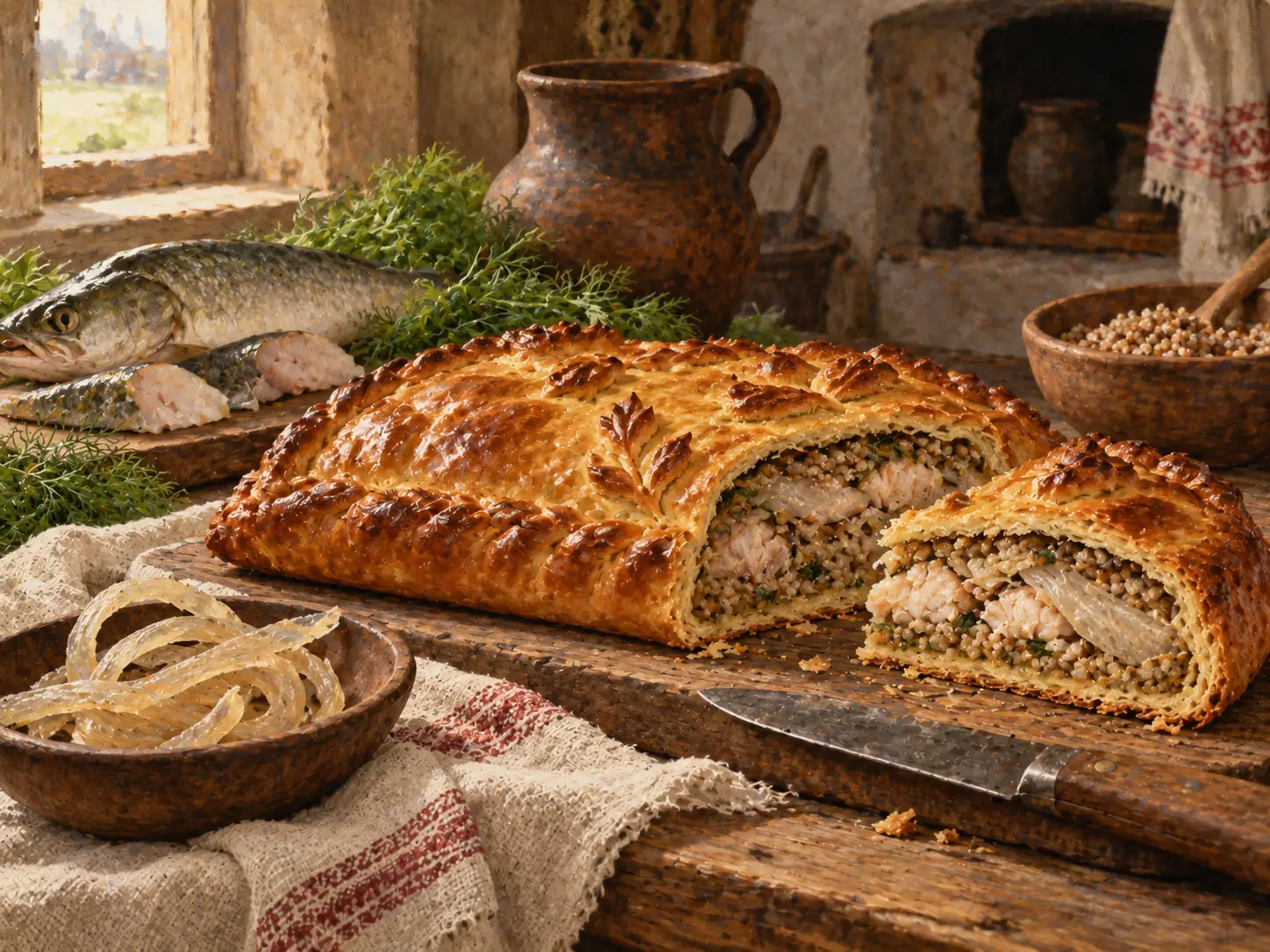
Viziga was not a fish bone
Viziga is the edible notochord of a sturgeon: a resilient cord running along the animal's body. It is neither the spinal cord nor an ordinary fish bone. Sturgeons, unlike most familiar adult bony fishes, retain this structure throughout life. The Brockhaus and Efron Encyclopedic Dictionary entry “Vyaziga” (1892) described the firm cord for readers of the late nineteenth century.
The distinction matters in a kitchen. The notochord was removed and dried; before use, the dried product was soaked and cooked until it became soft and gelatinous, then chopped for filling. It was not an interchangeable substitute for all fish flesh. In recipes it appeared alongside grain, herbs, and sometimes slices of actual fish.
From a sturgeon to a stored ingredient
Molokhovets includes a short independent entry, recipe No. 4056, “Sturgeon Viziga”. She describes extracting the cord-like material from the fish, cleaning it, and hanging it out to dry. At one stage it is wound much like a skein of thread before being finished over the stove.
This is not a recipe for an immediate dinner. It is a record of preparing an ingredient for later use. The string used for drying, the stove as a heat source, and the practice of preserving parts of a valuable fish are details of domestic material culture.
An account of Russian fish cooking published by the Russian Federation's UNESCO Commission also describes cooking and chopping dried sturgeon notochord for pies and kulebyaka. This does not mean that every traditional fish pie contained viziga: the original cookbook itself supplies exceptions.
A fish pie with viziga and rice
The clearest example is recipe No. 2370. Molokhovets calls for soaking the viziga from the previous evening, washing it the next day, and cooking it with root vegetables and seasonings until tender and translucent. Only then is it finely chopped. Rice is cooked separately and combined with herbs, onion, and butter.
Inside the pastry is more than one homogeneous filling: part of the rice-and-viziga mixture forms a layer, followed by thin slices of fish—pike, pike-perch, bream, sturgeon, or another fish named by the author—and then the remaining mixture. Viziga therefore accompanies fish rather than replacing it.
Reading the recipe closely reveals the sequence of work and the distinct properties of each ingredient. That is information easily lost when such a dish is reduced to the modern label “fish pie.”
Different fillings and different dishes
In recipe No. 1381, semolina takes the place of rice, together with cooked and chopped viziga, eggs, herbs, and fish. The ingredient was not tied to any single cereal. Recipe No. 2389 moves the combination of rice and viziga into small individual pastries.
More unexpectedly, in recipe No. 1266 viziga is mixed with rice and eggs to stuff a whole baked pike-perch. Its function was not limited to pastry. Yet Molokhovets' “Fish Kulebyaka,” No. 1386, uses pike-perch, sturgeon, salmon and Smolensk groats without viziga. The claim that viziga was required in every Russian fish kulebyaka would therefore be false.
What a forgotten product can tell us
The story of viziga gives us a narrow but revealing glimpse of household economy. Sturgeon supplied more than flesh for an immediate meal: other parts could be processed, preserved, and turned into a later dish. Molokhovets also recorded the making of sturgeon glue, another example of the many products derived from fish.
That observation must not become a romantic myth of a past in which nothing was ever wasted. A handful of recipes documents practices found in this particular book, not the habits of every household in the Russian Empire. What we can say is that the cookbook preserves techniques and ingredients that are now unfamiliar to many readers.
Viziga is therefore interesting not only because it was put into pies. It shows the labor involved in processing a fish, the logic of storing ingredients for later meals, and the way a seemingly minor part of an animal could become a separate culinary product.
Open the original recipes
Further examples: small pastries No. 2389; stuffed pike-perch No. 1266; and fish kulebyaka without viziga, No. 1386.
Sources and further reading
The central evidence is Molokhovets' A Gift to Young Housewives, 1901, recipes cited above. Additional background comes from the Brockhaus and Efron entry on viziga (1892) and a Russian Federation UNESCO Commission article on fish cuisine. For related topics, see the Russian studies of rice and its trade and pies and pastries at the dinner table.