Smolensk Groats and Green Rye: Forgotten Porridges of 1901
A historical study of Smolensk groats, porridges cut for soup, green rye, sweet pudding and the cookbook’s textual ambiguities.
Today buckwheat porridge is often imagined as a simple side dish made from whole or broken groats. Elena Molokhovets' 1901 cookbook offers a more varied picture. Smolensk groats appear with game, in the filling of a fish kulebyaka, in a sweet pudding and even cut into small cubes to accompany broth. Nearby is a method for preparing porridge from rye before the grain has fully ripened. These examples show how differently households could work with cereals.
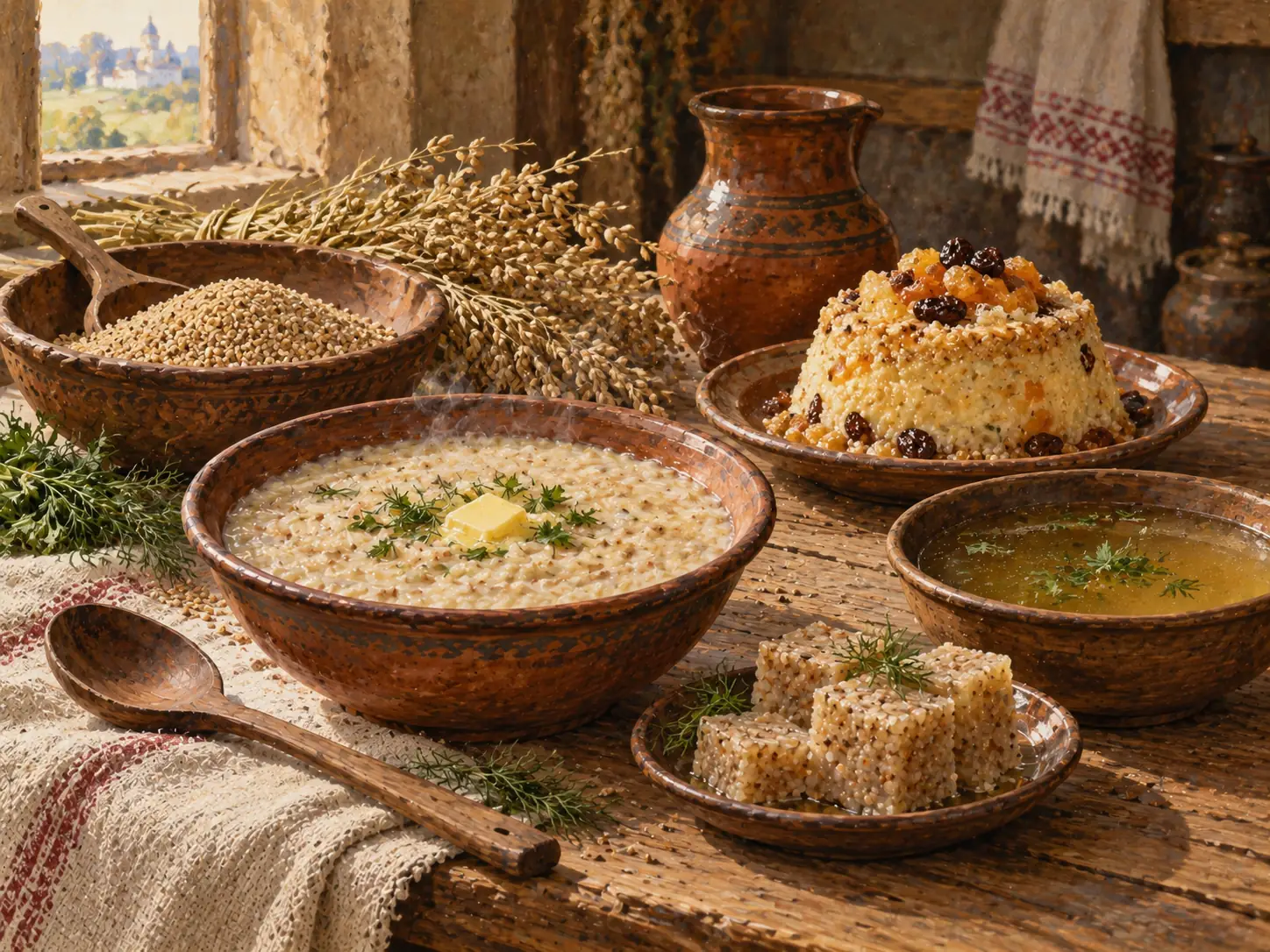
Smolensk groats were a particular kind of buckwheat
The name referred to small, carefully processed buckwheat groats, not a separate cereal called “Smolensk.” Nineteenth-century descriptions distinguish them by size, cleaning and preparation. For Molokhovets, that difference mattered: the form of the grain could determine what dish it was suitable for.
What were Smolensk groats?
Historical accounts connect Smolensk groats with Smolensk Governorate and a distinctive way of processing buckwheat. The finished product was exceptionally small and pale. A historical article in Kommersant cites nineteenth-century accounts of the local trade and the use of these groats in more than ordinary porridge.
Calling them simply the same as today's crushed buckwheat is not entirely accurate. Modern broken groats are produced by fragmenting kernels, whereas the historical Smolensk product underwent particular cleaning and processing. Its fine structure influenced the cooked result. We also cannot promise that any modern substitute reproduces the exact properties of every batch sold in 1901.
The clearest way to understand this ingredient is through the recipes: it can be a component served beside soup, mixed with poultry or fish, or made into dessert.
Porridge could be served alongside broth
In No. 381, “Porridge from Smolensk Groats,” the cooked grain is placed on a dish and cooled under a weight. The resulting firm layer is cut into neat cubes and served separately with clear broth. Rather than a spoonful of soft porridge in a bowl, it becomes small, carefully formed pieces accompanying a first course.
There is a related idea in No. 1756, “Croutons from Smolensk Groats for Borscht, Shchi, etc.” The porridge is chilled, cut and then fried in butter on both sides before serving. The word “croutons” does not mean cubes of toast here; they are pieces of cooked grain.
Such entries change the way we might picture a porridge course. Porridge could be a dish in its own right, or a shaped and fried accompaniment to soup, quite different from what a modern reader expects on seeing the word alone.
Smolensk groats with hazel grouse
In No. 1753, Smolensk groats are combined with hazel-grouse meat. The groats are rubbed with egg, dried, then cooked in broth before chopped poultry is added and the dish finished in the oven. This sequence involves several operations that are not obvious from the general description “fluffy porridge.”
Molokhovets also includes No. 1755, “Smolensk Porridge with Hazel Grouse,” but this page requires caution. The groats appear in its ingredient list, yet the surviving preparation text does not explain precisely when they are added. We do not fill that gap with an invented step. For a more complete preparation sequence, No. 1753 is the stronger reference.
Comparing the two entries illustrates an important feature of historical cookbooks: abridged directions and inconsistencies are part of the source. Readers should be shown them rather than given a confident modern reconstruction presented as original wording.
Buckwheat groats inside a fish kulebyaka
Smolensk groats also appear in a dish where many contemporary readers might expect rice or fish alone. In No. 1386, “Fish Kulebyaka,” the groats are cooked separately and mixed with minced pike-perch; sturgeon and salmon also feature in the filling. The layered arrangement helps make a substantial and carefully assembled pie.
Our English study of viziga examines other fish pies that use the dried sturgeon notochord as an additional ingredient. Comparing the recipes reveals how different the fillings could be, even within the same type of pastry.
But No. 1386 does not prove that all historic fish kulebyakas contained Smolensk groats. The cookbook offers other recipes, and this particular pie is valuable precisely as one documented variation.
Not just savory food: puddings and sweet porridges
No. 1507, “Smolensk-Groat Pudding with Apples and Jam,” first cooks the grain in milk, then turns it into a sweet dish with eggs, apples and preserves. This is not a side dish but a dessert quite different from an ordinary bowl of porridge.
In No. 1544, Molokhovets allows a choice of semolina, Smolensk groats or millet for a pudding. The ingredients vary while the method remains related.
Smolensk groats should not be confused with semolina, even if both occur in sweet dishes. In No. 1742, “Russian Porridge Called Guryev,” the 1901 source expressly specifies semolina, with layers of cream, nuts and preserves. Modern retellings sometimes insist that Guryev porridge was necessarily made with Smolensk buckwheat; this particular primary source does not support that requirement.
Green rye porridge: grain not yet fully ripe
Another unusual dish appears in No. 1789, “Porridge from Green Rye or Wheat.” “Green” here does not mean fresh herbs added to a bowl. Molokhovets describes ears in which the kernels have filled out but not yet fully ripened. The grain is processed, dried, made into groats and cooked in water or milk.
Such porridge depended not only on the grain species but on a brief stage of ripening. A modern Russian food-history article discusses a related dish called varakhovitsa, made from unripe rye. Molokhovets calls her recipe something else, so we should not declare the two terms exact synonyms for this edition without further evidence.
This is an unusual method of producing groats from a crop before full maturity. It shows how the moment of harvesting and the processing of grain could change both the dish and its cultural setting.
Why historical porridges were not all alike
Nearby, No. 1757 gives a thin porridge from small buckwheat groats, while No. 1762 is a firm buckwheat porridge cooked with steam. The difference lies in more than the amount of water. Heating time, vessels, treatment of the grain and intended service all matter.
One familiar word, kasha, thus encompasses a delicate milk porridge, a firm mass cut into pieces, an oven dish with game, a sweet pudding and food prepared from unripe grain. The point is not that each method should be repeated, but that the historical kitchen possessed remarkable diversity.
These pages cannot establish how often particular porridges were eaten by people of different social groups. They do show how the author proposed using different cereals, and which dishes she considered them suitable for. That is the particular value of the 1901 source.
Follow the original recipes
Additional recipes: groat croutons No. 1756, sweet pudding No. 1507, fish kulebyaka No. 1386, Guryev porridge No. 1742 and the incomplete grouse recipe No. 1755.
Historical context: Kommersant on the Smolensk trade in groats (2017) and “Forgotten Russian Porridges” (2024). Continue with our history of milling and old flour names and Russian research on imported rice.