From Hen Yard to European Market: Eggs in Russia around 1901
How eggs were collected, sold and transported, how trade depended on season, how Molokhovets described storage, and how eggs were used in the kitchen.
An egg may seem the simplest kitchen ingredient: buy it, break it and cook it. Around 1901, however, it could travel from a rural yard through collectors, railways and urban traders to the household pantry. Russia was already exporting enormous consignments, while domestic manuals advised preserving spring eggs for winter. We compare that trade with Molokhovets's four storage recipes and the dishes that depended on eggs.
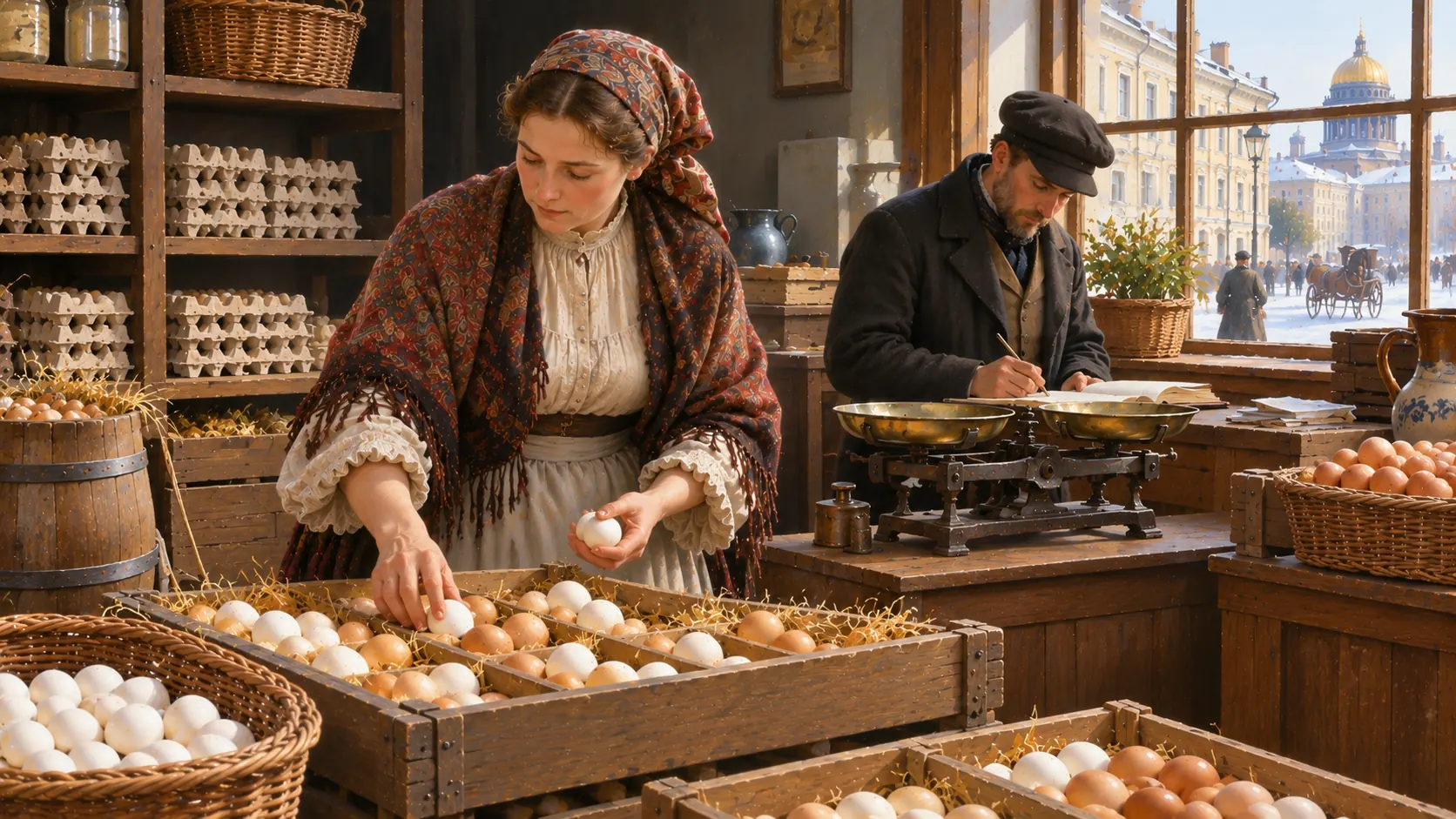
Different sources answer different questions: the pre-revolutionary encyclopedia and studies of egg exports describe production and trade. Section XLVIII of Molokhovets concerns preservation, and Section XV includes egg dishes. Recipes do not establish uniform practice in every household.
How eggs became a major traded commodity
By the late nineteenth century chicken eggs were not merely products of the household yard but a substantial export. Brockhaus and Efron's account of Russian industry and trade records exports of approximately 1.83 billion eggs in 1898. Historian Yevgeny Zhirnov also traces how railways expanded shipments to European countries.
This does not mean that every Russian egg was exported; domestic consumption existed. But these quantities required collection, sorting, packaging, transport and intermediaries as well as poultry raising. A buyer in a shop saw the result, without necessarily dealing directly with a rural producer.
How eggs reached St. Petersburg
Historical research describes waterborne supplies from towns of the upper Volga to St. Petersburg, followed by expansion of the procurement area. Nineteenth-century merchants sought supplies in the Vologda region and along the Sheksna. In 1876 the Agricultural Gazette reported railway shipments from the Kursk, Voronezh, Yaroslavl and Tver areas and the Baltic provinces.
Some eggs could come from nearby farms; others travelled considerable distances. Collection and transportation affected price and quality. None of these reports is a complete list of suppliers around 1901. The place of purchase must be distinguished from the place of production.
Why summer and winter eggs differed in trade
The Brockhaus and Efron article Egg: Statistics and International Trade notes that laying was concentrated in warmer months and prices varied seasonally. For first-grade eggs in Moscow wholesale trade in 1901 it gives an average of 25 roubles 17 kopecks per thousand.
This is a wholesale average for a specified city and grade, not a St. Petersburg retail price. Dividing by one thousand does not establish what each householder paid for one egg.
Preserving seasonal surpluses mattered. Household advice on storage appears alongside recipes for hot dishes and baking because fresh eggs were not equally available throughout the year.
Four storage methods in Molokhovets
No. 3668 describes coating very fresh eggs with fat and arranging them pointed end down in oats so they do not touch; dry salt, ash and sand are alternatives. No. 3669 calls for a dry cold room and straw-covered shelves, with eggs used in order of arrival, an early form of stock rotation.
No. 3670 describes limewater and earthenware or wooden vessels. No. 3671 mentions a salicylic acid solution. The author claims very long preservation periods. These reflect historical beliefs, not scientifically validated guarantees of freshness or safety today.
The variety shows an effort to make eggs a supply for months with fewer fresh eggs. The book cannot establish which method was most frequent in actual homes.
From soft-boiled eggs to breakfast in a pan
No. 1676 gives a short recipe for soft-boiled eggs served hot; No. 1677 describes eggs cooked to another degree of firmness. They are distinct dishes.
No. 1681 combines fried eggs with rye bread, ham and spring onion. No. 1683 allows herring, sardelki (small preserved fish, not sausages) or ham, while No. 1684 prepares breakfast eggs directly in a metal vessel and serves them in it.
These are options for a householder rather than statistics about everyday breakfasts. Historical heating times should not replace modern food-safety guidance.
Eggs in soup, pies and sauces
No. 289 places prepared poached eggs in cups of broth. No. 290 makes croquettes from hard-boiled eggs combined with thick sauce and cheese, then coated and fried. No. 337 uses boiled eggs in rice-filled pies, and No. 446 uses them in a butter accompaniment.
The same ingredient contributes to several parts of a menu, not breakfast alone. It connects our studies of pies, dairy products and economical use of ingredients. Its presence in the book does not prove that every social group could afford the corresponding dishes.
The history of eggs is also a history of intermediaries
Eggs passed through producers, collectors, transporters and traders. Railways made consignments substantially more mobile, but rural and urban transactions differed and producers might receive less than the final retail price.
Export volumes indicate organized commerce without proving that all participants benefited equally. Contracts, invoices, household accounts and records of grading, rejection and transport losses would be needed.
One ingredient could thus have several histories: production, trade and consumption.
What the 1901 book cannot establish
Molokhovets gives recipes and storage advice but no census of egg preservation across Russian households. Encyclopedia tables document exports and wholesale prices, not how many eggs a particular worker ate each week. A newspaper account of a route cannot automatically represent the whole country.
The supported conclusion is more modest and useful: around 1901 eggs were simultaneously a seasonal agricultural product, a major export, a household reserve and an ingredient in diverse dishes. Reading these histories beside the recipes preserves their context without turning old advice into present-day instructions.
Original recipes and historical sources
Elena Molokhovets, A Gift to Young Housewives, 1901 edition. Original source links are retained below.
- Brockhaus and Efron, Russia: Industry and Trade
- Yevgeny Zhirnov: Russian egg exports (2022)
- Section XLVIII: Butter, cheese, milk and eggs (in Russian)
- Section XV: Egg dishes (in Russian)
- Brockhaus and Efron, Egg: Statistics and International Trade
- No. 3668 — First Method for Storing Eggs · Russian original
- No. 3669 — Second Method for Storing Eggs · Russian original
- No. 3670 — Third Method for Storing Eggs in Limewater · Russian original
- No. 3671 — Fourth Method for Storing Eggs in Salicylic Acid Solution · Russian original
- No. 1676 — Soft-Boiled Eggs · Russian original
- No. 1677 — Medium-Soft Boiled Eggs · Russian original
- No. 1681 — Skillet Eggs with Dark Bread and Ham · Russian original
- No. 1683 — Skillet Eggs with Herring or Sardelki (Small Preserved Fish) · Russian original
- No. 1684 — Breakfast Eggs Baked in a Pan · Russian original
- No. 289 — Poached Eggs for Broth · Russian original
- No. 290 — Croquettes of Hard-Boiled Eggs · Russian original
- No. 337 — Small Pies with Rice and Eggs · Russian original
- No. 446 — Butter with Hard-Boiled Eggs · Russian original
Related reading
Safety note: limewater, acid solutions and dry packing materials are historical preservation methods, not validated guarantees of safe eggs or alternatives to modern storage guidance. Historical cooking times likewise do not replace current safe handling and cooking recommendations.