White, Red and Berry Kvass: Drinks in the 1901 Cookbook
White kvass for cooking, red kvass for the table and fruit drinks preserved in the cookbook of 1901.
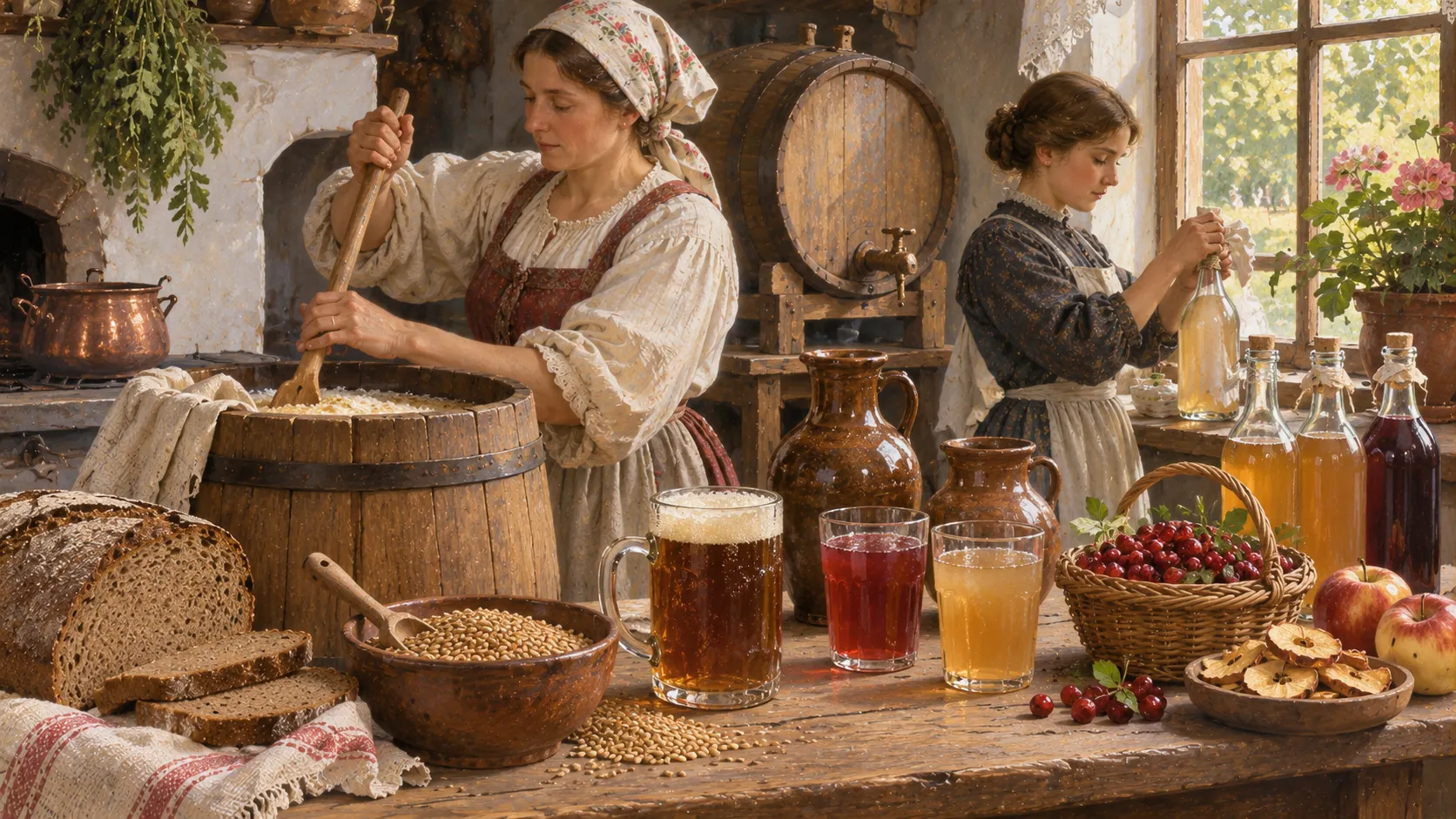
White kvass for borscht, red kvass for the table, a one-day drink made from dried bread, and apple or cranberry kvass: in Elena Molokhovets' 1901 cookbook these are not merely versions of one modern bottled beverage. They form a varied family of products made from malt and flour, leftover bread, berries and fruit; kept in vats, barrels or bottles; and used both for drinking and for cooking.
The original source: Section XLVI
Section XLVI, “Kvass, Beer and Mead”, gathers bread kvasses, so-called Moscow-style berry and fruit kvasses, then beer and honey-based fermented drinks. The terms kvass, kislye shchi, cider and mead are not necessarily interchangeable. Our separate Russian-language study of “sour shchi” explains why this name could mean either soup or a drink. Here the emphasis is on the ingredients, processes and everyday purposes of kvass.
White bread kvass: more than a beverage
Molokhovets calls No. 3520, “White Bread Kvass,” an important household staple. In addition to drinking it, she suggests using it to add acidity to borscht and cabbage soup and in preparing beef. The recipe uses rye and buckwheat flours, malt, hot water and some of the sediment left from an earlier batch.
That reused fermenting base is especially revealing. After drawing off the drink, the author keeps part of the thick sediment for the next preparation. A single recipe thus connects three uses: a drink, an ingredient in other dishes and a renewable starter. This describes historical practice, not a recommendation for fermenting without current hygiene and temperature controls.
Nor should “white kvass” automatically be equated with a clear, low-alcohol version of today's bottled drinks. The name alone cannot establish its color, alcohol concentration or the microbial behavior of a particular batch.
Red kvass: malt, the oven and a large vat
No. 3521, “Red Bread Kvass,” uses rye, wheat and buckwheat flours, several kinds of malt, yeast and mint. The stated proportions are intended for at least twelve vedros—a substantial quantity, quite unlike a modern saucepan of home-brewed drink.
No. 3524, “The Simplest Red Table Kvass,” is made differently. The malt mixture is left in an oven, diluted with water, strained, and then combined with yeast. The word “table” indicates intended serving, but does not prove that such a drink appeared on every household's table.
The stove, cast-iron vessels, vat, small barrel and straining utensils were part of the process. That connects the history of kvass with the tools and working spaces of a 1901 kitchen.
Stale bread: thrift or simply another recipe?
No. 3526, “One-Day Kvass from Pieces of Rye Bread,” begins with dried stale rye bread, water, dark patoka syrup and yeast. The bread liquid is strained and bottled, with raisins added. Another quick version, No. 3527, also uses leftover dried rye bread but includes sugar and lemon.
Both recipes show that already-baked bread could become raw material for a beverage rather than simply being discarded. This is a meaningful example of using leftovers, as in our Russian study of one ingredient serving several dishes.
It would be wrong, however, to claim that “all real kvass was made from rusks.” The neighboring recipes use flour and malt without beginning with a finished loaf. Bread-based kvass and kvass made from malted grain belong to overlapping but distinct preparations.
Fruit and berry kvasses: one name, several methods
In the same section, No. 3530, “Apple and Pear Kvass from Wild Fruit,” calls for pouring boiling water over dried fruit, letting it stand and drawing off the liquid. As written, this resembles a fruit infusion more closely than a clearly specified yeast fermentation. An old title does not guarantee one common technology throughout the chapter.
No. 3531 gives another apple method involving larger quantities and a period of standing. Cranberry kvass, No. 3532, includes berries, sugar, yeast and raisins; lemon kvass, No. 3533, uses lemons, raisins and patoka or honey; and No. 3534 turns to ginger.
This is a much broader range of ingredients and tastes than a single “bread drink.” Availability of fruit, sugar, spices and sweet syrups varied, so the presence of a recipe tells us little about how frequently every Russian family prepared it.
“Moscow kvasses”: berries, small barrels and ice
In her introduction to preparing Moscow-style kvasses, Molokhovets emphasizes ripe fresh fruit, clean containers and cold storage. No. 3537, “Moscow Kvass from Raspberries and Strawberries,” uses a special vat with a drain and straw as a filter. Cloudberry kvass, No. 3538, works differently: the fruit is covered with cooled boiled water and kept cold until the required flavor develops.
Other variants use barberries, cherries, apples, pears, currants, lingonberries and rowanberries. In cherry kvass No. 3540, the author explains that removing the stem helps the fruit release juice. It is an observation about the ingredient, not evidence that all “Moscow” kvass was manufactured inside Moscow.
The icehouse named in these recipes was a real historical means of storage, but not an exact equivalent of a refrigerator with monitored temperature and sanitation.
From the domestic vat to urban refreshment stalls
Kvass could also be sold rather than made at home. In the photographic archive “History of Russia in Photographs,” an exhibition of old food service includes a street kiosk with the sign “Lemon Kvass.” This demonstrates that a beverage under that name could be part of city trade.
It does not establish that the vendor used Molokhovets' recipe No. 3533. A commercial producer might have different equipment, quantities and suppliers. The shared name permits a comparison, not the assumption that every preparation was identical. Likewise, in our English study of Petersburg bakeries we distinguish household methods from specialized urban production.
A specialized kvass book had appeared by 1899
The catalogue of St. Petersburg Polytechnic University describes E. I. Frolov's Kvasovar, published in St. Petersburg in 1899. Its contents enumerate bread, fruit, berry, ginger and other kvasses alongside meads, fruit juices, syrups and beer.
This independent publication, only two years before the Molokhovets edition considered here, shows substantial interest and variety in the written literature on preparing such drinks. It does not prove that every variety was widely consumed or that all recipes used the same process.
“Sour shchi” was sometimes a beverage
Two neighboring entries are No. 3528, “Sour Shchi,” and No. 3529, “Excellent Kvass or Sour Shchi.” Here the expression denotes a drink made with malt and flour rather than a cabbage soup. Elsewhere in the cookbook shchi names a hot first course.
The Russian investigation based on Dahl's 1882 dictionary examines that change of meaning in detail. For kvass studies, it is especially important not to infer composition, alcoholic strength or safety from the historical name alone.
What cannot be followed literally today
Molokhovets attributes nutritional and healing qualities to kvass, including claims about consumption. Such assertions belong to the medical understanding of the period; kvass has not been established as a treatment for tuberculosis and must never replace appropriate medical care.
Some recipes advise tightly corking bottles containing drinks that may continue to ferment, sometimes with raisins added. Without measured controls, pressure may rise dangerously, while contamination, spoilage or unintended alcohol production can occur. Promises of long storage, “unspoiling” starters and icehouse preservation are not modern microbiological validation.
Find the original recipes
See also red bread kvass No. 3521, table kvass No. 3524, apple and pear No. 3530, cranberry No. 3532, Moscow berry kvass No. 3537, and cloudberry No. 3538. Related reading: food preservation in 1901 and historic coffee substitutes.