Porcini, Ryzhiki and Morels: Mushrooms in the 1901 Cookbook
Mushroom terminology, preparations, drying, salting and culinary uses documented in the original Russian recipes.
Porcini, saffron milk caps, milk mushrooms, morels and champignons appear repeatedly in Elena Molokhovets' 1901 cookbook. Some are fried with sour cream, others added to soup or pastry fillings, and still others dried or salted for use months later. Their many names show why “mushrooms” in historical Russian food writing cannot be treated as one interchangeable ingredient. This English research is prepared directly from the Russian recipes, bringing together culinary uses and the problem of seasonal storage.
A network of recipes, not one mushroom chapter
Section VI includes mushroom and vegetable dishes; Section XXVIII covers meatless foods; Section LI describes stores of mushrooms and other produce. Mushroom preparations also occur in soups, sauces, fish and meat dishes, savory pies and salads. This distribution is itself revealing: mushrooms were not restricted to one particular place within dinner.
Porcini: dried provisions for another season
Porcini, often called belые griby (“white mushrooms”) or boroviki, occur in both preserved and cooked dishes. No. 3932, “Dried Porcini,” describes preparing them for keeping; No. 3933 gives another historical drying method. No. 3939, “Powder from Porcini,” illustrates how the dried product could become a concentrated flavoring rather than an intact mushroom on a plate.
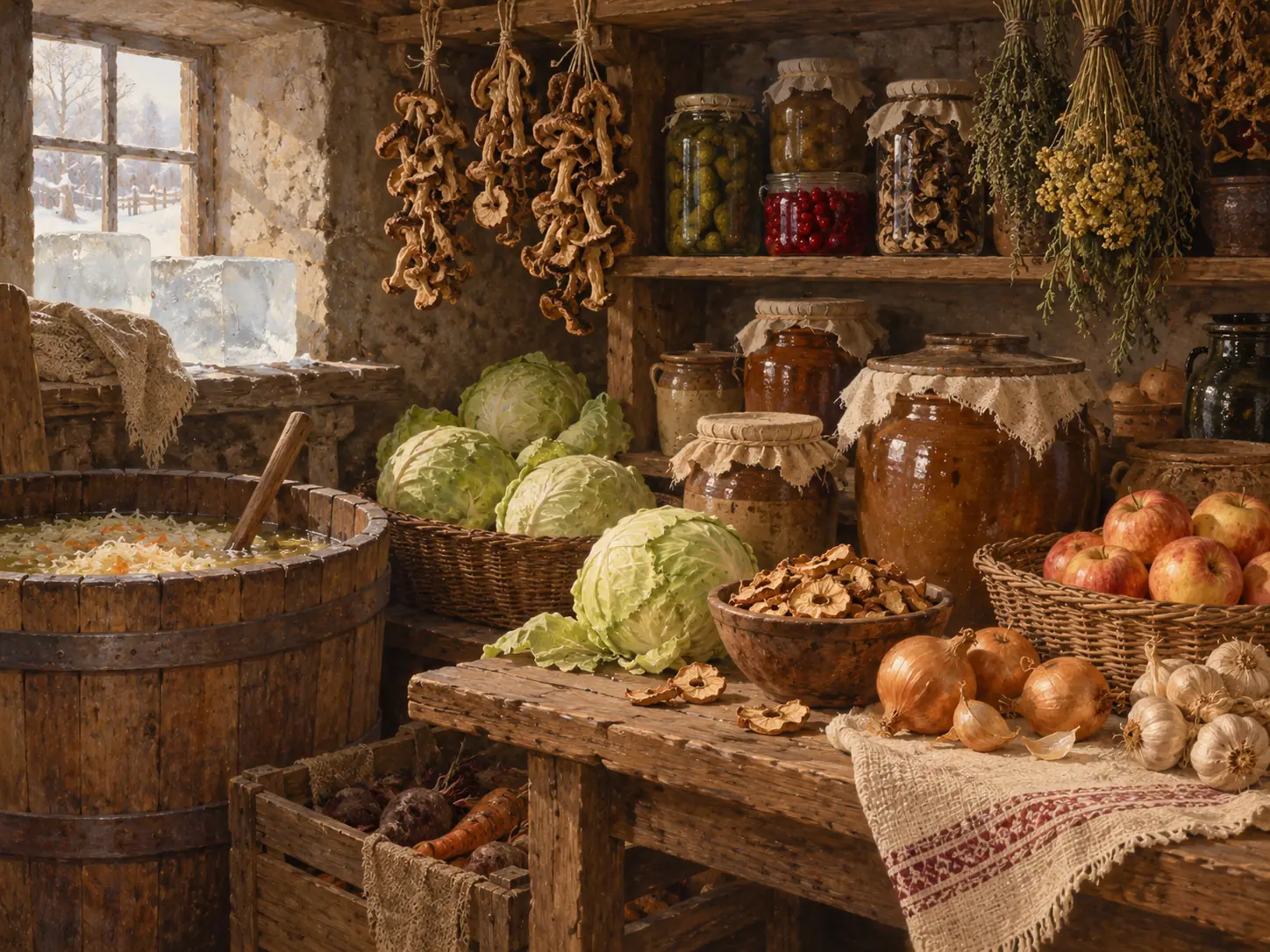
The relevant household issue was time. Forest mushrooms were seasonal and perishable; dried stores allowed some of their flavor to enter later meals. Our English study of winter provisions demonstrates how such stored products appeared in menus outside their harvest season.
These recipes are valuable historical evidence, but drying by old timing or appearance alone does not demonstrate microbial safety or correct identification of wild fungi today.
Mushroom soup and the meatless table
In No. 2318, “Mushroom Soup with Ushki,” mushrooms supply the flavor of a soup accompanied by small filled pastries. The term ushki refers to little ear-shaped pieces of filled dough, not an animal ingredient.
No. 32, “Soup from Salted Saffron Milk Caps,” uses a mushroom that has already undergone preservation. This is a different starting point from a soup made with freshly gathered or dried porcini.
The same ingredient category could thus support fresh, dried and salted variations depending on season, storage and intended taste. A historic label such as “Lenten” also indicates the author's organization of dishes, not a guarantee about the actual daily food of every religious household.
Saffron milk caps: fried, salted and marinated
The Russian ryzhik denotes saffron milk caps, a group of Lactarius mushrooms, rather than a generic small red fungus. No. 3923 concerns salted ryzhiki; No. 3924 gives a pickled version, and No. 3927 describes making a powder. Several more variations appear in the same section.
The mushroom was not confined to the pantry. No. 2474, “Fried Saffron Milk Caps,” is a direct cooked dish, while No. 773 uses salted ryzhiki in a sauce for beef.
A single mushroom name thus links the forest harvest, a preparation for storage and a dish served with meat. But none of these older storage methods is an independently tested modern preservation procedure.
Milk mushrooms were a different group
The Russian gruzdi refers to milk-cap mushrooms traditionally used in salted preparations. In No. 3946, “Salted Milk Mushrooms and Volnushki,” Molokhovets combines references to several varieties. No. 3947 is specifically devoted to salted milk mushrooms.
They also appear cooked: No. 729 describes ryzhiki, milk mushrooms and other mushrooms fried with sour cream. No. 730 treats milk mushrooms separately, and No. 1075 uses them as a stuffing for duck.
The names are botanically and culturally significant. An English translation that renders every original term simply as “mushrooms” would lose distinctions in flavor, processing and role. However, a traditional common name is not a reliable guide to identifying a wild mushroom today.
Morels: seasonal ingredients for sauces and meat
Smorchki, or morels, are another quite different group of mushrooms. No. 722, “Morel Sauce,” describes them as a sauce ingredient. No. 884 pairs morels with boiled veal breast, while No. 1262 uses them with fish.
In No. 58, “Chicken Soup with Stuffed Morels,” the mushrooms become part of a more elaborate first course. Their use is not limited to a simple sauté.
Morels can pose serious risks when improperly identified or prepared. Historical mushroom recipes cannot substitute for expert species identification and current safety guidance.
Champignons and the more elaborate kitchen
Champignons, a term commonly used for cultivated or market mushrooms, appear in sauces and as fillings. No. 435 is a mushroom sauce; No. 723 adds wine.
No. 725 concerns fried champignons, while No. 726 describes stuffed versions, including meatless variations.
There is also No. 527, “Artichokes Stuffed with Champignons,” in which mushrooms are part of a complex vegetable dish. These combinations illustrate the extent of Molokhovets' culinary repertoire, but do not establish what share of Russians bought cultivated mushrooms.
One mushroom, several parts of a dinner
No. 1395, “Pie with Mushrooms and Viziga,” combines dried mushrooms with rice and a processed sturgeon ingredient. No. 1393 uses mushrooms with sauerkraut. The combination of mushrooms with grains and vegetables could make them central to a meatless dish or a rich pastry filling.
Another example is No. 2609, “Vinaigrette from Salted Milk Mushrooms, Saffron Milk Caps and Porcini.” Its title alone names three distinct mushroom categories in one cold dish.
The cookbook's cross-references link the larder, oven, soup pot and table. What may look like a single chapter of “mushroom recipes” is really a network of distinct ingredients prepared for different purposes.
Keeping mushrooms in butter or sour cream
Some historic methods are especially revealing of the household's concerns. No. 3934 proposes keeping porcini in butter. No. 3935 describes mushrooms kept in sour cream. These recipes explain why apparently “fresh mushrooms” could be mentioned in a winter menu, as discussed in our seasonal research.
They do not establish that the preserved products were actually fresh in the modern sense. Nor is fat or sour cream a validated way to preserve wild mushrooms at room temperature. The historical text is best read as evidence of attempts to manage a seasonal food.
The risks hidden by a familiar word
Modern readers should not use the cookbook to identify species gathered in a forest. Common names can cover more than one biological species and may vary by region. Poisonous lookalikes, contamination, inadequate cooking and unsafe storage all make wild fungi a special concern.
Similarly, recipes for salting, drying, packing in butter or keeping mushrooms under other materials cannot guarantee safety. We preserve the wording for historical understanding rather than endorsing the methods.
What the recipes tell us—and what they do not
The 1901 book documents a diverse vocabulary of mushrooms and multiple uses: soup, sauces, pies, cooked side dishes and seasonal stores. Its evidence is particularly strong for how the author classified and prepared ingredients.
It cannot tell us the number of mushrooms gathered in each region, exactly which species were present in a purchased basket or how frequently urban households cooked these dishes. Such questions require separate botanical, ethnographic and market records. By keeping that distinction, the historical recipes remain valuable without being turned into myths about an identical “Russian mushroom tradition” everywhere.
Explore the mushroom source pages
Other primary recipes: mushroom soup No. 2318, salted milk mushrooms No. 3946, fried champignons No. 725, mushroom and viziga pie No. 1395 and mushroom vinaigrette No. 2609. Browse the original Russian mushroom collection.