Orgeat: Molokhovets’s Forgotten Almond Drink
How orgeat was made from almonds, water and sugar in 1901, why orange blossom water was optional, and how it differed from lemonade.
What orgeat meant in the 1901 book
Beside lemonade in the drinks section is No. 3509, orgeat. In Molokhovets's available text, it is an almond drink with sugar and optional flavouring. Unlike lemonade, its character comes not from fruit juice but from crushed nuts, from which dissolved and suspended substances are extracted. No animal milk appears in the recipe. Comparing it to a modern almond drink helps explain the appearance, but does not make them exact equivalents: historical sweetness, filtration and flavouring may have differed considerably.
Two extractions from the almonds
The author calls for scalding, peeling and finely pounding the almonds. The first time, they are mixed with three glasses of boiled water, strained and pressed. The remaining almonds are pounded again and mixed with two glasses of water. This sequence makes fuller use of one ingredient. Small particles and some substances from the almonds pass into the liquid, while the larger residue is separated. Filtration affects density and cloudiness, but the exact properties of the historical drink were not measured in the book.
Sugar and orange blossom water
For six glasses of the drink, the ingredient list specifies a quarter to a third of a Russian pound of sugar. This is a historical proportion, not a modern consumption recommendation. A quarter glass of orange blossom water may be added if desired. This means aromatic water associated with citrus flowers, not orange juice. It changes the scent without replacing the almond base. The author's expression 'if one likes it' leaves the flavouring to the cook. Such small variations make the old cookbook a guide to taste as well as a list of dishes.
Why bitter almonds appear in the original
No. 3509 lists bitter as well as sweet almonds. This important historical detail must not be transferred uncritically to modern practice. Bitter almonds may contain compounds that release toxic hydrogen cyanide. We do not recommend acquiring or using them to reconstruct orgeat. A safe modern interpretation can use ordinary edible sweet almonds and food-grade blossom water; that is an adaptation rather than a literal reproduction of the 1901 list. The drink is unsuitable for people with nut allergies.
Orgeat, lemonade and berry drinks
In No. 3508, lemon zest is rubbed with sugar, water is added, lemon juice is squeezed in and the drink strained. After orgeat comes No. 3510, a drink made from cranberries and other berries. All three entries illustrate water-based drinks but extract flavour differently: citrus juice, pounded almonds or a berry decoction. Orgeat stands apart through its fine almond suspension and optional floral aroma. It does not require fermentation; no such stage is specified in No. 3509.
Was orgeat an everyday drink?
Its inclusion in the cookbook shows that the compiler considered the recipe appropriate for a domestic collection. The book does not say how often ordinary families prepared it, where they bought almonds or how much a particular portion cost. Price lists and independent accounts of household life would be needed. Nor do we establish the etymology of the word from one recipe. Its history extends beyond the Russian edition and requires separate dated sources.
A modern reconstruction
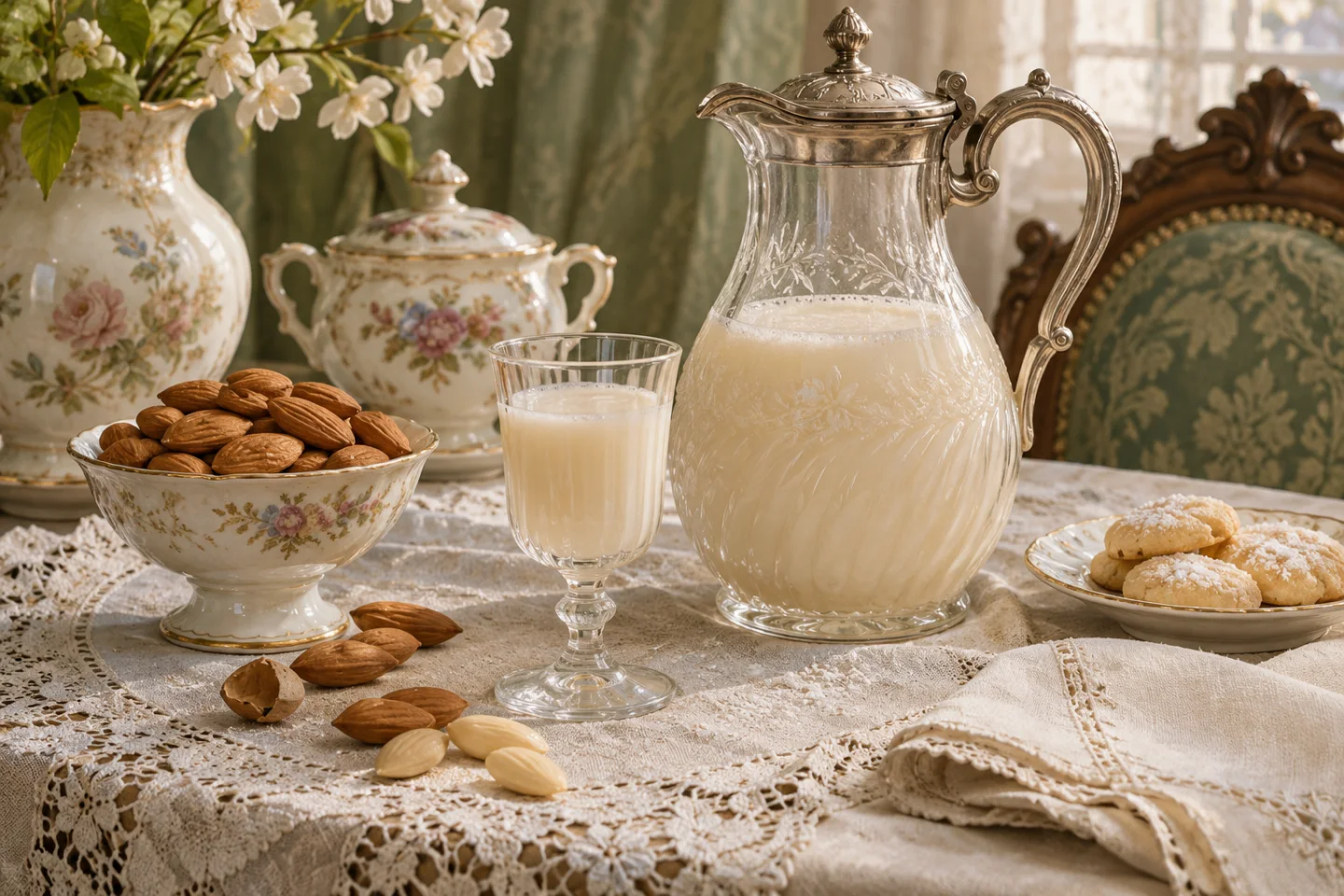
A milky hue without dairy, a glass or small jug and peeled almonds nearby are a plausible way to picture the drink from the text. Flowers may indicate the optional aromatic ingredient, but are not proof of historical serving arrangements. The image must not be confused with an authentic photograph. A modern nut-based drink remains perishable: it should be refrigerated rather than stored at room temperature.
Original recipes and sources
Elena Molokhovets, A Gift to Young Housewives, 1901 edition. Links to scans are available on the original Russian recipe pages.