Rye Rusk Baba: Why the Historical Cake Used Thirty Eggs
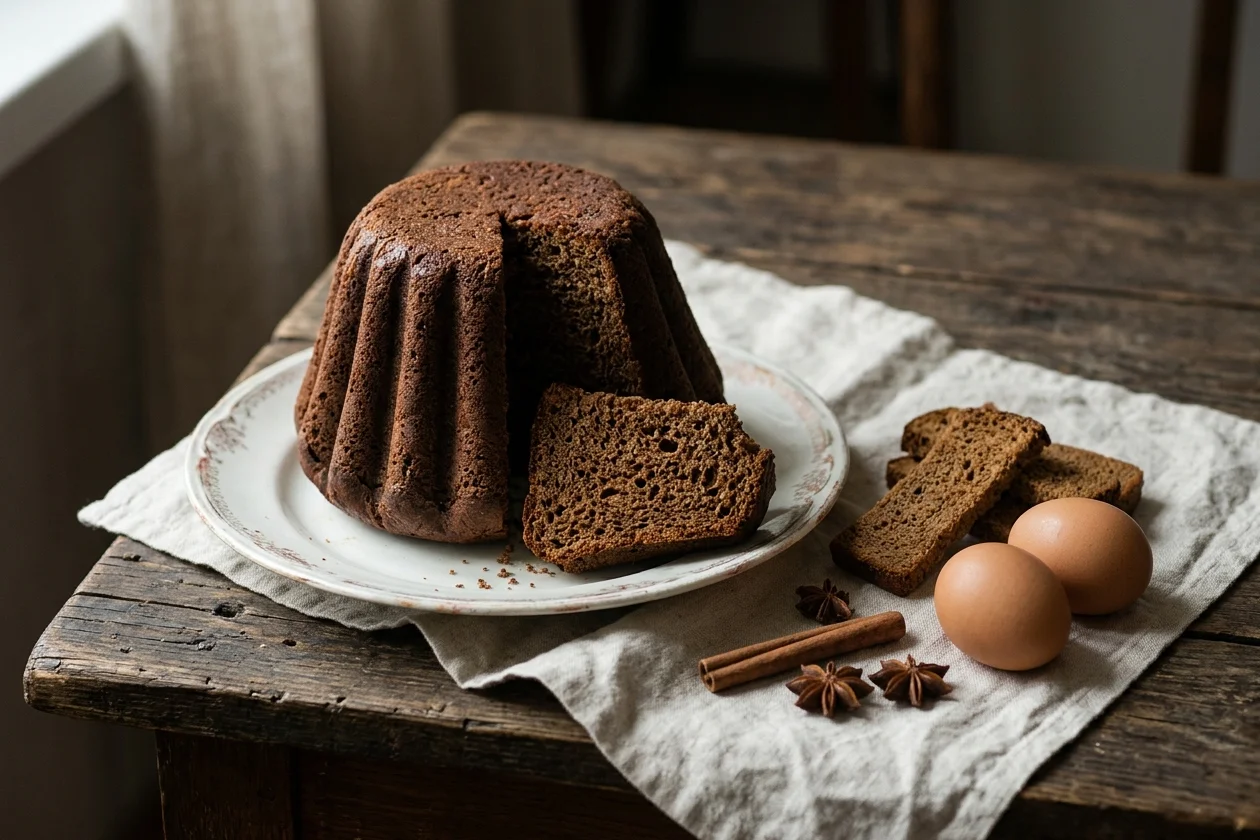
Three bread babas from Molokhovets: rye rusks replace much of the flour, with beaten whites, spices and candied orange peel.
Not just rum baba
The word baba often evokes a small enriched cake soaked in syrup. Nos. 3042, 3046 and 3047 describe a quite different group of baked goods. They use yolks worked with sugar, beaten whites and crushed rusks. In two, black rye bread provides the dry base; the third uses sweet-and-sour bread. Yeast is not named in these three entries. Neither the appearance nor the rising method of modern yeast babas can automatically be assigned to these historical cakes.
Why the recipe begins with thirty yolks
No. 3042 gives a large batch: thirty yolks, a Russian pound of sugar, spices, three-quarters of a glass of dry sifted rye bread flour and two spoonfuls of krupchatka flour. Foam from thirty whites is added at the end. The author explicitly says that one-third of this proportion is needed for six people. Thus thirty eggs does not mean a usual six-person serving: the reduced recipe uses ten eggs. This illustrates how the initial quantities in the old book did not necessarily correspond to the number of diners in a particular household.
What rye bread flour meant
Molokhovets separately explains how to prepare it: slice black bread, dry it without burning, pound it and sift it. This is not raw rye flour from a mill but ground bread that has already been baked. Its starch has previously been heated, and its aroma comes from the bread and drying. It behaves differently in batter from an equal amount of fresh flour. Measuring by glasses does not establish an exact modern weight either, because density depends on grinding and compaction.
How the airy texture was created
The large quantity of eggs is not solely about richness. Working yolks with sugar separately and incorporating egg-white foam introduce air into the mixture. During heating, egg proteins and dry ingredients help establish the structure. No. 3042 fills three-quarters of the mould, leaving space above. This is consistent with a possible rise during baking but does not predict its height. The recipe supplies no oven temperature, mould dimensions or foam density; the result need not have resembled a modern sponge cake exactly.
Spices and optional chocolate
No. 3042 mentions cinnamon, cloves and star anise measured in zolotniks. A zolotnik was an old weight unit of about 4.27 grams; three zolotniks of cinnamon amount to approximately 12.8 grams for the entire large batch. This is a conversion of a historical quantity, not a recommendation to increase spice in modern baking. The author also permits adding chocolate, in which case the krupchatka flour may be omitted. Even one entry therefore allows a version with a different composition of dry ingredients.
Two neighboring bread babas
No. 3046 adds pounded sweet almonds and bitter orange peel to rye rusks, using yolks, whole eggs and beaten whites. No. 3047 differs in that slices of sweet-and-sour bread are first moistened with wine, dried and crushed. Cardamom, candied orange peel and the egg mixture are then added. These are three different compositions: spiced rye, almond-and-rye, and bread with wine and candied peel. Baking does not guarantee complete removal of alcohol.
Why this cake merits its own story
In black bread charlotte, rusks and fruit form alternating layers; in bread baba, crumbs belong to the whole beaten mixture. In rye bread ice cream they serve yet another purpose, forming part of a chilled sweet base. The comparison shows how many different structures one familiar ingredient could produce. A modern illustration of a tall dark baba with a porous cut surface remains conjectural. Practical adaptation requires safe ingredients, validated proportions and thorough baking of the egg mixture.
Original recipes and sources
Elena Molokhovets, A Gift to Young Housewives, 1901 edition. Links to scans are available on the original Russian recipe pages.