Molokhovets's Quenelles: Why They Were Not Always Small Balls
Meat, fish and crayfish quenelles in 1901: sieving minced ingredients, cream-based mixtures, boiling in sausage form and shaping with a spoon.
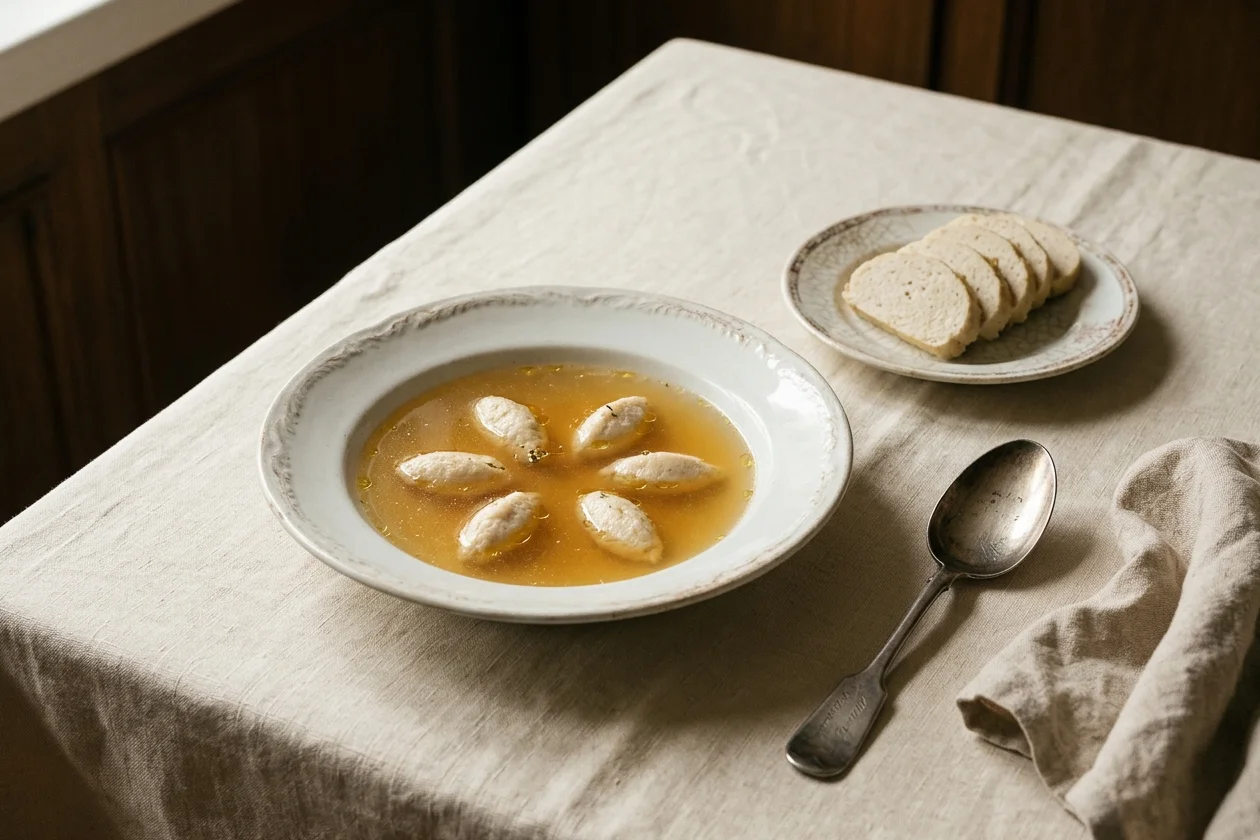
Not every quenelle was a small ball
In the 1901 edition, Molokhovets groups several methods of preparing minced meat and fish under the name quenelle. In No. 226, beef or veal is combined with soaked bread, egg, onion and spices, then pounded and rubbed through a sieve. The mixture is shaped into a thin sausage, boiled and sliced for serving with broth. The shape of a small individual piece is therefore not a mandatory characteristic of a quenelle in this book. The smoothness of the minced mixture and its subsequent processing are more important for understanding this particular recipe.
Chicken quenelles with cream
In No. 227, chicken or turkey flesh is minced several times, pounded with cream and sieved. The cooled mixture is then beaten with a spatula and additional cream. Unlike the beef version, its original composition does not specify egg or bread. The author suggests testing the consistency with one trial quenelle: an excessively firm mixture is adjusted with cream, and an insufficiently cohesive one with a prepared flour thickener. This is an interesting example of checking the result before cooking the entire batch. Quenelles No. 228 are different: they contain eggs, butter and soaked white bread or rusks. The two versions should not be merged into one recipe.
Fish quenelles and fish roe
Pike, pike-perch or perch are suitable for No. 229. The flesh is carefully freed from bones, minced with bread, onion, eggs and spices, pounded and sieved. The author again proposes a shape resembling a thick sausage, and the cooked quenelle is served with fish soup, or ukha. In No. 230, fish is combined with roe from the same kind of fish in equal weights, adding bread and cream or butter. Here too the mixture is shaped into an elongated form. A modern illustration of individual slices conveys this serving method rather than presenting every fish quenelle as a small identical ball.
How crayfish quenelles were shaped
No. 231 concerns quenelles made from crayfish tails and legs. The author adds crayfish butter, soaked bread, eggs, cream and herbs, and beats the minced mixture with a spatula. In this case individual portions are shaped with a teaspoon and boiled in broth. The instruction to use the remaining shells for crayfish soup or butter connects the recipe with other dishes in the book. However, the historical entry does not establish modern sanitary conditions for preparing and storing crayfish. A practical adaptation requires safe food-grade ingredients and validated handling.
Herring and cheese as soup accompaniments
In No. 234, a herring-and-onion mixture is heated beforehand, combined with eggs, sour cream and rusks, then shaped with a spoon and served in potato soup. Neighboring No. 225 describes not quenelles but cheese frikadelki, or small cheese dumplings: grated cheese is mixed with butter, eggs, bread and sour cream. They are boiled separately in broth, cooled and cut in half. Similar shaping and serving methods make comparison useful, but do not justify renaming the cheese dumplings as quenelles contrary to the original heading.
What historical quenelles have in common
Repeated mincing, rubbing through a sieve and adjusting the firmness of the mixture recur in several entries. Binding ingredients, shapes and accompaniments nevertheless differ. The precise texture depended on the properties of meat, fish and cream and on the cook's work, so one description cannot establish a universal consistency. An artistic reconstruction can show elongated quenelles and a sliced boiled mixture as different versions. Historical heat-treatment methods do not replace validated modern requirements for preparing minced poultry, meat, fish and eggs.
Original recipes and sources
Elena Molokhovets, A Gift to Young Housewives, 1901 edition. Links to scans are available on the original Russian recipe pages.
- No. 226 — Beef or Veal Quenelle Russian original
- No. 227 — Chicken or Turkey Quenelles with Cream Russian original
- No. 228 — Chicken or Turkey Quenelles, Another Method Russian original
- No. 229 — Fish Quenelles Russian original
- No. 230 — Fish Quenelles with Roe Russian original
- No. 231 — Crayfish Quenelles Russian original
- No. 234 — Herring Quenelles Russian original
- No. 225 — Dutch or Swiss Cheese Meatballs Russian original