From Herring Barrel to Appetizer Table in 1901
White Sea herring trade, barrels, Dutch-style preparation and old Russian appetizer traditions.
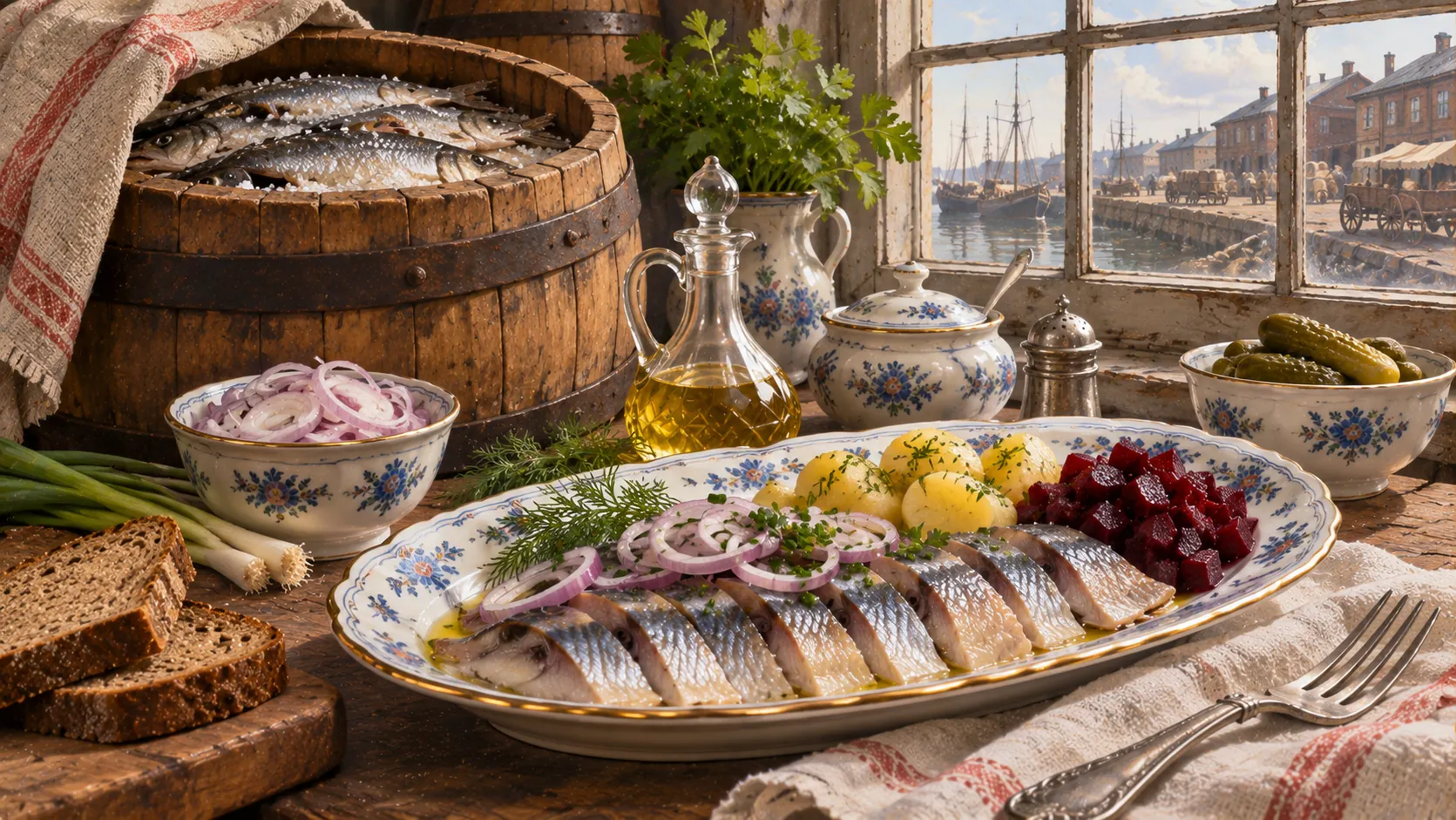
On Molokhovets' table, herring can look like a simple appetizer: sliced fish, onion, olive oil, potatoes or beetroot. But the plate had a longer history before it reached the dining room—fishing, salting, barrels, shipping, merchants and a second round of household preparation. The 1901 edition of A Gift to Young Housewives contains a series of recipes for this already preserved fish, including marinades, serving methods and even a remarkable suggestion for using leftover brine.
The primary sources in the cookbook
No. 1219, “Herring with Provençal Oil and Vinegar,” describes the fish arranged for serving. No. 1481 points back to it. And Section LII contains Nos. 4062–4071, a series on soaking, marinating and keeping herring. These are culinary sources, not statistical accounts of trade.
Why a barrel mattered
Herring is highly perishable, while large seasonal catches could occur far from the eventual customer. Salting changed the product and helped make long-distance trade possible. Barrels allowed many fish to be packed, transported and sold with brine. But not every barrel contained the same degree of salt, used the same process or offered the same safe storage period.
Nikolai Danilevsky's reports on White Sea fishing and hunting describe the White Sea Company salting approximately 700 poods of herring in 1858 and about 4,000 poods in 1859. The fish were salted near the catch in larger barrels and sorted and repacked into smaller containers at Arkhangelsk.
These are reports about one enterprise in the middle of the nineteenth century, not total national output in 1901. Nevertheless they establish the practical importance of salting, packaging, grading and moving fish from a regional fishery to commercial buyers.
From the White Sea to a market customer
A historical study of northern Russian herring fishing describes trade through Arkhangelsk, regional fairs and merchants from neighboring governorates. Some herring could be consumed locally, while other catches entered wider distribution networks.
By the time a city customer purchased herring, it might be separated by a considerable distance and several commercial transactions from the fishing grounds. In the English study of the Sennaya fish market we examine other aspects of the city's fish trade. Without actual shipping documents, however, we cannot claim that a particular barrel sold in Petersburg came from one named White Sea landing.
What did “Dutch herring” mean?
Molokhovets begins No. 1219 with “two Dutch herrings.” The practical point of her recipe is not a geographical record: she describes soaking purchased salted fish, cleaning it, removing bones and arranging neat slices for serving.
An even clearer clue is No. 4067, “Making Ordinary Herrings Taste Like Dutch Herrings.” Here the word “Dutch” describes a desired quality or standard of flavor to which an ordinary purchased fish might be compared. The method involves additional seasoning and treatment after the original salting.
The term cannot establish that every fish called “Dutch” in a Russian household was physically caught or packed in the Netherlands. Trade designation, production style and actual country of origin are separate matters, and a recipe does not provide the documentation required to untangle them.
The herring platter: onion, potato and beetroot
No. 1219 describes more than one presentation. Herring may be sliced at an angle and laid on a dish with its head and tail to retain the recognizable silhouette; boiled potatoes, beetroot, onion, capers or pickles can be arranged beside it.
The dressing includes what Molokhovets calls “Provençal oil,” the historical name for edible olive oil, rather than butter with herbs. See our English guide to the different historic fats and oils.
In No. 1481, the same appetizer appears in the section on cold dishes with a reference back to No. 1219. Thus one preparation belongs to several editorial categories: fish as an ingredient and cold food as a serving occasion.
The section on setting the table also places herring among appetizers arranged on small dishes. This confirms a possible place at the formal appetizer table, not compulsory presence in every home.
Ten entries: soaking, marinating and serving
In Section LII, Nos. 4062–4071 follow one another. They are not ten independent ways of curing freshly caught herring. Many begin with fish that has already been salted, then soaked or given further flavoring.
No. 4063, “Hamburg-Style Marinated Herring,” describes rolled fish with mustard and spices. No. 4064 uses vinegar, onion and pepper; No. 4065 uses olive oil with vinegar or lemon. No. 4068 includes thin slices of apple in a summer preparation.
The variations illuminate how a salted commercial food could acquire different tastes after purchase. They should not be treated as certified safe methods for modern long-term fish storage, soaking or keeping fish under oil.
Even the brine was not always discarded
Perhaps the most unusual entry is No. 4071, “Preparing Herring Brine So It Can Replace Sardines in Sauces.” Molokhovets proposes straining brine from purchased salted herring and keeping it as a strong seasoning in bottles. What might otherwise have been discarded becomes an ingredient for another kitchen task.
This is powerful evidence of historical thrift and flavor preferences, but not a recommendation to use leftover fish brine today. Saltiness alone does not establish the safety of an old liquid or a sauce made with it. Our Russian study of using one product in several dishes discusses the broader domestic logic.
Herring with potatoes: two economic histories on one dish
Served with potato or beetroot, herring brought together ingredients from different production networks. The fish depended on fishing, salting and trade; roots depended on cultivation, urban transport and household storage.
Our English study of potatoes around St. Petersburg explains how potatoes entered city markets and became ingredients in many dishes. The fish-and-potato pairing makes an everyday plate a meeting place of agricultural and maritime histories.
What the sources do not establish
The cookbook supplies names, treatments, accompaniments and patterns of presentation. Reports on fisheries explain how some herring was caught, packed and shipped. They do not tell us what variety was most common in every city, which households bought herring daily or the exact origin of each barrel sold in 1901.
The distinction is important. A book of recipes cannot substitute for trade statistics, and a shipping report from 1859 cannot be presented as the state of the market four decades later. Together, however, these records reveal the different kinds of labor required before herring became a simple cold appetizer.
Read the original evidence
Additional primary recipes: Hamburg style No. 4063, vinegar marinade No. 4064, olive-oil marinade No. 4065, herring with apple No. 4068 and cold appetizer No. 1481. For the fishery's trade background consult Danilevsky's White Sea reports.