From Suburban Fields to the Kitchen: Potatoes Around 1901
A 1901 history of potatoes linking farming and trade around St. Petersburg to recipes in Elena Molokhovets’ cookbook.
Potatoes appear throughout Elena Molokhovets’ cookbook: in soups, side dishes, salads, cutlets, vinaigrettes and even bread. Behind this seemingly ordinary ingredient lay a major nineteenth-century transformation: the expansion of potato cultivation, trade between the countryside and St. Petersburg, and ways of storing a harvest through winter. We can follow a tuber from field to table by reading contemporary accounts of St. Petersburg Governorate alongside the recipes of 1901.
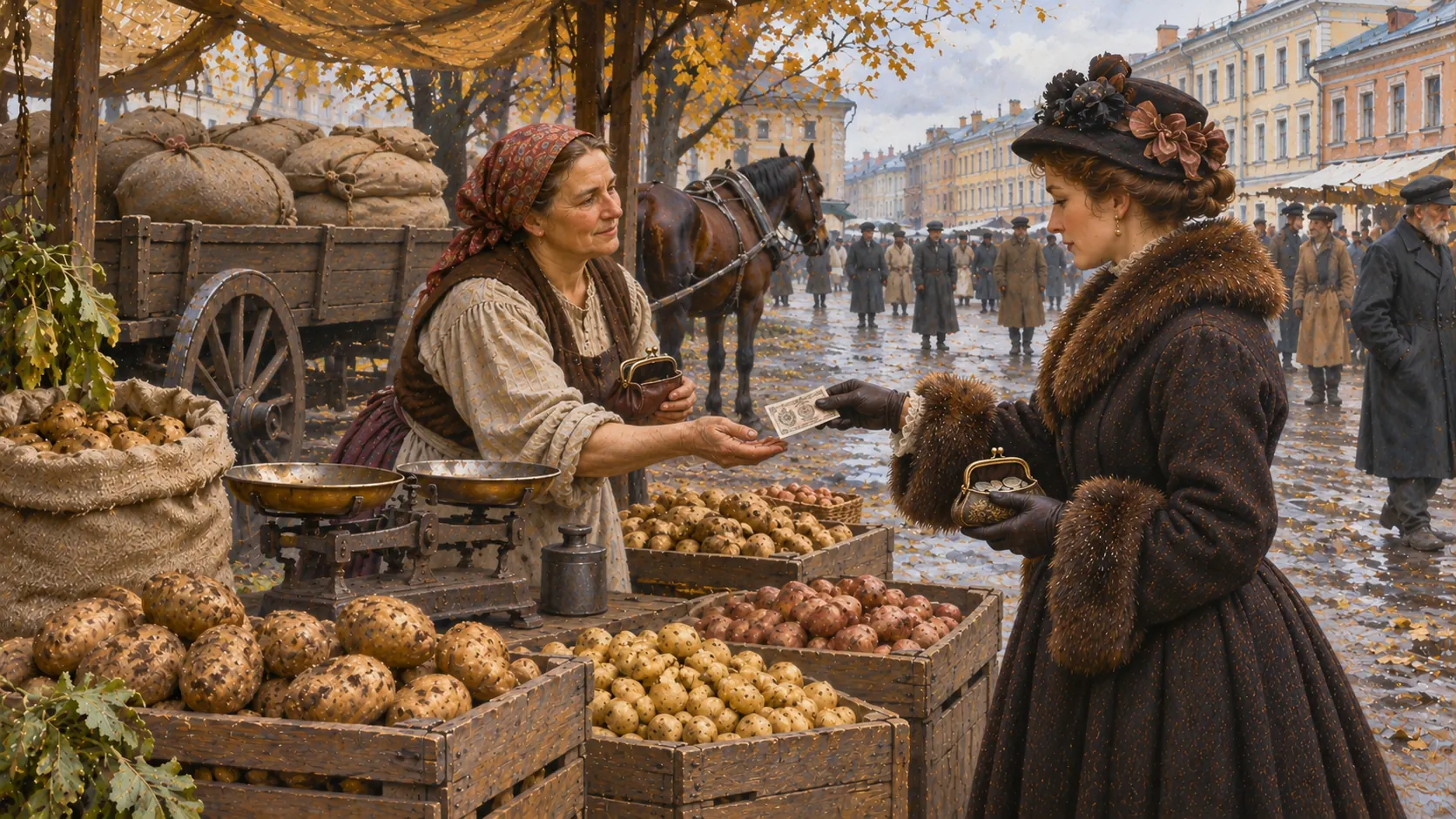
Two scales of the same story
Recipe No. 4029, “Growing Potatoes,” and No. 4033, “How to Keep Potatoes Through Winter,” show how a household manual discussed cultivation and storage. Section VI describes the dishes potatoes could become. A historical survey of potato cultivation in the region and the Brockhaus and Efron account of St. Petersburg District provide a wider economic setting. Recipes do not amount to statistics on the country's diet.
Potatoes did not become commonplace everywhere at once
The potato was not an ancient, indispensable feature of every Russian kitchen. Its adoption took decades and varied by region. Reports of early plantings do not establish mass consumption. During the nineteenth century the state repeatedly attempted to expand potato growing through compulsory measures, and opposition became associated with the so-called “potato riots.”
Historical materials from the Free Economic Society connect a renewed phase of official pressure to the years 1840–1842. The disturbances, however, should not be reduced to peasants disliking a new vegetable: property relations, obligations and methods of coercion also mattered. Conditions in particular state villages cannot stand for the experiences of the whole Russian Empire.
By the late nineteenth century the position had changed in some districts. Farms near a major city could cultivate potatoes not as a novelty but as a crop for sale. The proximity of fields, urban markets and a large body of potential customers was especially important around St. Petersburg.
Suburban fields and the St. Petersburg market
The article “Potato Desyatinas,” published in St. Petersburg Vedomosti, traces the expansion of planting in the governorate through the nineteenth century. In certain districts potato growing was already extensive during the 1830s and 1840s; by the century's final decades, suburban peasant households raised potatoes and market-garden produce for urban customers.
The encyclopedic article on St. Petersburg District explicitly notes that potatoes were produced chiefly for sale, while the bread that local families lacked had to be purchased. That observation reveals an important principle: land could support a family not only through crops eaten at home but through money earned from selling them.
Yet a statistic for one district cannot describe the whole governorate. The city could receive potatoes from other areas as well, and these sources do not allow us to trace each sack to a particular greengrocer.
From cart to shop: the people between field and buyer
A crop had to be cultivated, lifted, sorted, transported and sold before it reached a city table. For farms around St. Petersburg, the distance to market mattered: carriage by horse required time, equipment and money.
Our English study of vegetable trade examines wholesale carts, dealers and the Sennaya Market. Potatoes belonged to this wider story as a crop that could generally be transported and stored more easily than tender greens. Without a particular merchant's accounts, however, it would be misleading to assign potatoes one fixed “ordinary” price across all St. Petersburg markets in 1901.
The buyer saw a sack or basket of tubers rather than the months of field labor behind them. Following the crop into the city brings growers, carriers and shopkeepers into a culinary history usually dominated by recipes.
What Molokhovets advised about cultivation
In No. 4029, Molokhovets recommends mature tubers for planting, cutting large ones into pieces with eyes, preparing loose soil and spacing the planting rows. This is not a dinner recipe: it deals with organizing agricultural work. The quantities of planting material and manure are given per desyatina, a historical measure of land rather than a kitchen quantity.
No. 4030, “Growing Potatoes from Seed,” describes another method, producing seeds from potato berries. That does not contradict propagation from tubers; it is an alternative method of reproducing the plant.
The fertilizer quantities and agronomic practices recorded in 1901 should not be adopted uncritically today. Modern soil conditions, cultivation standards and environmental or food-safety requirements must come first. Historically, the remarkable feature is that the household cookbook paid attention to potatoes long before they were brought into the kitchen.
Winter stores: potatoes as a longer-term calculation
“How to Keep Potatoes Through Winter,” No. 4033, discusses building an outdoor storage mound on dry, raised ground, with straw, earth and a ventilation passage. Molokhovets pays attention to drainage, frost and adjustments during thaws.
Such instructions show why storage was part of household economics: keeping the autumn harvest determined how long it remained available. Yet the book cannot guarantee that a mound built by those directions would preserve every potato until spring. Weather, tuber condition and construction quality all varied.
This is a historical description, not current storage guidance. Modern requirements for ventilation, temperature, humidity and safe food handling should be obtained from contemporary agronomic authorities.
One crop, many dishes: from soup to cutlets
In No. 616, cooked potatoes are combined with butter, herbs and broth. In No. 627, they become mashed potatoes with butter and hot milk. These are already two quite different side dishes from the same crop.
“Potato Cutlets,” No. 630, combines boiled potatoes with eggs and flour, coats them in breadcrumbs and fries them, with mushroom or milk sauce suggested for serving. The second part of the book also contains No. 2459, a different potato-cutlet recipe with a range of sauces. Similar titles do not guarantee identical preparation.
No. 166, “Potato Purée Soup Without Meat,” uses potatoes as the basis of a first course. The existence of these recipes does not establish that the dishes were everyday or inexpensive for all families: butter, milk, eggs and accompanying sauces also had to be acquired.
Potatoes and herring: the garden meets the fish trade
No. 639, “Potato and Herring Vinaigrette,” combines boiled potatoes with herring, onion, egg yolks, mustard, vinegar and Provençal olive oil. But vinaigrette could name other, more elaborate dishes in the book.
For No. 2461, “Hot Potato and Herring Vinaigrette,” potatoes are mashed, mixed with chopped herring, topped with breadcrumbs and baked. The same pairing becomes either a cold dish or a hot one.
This is a natural companion to the Russian study of herring from barrel to appetizer table. On one plate, products from different economic chains—the fishing trade and the potato field—could meet.
Beyond lunch: potatoes in bread and starch making
No. 3688, “Sieve Bread with Potatoes,” introduces cooked potatoes into bread dough, treating the tuber as an ingredient in a flour-based product rather than a side dish. No. 3612, “Potato Flour,” describes extracting starch through washing and settling material from grated potatoes. The term “flour” here should not be silently translated as ordinary wheat or rye flour.
The household text thus records several uses of a harvest: cooked dishes, dough and starch production. Historical accounts of industry in Yaroslavl Governorate also mention processing potatoes into starch and syrups in the second half of the nineteenth century. These general examples do not establish what proportion of potatoes grown around St. Petersburg was processed in factories.
What this history can—and cannot—prove
Read together, the historical sources and recipes show that by 1901 potatoes had entered three interconnected worlds: agriculture, urban commerce and domestic cooking. The tuber served many purposes, while maintaining stores through winter was a distinct economic task.
Molokhovets' recipes are not a diary of the average household, and district-level statistics are not a detailed map of every quarter of Petersburg. They do not prove potatoes were equally affordable everywhere, that they had entirely displaced turnips, or that every urban resident regularly ate the recipes of Section VI.
The line between cultivation advice, economic testimony and a finished dish is precisely what makes the potato's history worth studying. An ordinary-looking ingredient connects the labor of the field, the supply of a city and decisions in a household kitchen.
Sources and original recipes
Further recipes: growing from seed No. 4030, mashed potatoes No. 627, potato cutlets No. 630, herring vinaigrette No. 639, potato starch No. 3612 and potato bread No. 3688. For historical context see Brockhaus and Efron on St. Petersburg District and the Free Economic Society.