Molokhovets's Croquettes: How Pasta, Rice and Eggs Became Little Pies
Four kinds of croquettes from the 1901 cookbook: pasta, rice, potato and egg bases, breading and serving with soup.
What little croquette pies meant
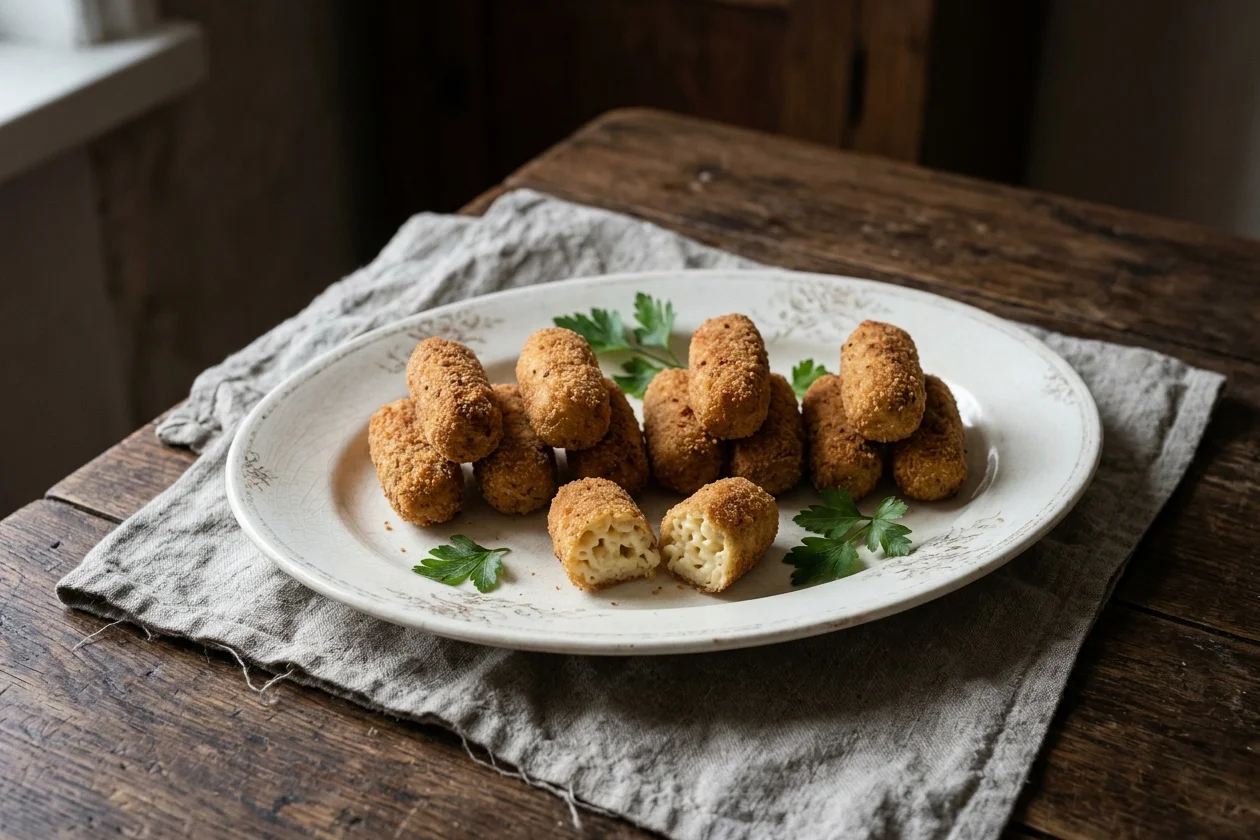
No. 375 concerns little croquette pies made from Italian macaroni. Unlike small pies in which filling is enclosed in rolled pastry, the main mixture itself forms the item. It consists of cooked pasta and a thick binding base. The croquettes are coated with breadcrumbs. The author uses the word little pies to describe their shape and manner of serving but does not describe a separate pastry crust. This shows that a historical name does not always establish the presence of a flour-based shell.
Pasta, béchamel and Parmesan
In No. 375, macaroni is boiled and combined with béchamel, yolks and grated Parmesan. The mixture is spread on a dish and cooled so that it can be divided into elongated pieces. Each piece is coated with cheese, egg and grated stale bread. Cheese is therefore used both inside and on the surface. Béchamel helps bind the pasta pieces, but the exact firmness depends on the flour, milk and degree of thickening. The source does not specify a modern portion weight.
Rice shaped while still warm
In No. 376, Molokhovets chooses Carolina rice, cooked until soft in stock with butter. The croquettes are shaped before the rice cools. Their exterior consists of yolks with Provençal oil and grated white bread. No. 751 describes another way of giving such a rice mixture an elongated shape; a filling may be used or omitted. Unlike the pasta version, cooked rice is the principal binding component. Liquid proportions depend on how the grain behaves during cooking, so the author suggests replenishing stock or water as it diminishes.
Croquettes made from boiled eggs
No. 290 presents an unusual version: hard-boiled eggs are finely chopped and mixed with thick béchamel and a little Parmesan. Once cooled, the mixture is divided into portions and shaped into elongated pieces. Egg-and-bread coating follows. Eggs thus serve twice, as the base and as part of the coating. The author suggests serving the croquettes with broth or green shchi made from sorrel and spinach. Rather than simply frying eggs, the recipe transforms an already cooked product into a shaped appetizer.
A potato base and a different accompaniment
In No. 628 the base is hot sieved mashed potatoes. Yolks and potato flour are added, and the mixture is shaped into balls or elongated pieces and coated with rusks. The author specifically associates this kind of croquette with roast meat. Unlike the pasta and egg versions, it does not require béchamel. Four entries thus demonstrate different ways of creating a cohesive mixture. The common features are shaping small pieces, coating the outside and browning, while ingredients and culinary roles can differ substantially.
Why they were served on a napkin with herbs
Nos. 375, 376 and 290 repeatedly specify serving on a small dish with a napkin and herbs. Before serving, the pieces are placed on a sieve or absorbent paper. This separates frying from final presentation. Historical instructions concerning very hot frying fat are not modern safety guidance: controlled conditions and suitable cookware are required. An illustration of assorted croquettes can convey the differences between bases, but cannot establish mandatory historical sizes or exact shapes.
Original recipes and sources
Elena Molokhovets, A Gift to Young Housewives, 1901 edition. Links to scans are available on the original Russian recipe pages.