From Saracen Millet to Pilaf: Rice in Russia Around 1901
An investigation of imported rice, historic trade names, Caspian commerce and original Russian dishes from the 1901 cookbook.
Rice is easily imagined today as a side dish, porridge or filling. In Elena Molokhovets' 1901 cookbook, however, it has many more roles: it is added to broth, combined with mushrooms and viziga, prepared with hazel grouse and crayfish butter, transformed into pudding and served with cranberries. The recipes use such names as “Carolina rice” and “Saracen millet.” Why did this grain have different names, how did it reach Russia, and what can we really know about the people who bought it?
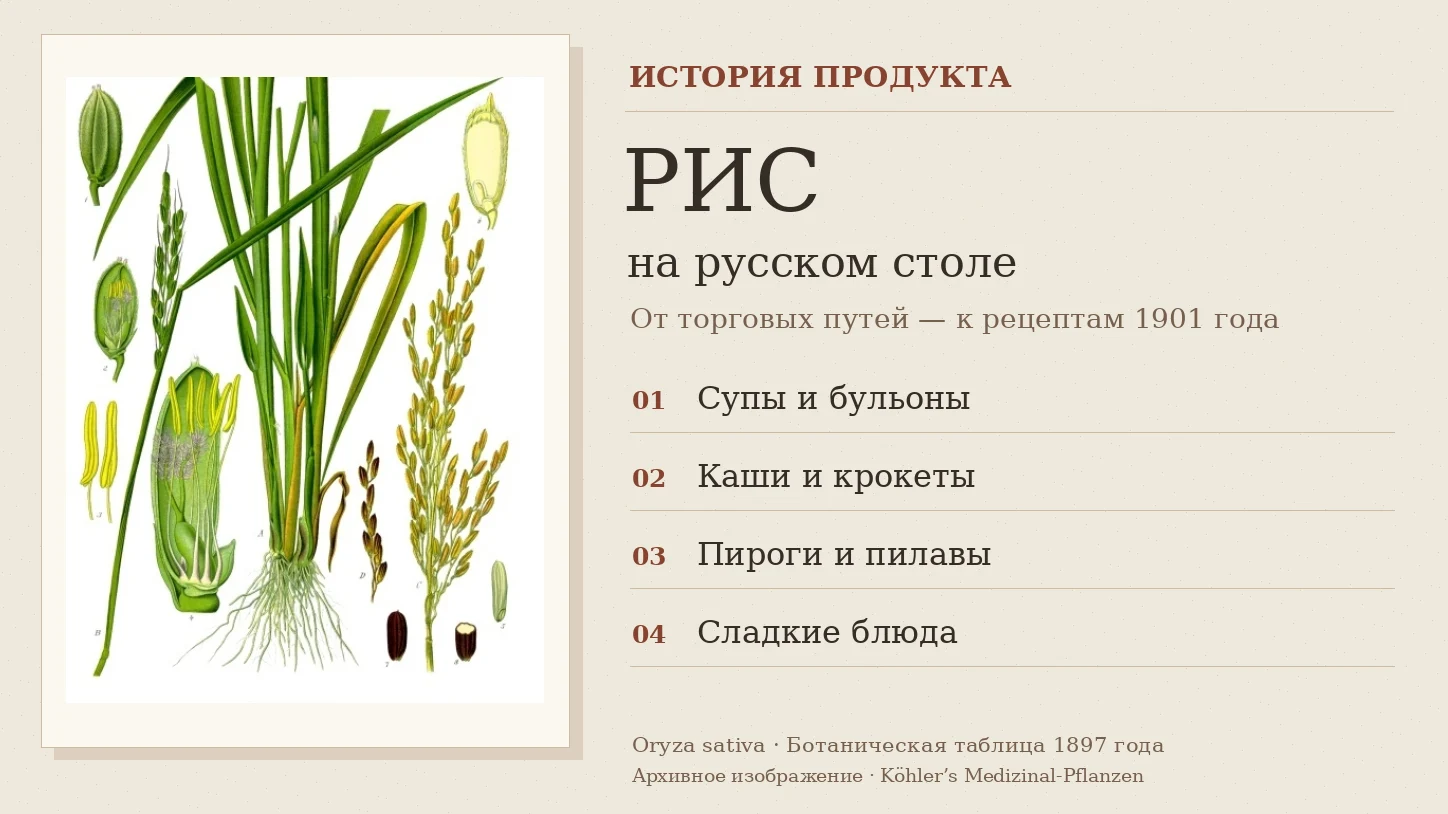
A trade name is not a receipt for a particular shipment
In porridge No. 382 and croquettes No. 376, Molokhovets specifies “Carolina rice.” The name recalls the history of rice exported from Carolina in North America, but it does not prove that every packet sold under that name in Russia was actually grown there. Other sources document rice imported from Persia through the Caspian region. An invoice or customs record would be needed to establish the provenance of an individual lot.
“Saracen millet”: why rice had another name
No. 2335, “Almond Milk Soup with Saracen Millet,” preserves an old Russian name associated with rice in culinary and trade language. The preceding recipe, No. 2334, refers directly to rice and sago. The terms occur in adjacent entries of the same edition.
Curiously, No. 2335 suggests using “Saracen millet” instead of the rice specified in the previous recipe. Historical dictionaries may identify both terms with rice, so the contrast is not immediately clear. Perhaps size, grade or an editorial difference lay behind it, but the page does not establish which explanation is correct. We retain the author's distinction instead of silently “fixing” it.
A study of nineteenth-century trade through Astrakhan likewise records a variant, “Sarochin millet,” among Asian food products. The term links domestic cooking vocabulary to commercial records without telling us the price or origin of any particular household purchase.
Carolina rice and the Atlantic trade
The Carolinas were important exporters of rice to European markets in the eighteenth and nineteenth centuries. The cultivation and export system relied on enslaved people's labor and agricultural knowledge. This is not a romantic tale about an exotic variety but part of the history of coercion, production and trade.
European merchants distinguished “Carolina” rice from other commercial types. As suppliers and trade practices changed, a familiar name did not necessarily provide a dependable geographical certificate for each grain. Molokhovets' use of the term establishes that it was part of her culinary vocabulary, not that we can reconstruct a specific plantation or voyage.
In No. 382, the grain is partly cooked separately and finished in broth. For No. 376, it is used to make rice croquettes. The author discusses handling and texture rather than the history of the overseas trade.
The Caspian route: rice from Persia
Encyclopaedia Iranica's research on rice describes cultivation in northern Iran, especially Gilan and Mazandaran, and sales to Russia. In the later nineteenth century some rice from Gilan was exported to Baku; other consignments were intended for food or for starch production.
Its account traces growth in exports from Gilan to Russia between 1874 and 1892. These are figures for a particular trade direction and period, not the total rice consumption of the Russian Empire in 1901. Nor can we assume that rice purchased by a St. Petersburg family necessarily passed through Baku.
A separate history of Gilan also describes the expansion of rice production and exports in the nineteenth century. The cookbook therefore stands at the intersection of several commercial networks, not a single imaginary “rice route.”
Astrakhan and the eastern trade
A study of Russian trade with eastern countries via Astrakhan lists rice among foods arriving during the first half of the nineteenth century alongside fruit, spices and nuts. Astrakhan was not merely a market for local consumption; much of the cargo continued into wider distribution networks.
Rice could pass through wholesale purchase, storage and resale long before it reached a recipe. The study concerns an earlier period, however. Its figures cannot simply be carried forward to 1901. Trade in rice may also have differed markedly from the vegetable markets described in our study of Petersburg market gardeners.
Rice in a monastery's accounts: more than festive food
Historians A. E. Videneeva and E. I. Sazonova examined accounts of the Rostov Spaso-Yakovlevsky Monastery in the second half of the nineteenth century. Rice, also called “Saracen millet,” appears among purchases of groats alongside buckwheat, pearl barley and millet. The published research reports about 22–23 poods each of pearl barley and rice in 1875, and roughly 8–13 poods for rice and buckwheat in 1894.
These are records of real purchases by one institution rather than a cookbook's recommendations. They show that rice was not merely a literary luxury. But a monastery had its own population, fasting calendar, finances and arrangements; its purchases must never be used as the average diet of a Russian family.
Rice in soup: grain as part of a clear broth
No. 240, “Rice,” concerns preparing the grain for serving with broth. Molokhovets suggests either cooking it in strained stock or briefly scalding and cooking it separately to keep the broth clear. The alternatives balance the character of the soup and the desired texture.
In rice porridge No. 382, the grain is washed and scalded before finishing in rich broth, then offered with meat soup. Despite the name “porridge,” this can be an accompaniment to a first course rather than an independent bowl of cereal.
Such details demonstrate how strongly the author valued the texture and appearance of cooked rice. They are not a modern guide to cooling or storing it safely.
Pies and pilaf: rice with fish, viziga and chicken
For No. 2370, “Pie with Viziga, Rice and Fish,” rice is cooked separately with aromatic vegetables, fish stock and herbs. Viziga—the prepared notochord of a sturgeon—is treated beforehand. Our English study of viziga explains the historical ingredient.
In No. 1023, “Chicken Pilaf with Rice,” the grains are added over browned chicken and stewed with the meat. The two dishes illustrate different uses: a prepared filling and a grain-and-meat dish cooked together.
Rice also appears in Lenten or meatless foods, including mushroom-and-rice pies No. 2393 and rice with mushrooms No. 2683. Calling it only “a luxury side dish” would overlook these parts of the source.
An “Italian risotto” and saffron rice
Molokhovets labels No. 1777, “Rice with Hazel Grouse,” an “Italian risotto.” Game is combined with rice, stock, tomatoes, mushrooms and Parmesan. That does not make the recipe identical to a particular contemporary Italian restaurant preparation; its composition and sequence are those recorded by the author.
In No. 1775, “Fluffy Rice with Saffron,” the prepared rice is fried in butter, liquid is gradually added, and saffron and Parmesan contribute aroma and flavor. Rice, saffron, cheese and game have distinct geographical histories.
A borrowed culinary style and the provenance of an ingredient are separate questions. “Italian” refers to the way the author characterized the dish, not the origin of a specific sack of rice.
Rice at the sweet table: cranberry, orange and almond milk
Rice could be sweet. In No. 2680, fluffy rice is combined with sugar and raisins and served with almond milk or jam. No. 1608 pairs rice with almonds and concentrated cranberry juice, bringing a regional berry flavor to the grain.
No. 2627, “Cold Rice with Oranges,” uses syrup, zest and sections of fruit. No. 1597 is a cold rice pudding with apples and fruit syrup. These differ greatly from the idea of rice as a plain addition to meat.
Imported citrus and local berries could be combined with sugar and rice, but the existence of a recipe cannot prove that every family could afford such desserts.
Why so much washing and scalding?
Many recipes call for washing rice, draining it through a sieve, briefly scalding it and then cooking it in stock or milk. Molokhovets used these steps to manage separation of grains and the cloudiness of cooking liquid. Rice for pastry fillings might be cooked separately before combining it with other ingredients.
The techniques do not tell us the exact condition of every shipment in the rice trade of 1901. They could reflect the intended dish, a grade of grain, its processing or the author's preferences. Nor does the word “Carolina” identify the polishing process of every batch.
Historical recipes are useful evidence about desirable textures and forms of service, but cooked rice requires timely cooling, safe storage and reheating according to contemporary food-safety guidance.
One product, several trade routes and many dishes
In Molokhovets, rice brings together “Saracen millet” from older culinary language, “Carolina rice” from trade terminology, imports through Persia and Astrakhan, documented monastery purchases, and finally soups, pies, pilaf, porridges and desserts.
No single source proves that all rice in 1901 had one origin or that every household cooked all these dishes. Together, they show how an internationally traded grain became part of a local kitchen and how a cookbook preserves traces of its commercial history.
Original recipes and research
Trade evidence: Encyclopaedia Iranica, Astrakhan trade research and monastery purchasing records. More recipes: rice for broth No. 240, pilaf No. 1023, “Italian risotto” No. 1777, cranberry rice No. 1608.