Petit Choux: Historical Pastries With and Without Filling
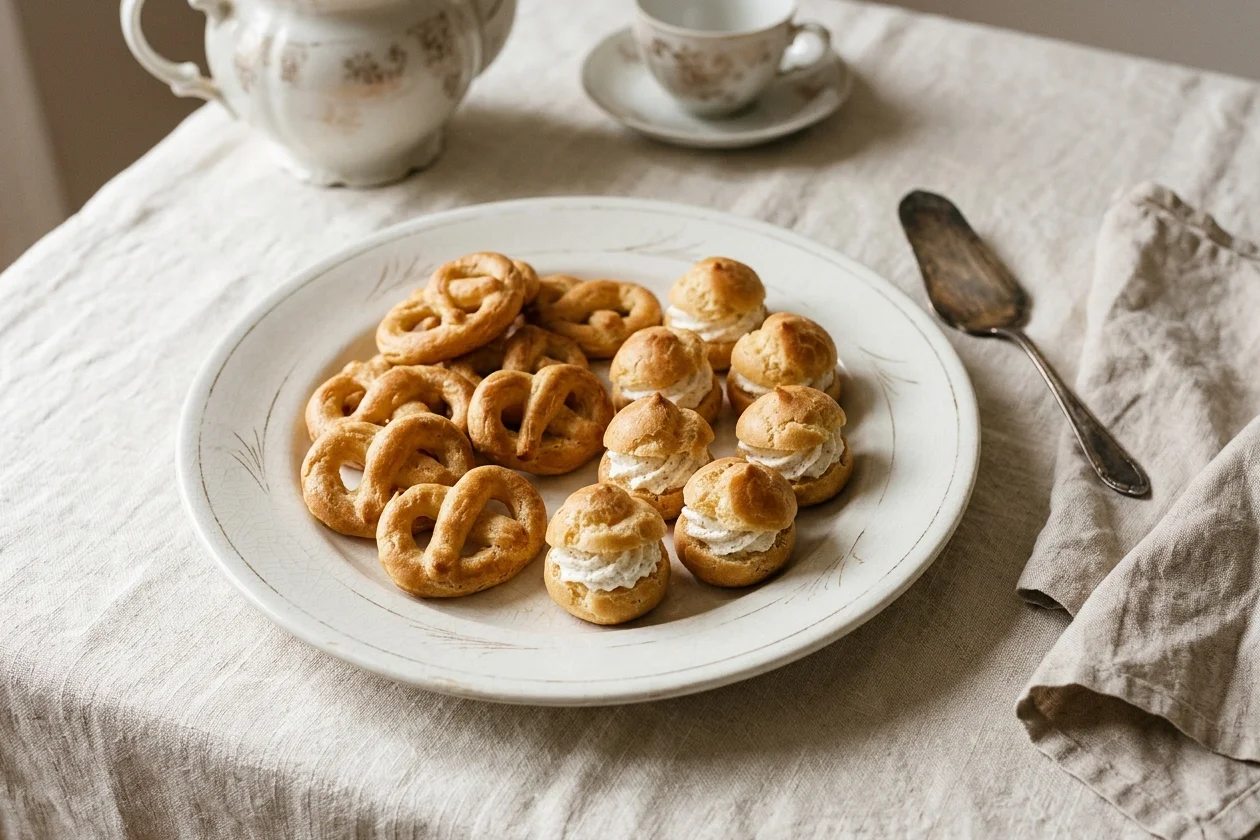
Three recipes, Nos. 1864–1866: cooking flour into choux pastry, small pretzel shapes and buns filled with whipped cream or sweet béchamel.
What petit choux meant
In No. 1864 Molokhovets describes petishu, small choux pastries that may be shaped like pretzels. She suggests serving them at dinner in place of a sweet pastry, and with tea or coffee. Filling is not obligatory in the main version. Only No. 1866 specifically concerns filled buns. It is therefore inaccurate to equate every petishu in the book exclusively with modern éclairs or profiteroles. Those names offer readers a useful point of reference, but the shape and composition of each historical item are established by its own text.
How flour became choux pastry
In No. 1864, water with melted butter and salt is brought to the boil, then flour is added and stirred vigorously until the dough pulls away from the saucepan. Once removed from the heat, eggs are added one at a time to achieve smoothness. Contact with hot liquid causes flour starch to swell and alters the mixture's properties. During baking, water in the dough turns to steam and contributes to expansion. The extent of rising depends on moisture, portion size and heating. The author gives neither an exact oven temperature nor the weight of each pastry.
A different proportion and yield
No. 1864 says that the stated quantities yield twenty-four pieces. No. 1865 gives a different proportion: one glass of water, one glass of melted butter, one and a quarter glasses of flour and six or seven eggs. The comparison shows that the author offers several choux mixtures rather than a single formula. Volume measures of flour and butter should not be confused with weight measures without clarification. The first recipe also permits lemon zest and a sprinkling of sugar and finely chopped almonds.
Pretzel shapes and filled buns
In No. 1864 the dough is laid out in small mounds, and water may be used to form a hole in each, producing pretzel shapes. No. 1866 proposes a different appearance: the pastries are baked like small buns, cut across and filled. When whipped cream is used, the author specifically calls for excess liquid to drain through a sieve first. This relates to the desired firmness of the filling, although the book does not measure its moisture content. Sweetened cream is a separate preparation; the choux shells themselves need not have been very sweet.
Sweet béchamel and the horn of plenty
The other filling in No. 1866 is called béchamel, flavoured with zest, vanilla or flower water. The available digital text of its proportions appears incomplete: thickening is mentioned, but the principal thickener is not explicitly identified. We do not reconstruct it by guesswork. Sweet béchamel is described more fully in No. 1839, puff pastries shaped like horns of plenty. Their shape is produced by wrapping strips of pastry around a special rod, not by expansion of choux pastry. Both may be filled with a sweet mixture, but their shells are made by fundamentally different techniques.
How to picture petit choux today
Molokhovets's variants allow simple pastry rings and cut buns filled with cream to be shown on one dish. Their precise size, browning and internal cavity cannot be guaranteed to match historical examples. A modern adaptation should use a validated choux pastry technique, bake the shells thoroughly and refrigerate cream or egg fillings. These entries are valuable for their variety of shapes and serving arrangements, and for preserving a familiar technique under a name now rarely encountered in Russian cookery.
Original recipes and sources
Elena Molokhovets, A Gift to Young Housewives, 1901 edition. Links to scans are available on the original Russian recipe pages.
- No. 1864 — Choux Petits Choux Russian original
- No. 1865 — Choux Petits Choux, Another Proportion Russian original
- No. 1866 — Choux Puffs Filled with Cream or Béchamel Russian original
- No. 1839 — Cornucopia-Shaped Puff Pastries with Sweet Béchamel Russian original
- No. 303 — Puff Pastry for Small Pies Served with Soup Russian original