Hazel Grouse Soup with Champagne: Why Wine Was Added Just Before Serving
Comparing Nos. 86 and 87: sieved game meat, white stock, cream, asparagus and an unusual wine addition.
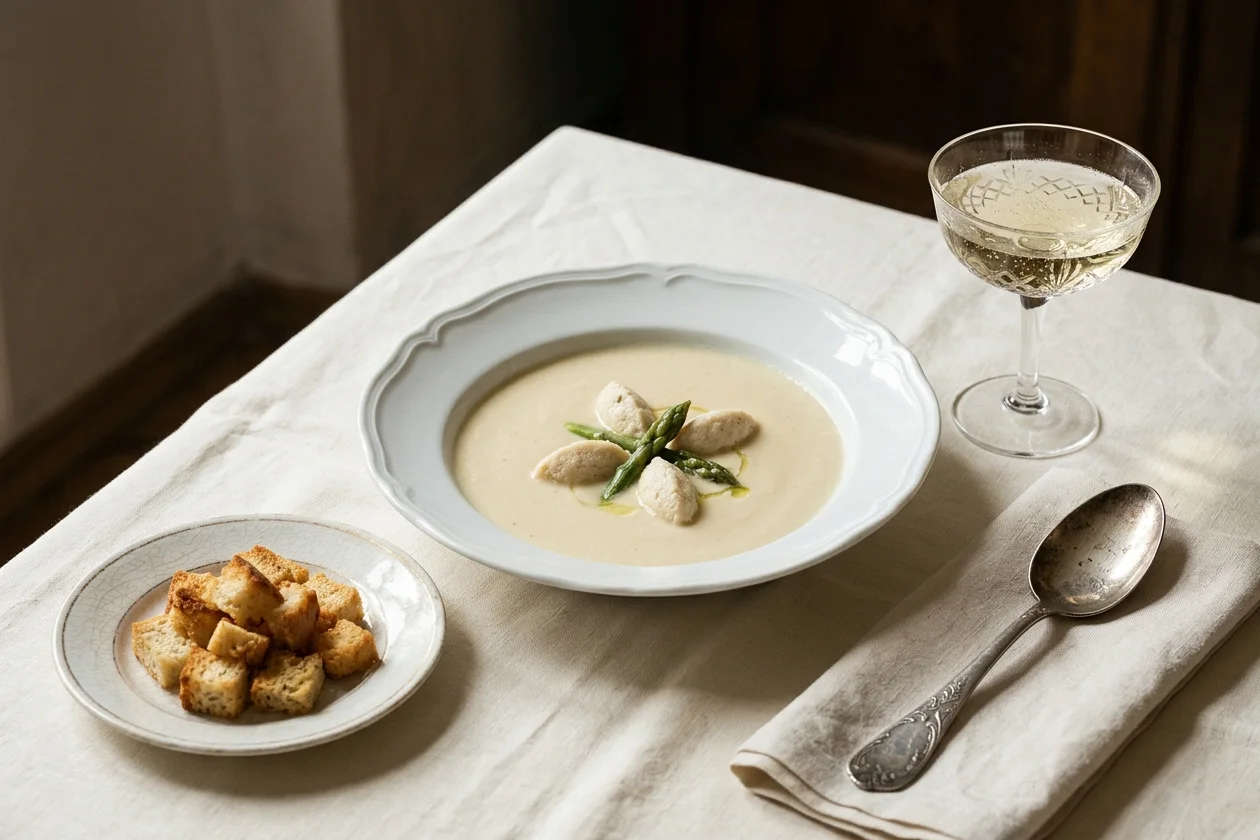
A soup in which champagne appeared at the last moment
No. 87 describes a purée soup of hazel grouse or pheasants with champagne. The drink is not the base for cooking the meat: it is added when the finished soup is served. Most of the work involves making white stock, frying the birds, separating meat from bones and turning it into a sieved mixture. This differs markedly from beer soups, where the drink forms part of the liquid base from the beginning. Champagne is an addition to an already assembled first course.
Which birds were allowed in one recipe
Although the heading names hazel grouse and pheasants, the text also permits snipes and woodcocks. Cooked meat is separated from bones, chopped, pounded and rubbed through a fine sieve. This explains why the dish is called a purée although its base is not vegetable. The entry gives no information about the availability of birds or the popularity of the soup in ordinary households. A modern interpretation need not seek game: safe edible poultry may be substituted if clearly identified as such.
How the meat purée was thickened
In No. 87 flour is separately toasted with a little butter, combined with stock and then mixed with the sieved meat. Yolks and thick cream are added. The ingredients serve different purposes: meat provides body, flour binds liquid, and cream and eggs affect richness and texture. The author calls for heating the soup until hot but gives no measurable temperature. This description does not replace modern safety requirements for meat and egg enrichment.
How Marie Louise soup differed
Preceding No. 86 is called game purée soup, Marie Louise. It also uses white stock, cooked poultry, yolks and cream, but specifies separately cooked and sieved pearl barley for thickening. Champagne is absent. Both recipes are served with asparagus and quenelles. These accompaniments reveal related elements of their composition, while differences in thickener and wine distinguish the dishes. Marie Louise is retained as the author's name without assigning it an undocumented origin.
Asparagus, quenelles and soup accompaniments
No. 87 places separately prepared meat quenelles and asparagus in the soup tureen. They retain their own form, unlike the sieved game. Sardine croutons, puff pastry pies or pies in shells are suggested as accompaniments. These are alternatives rather than a requirement to serve everything together. In the next entry, No. 88, cauliflower purée soup, the author similarly combines a sieved base with separately cooked pieces. This illustrates a general method of contrasting a smooth liquid and solid additions.
What can be said about champagne's role
Adding wine just before serving may suggest an intention to preserve some characteristic aroma, but Molokhovets gives no explanation. We cannot confidently claim that the soup foamed or retained a particular quantity of carbon dioxide: hot liquid affects the drink's behaviour. Since wine is added at the very end, the dish especially should not be regarded as alcohol-free. A reconstructed serving may show soup with quenelles and asparagus; the precise appearance and taste are not established.
Original recipes and sources
Elena Molokhovets, A Gift to Young Housewives, 1901 edition. Links to scans are available on the original Russian recipe pages.