From Northern Forests to St. Petersburg: The Hazel Grouse Trade
How hazel grouse and other game reached city markets, with original Molokhovets recipes and period evidence.
A hazel grouse in a northern forest and a roasted hazel grouse on a St. Petersburg table are two ends of a long story. Between them stood a hunter, a local buyer, a road, winter frost and a city-market trader. Elena Molokhovets described how to cook hazel grouse, partridge, black grouse and capercaillie, but said little about how such game reached a household. Late-nineteenth-century accounts help reconstruct the missing part of the journey.
Comparing different kinds of evidence
The kitchen evidence comes from Section VIII of the 1901 cookbook, covering poultry and game. The economic setting comes from the 1898 Brockhaus and Efron article on commercial hunting, a history of Cherevkovskaya Volost recording the trade in hazel grouse, and recollections of St. Petersburg markets from the 1890s to the 1910s. These are sources of different kinds, not comprehensive statistics for the whole empire.
For whom was hunting work, not entertainment?
The encyclopedic article “Commercial Hunting” (1898) presents hunting as an important source of income in several northern and northeastern governorates of European Russia—Arkhangelsk, Olonets, Vologda, Vyatka and Perm—as well as in parts of Siberia. Selling game could supplement other kinds of work.
Thus a bird in a city shop might have been supplied not by a wealthy sportsman on a recreational hunt, but by someone who depended on hunting for income. The value of that work, methods used and volume of the catch varied greatly by location. No single picture of the “northern hunter” can explain every shipment of game to Russian markets.
1894: a witness describes the journey to St. Petersburg
A particularly vivid account survives in the history of Cherevkovskaya Volost. It quotes artist Vasily Vereshchagin's description of a hunter he met in 1894: in autumn the man caught hazel grouse and sold them to a local buyer, then in winter hired himself out to accompany a shipment of birds to St. Petersburg.
According to this account, buyers paid hunters between 20 and 50 kopecks per pair, depending on the year. For 1893, the description names a purchase price of 35 kopecks and a sale price of 48 kopecks per pair. These figures belong to a particular trading episode. They are not national averages, and they do not show all the middleman's costs.
The journey to Petersburg and back reportedly took about two weeks. The birds traveled in a caravan of horse-drawn carts and were sold wholesale at Sennaya Square. Seasonal hunting, a local buyer, road transport and the capital's wholesale trade formed one chain. None of those occupations is visible when a reader opens a recipe for roasted grouse.
Winter was both a means of transport and a trading season
For perishable produce, freezing weather could make long journeys easier, and frozen game became a conspicuous winter commodity. Natural frost is not the same as modern continuous temperature monitoring; frozen birds on a market stall were not necessarily microbiologically safe.
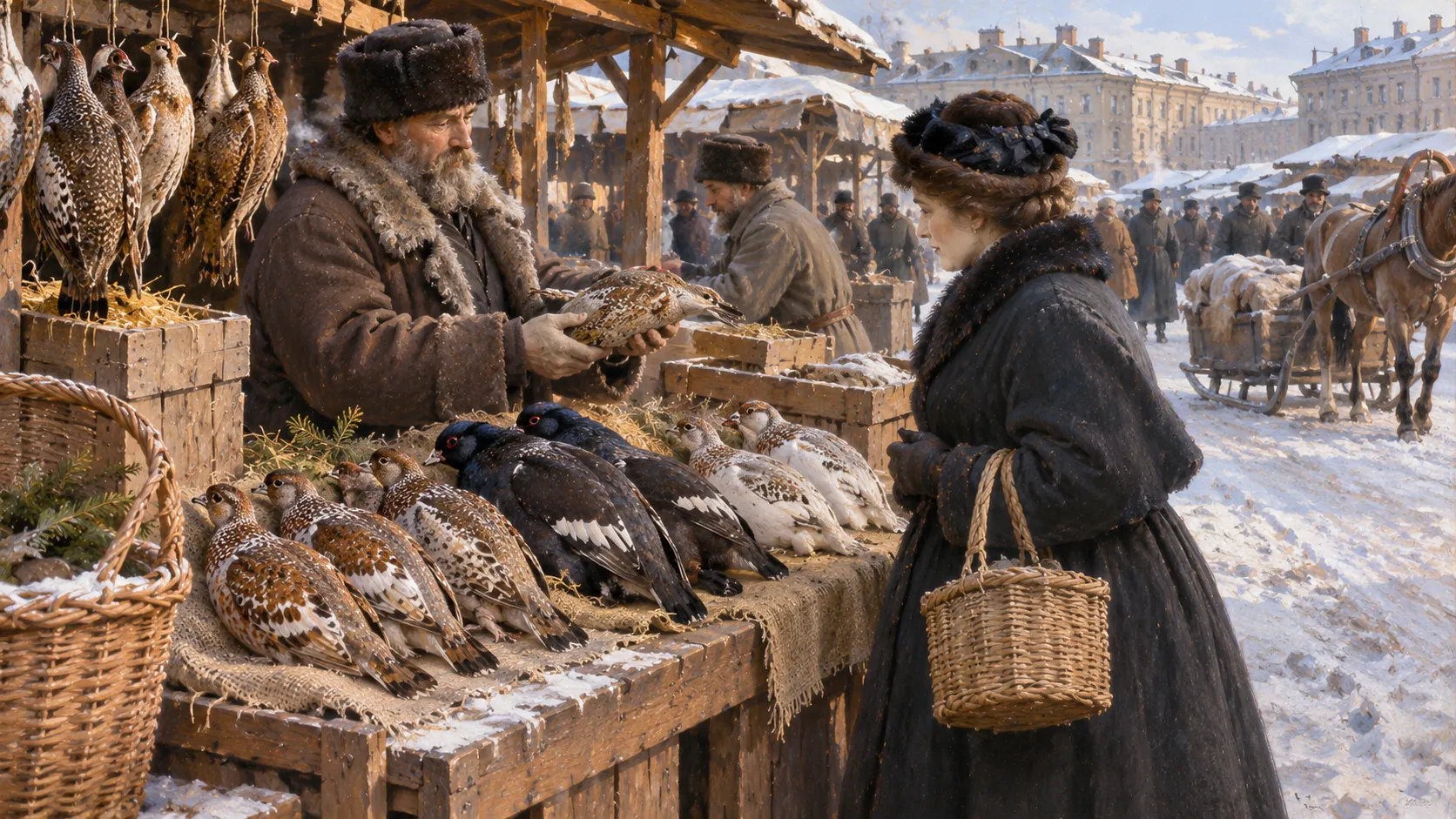
In Life in St. Petersburg in the 1890s–1910s, Dmitry Zasosov and Vladimir Pyzin recall meat rows becoming full of geese, turkeys, capercaillie, hazel grouse, black grouse and partridges near Christmas. They also mention frozen hares hanging head down.
Such memories convey the appearance of a market, but are not inventory ledgers. They cannot reveal how many birds were sold, the share of wild versus domestic poultry, or the retail price for every season.
From wholesale buyer to urban customer
In Vereshchagin's story, Sennaya Square was the destination for wholesale sale. The market memoirs also describe stalls where urban customers bought meat and poultry. Game did not necessarily go straight from the cart to a private kitchen; different areas and merchants specialized in various products.
Each stage cost money or labor: hunting, gathering a sufficient lot, transporting it, receiving and storing the shipment, and retailing it. The difference between the hunter's price and a city price would therefore not simply equal one dealer's profit. Without detailed accounts we cannot assign precise margins.
Our English study of the Sennaya fish trade describes a somewhat comparable chain with different supplies and seasonality. Fish and game could appear on the same dining table, but the economic routes behind them were not identical.
What happened to hazel grouse in Molokhovets' kitchen?
In No. 1109, “Roast Hazel Grouse,” the bird is cooked with butter and may be served with sour cream or cream, breadcrumbs and parsley. No. 1110, “Hazel Grouse with Sauce,” takes another route, cooking it gently in sour cream. No. 1112 makes cutlets from portions of the bird and proposes mushrooms or asparagus alongside.
Hazel grouse was thus not restricted to a single ceremonial roast; it could be prepared in several ways. The same chapter includes roast capercaillie No. 1091 and roast partridges No. 1100. These recipes show the game familiar to the author, not the food accessible to every household.
Such dishes might require butter, sauces and other costly ingredients in addition to the bird. We should not project this range of culinary possibilities onto the everyday diet of the whole country.
Attempts to keep game until later
In the second part of the book, No. 4048, “Preserving Hazel Grouse and Snipe,” describes a reserve of birds: they were partially cooked, placed in a small barrel and covered in melted butter, then kept on ice. The procedure demonstrates how important the interval between purchase and eating could be for a household.
An even more striking passage is No. 4047, “Refreshing Spoiled Hazel Grouse,” which recommends treating birds that had already deteriorated. This is a document of historical assumptions about keeping food. It is not a safe way to restore the quality of spoiled meat, and must not be reproduced.
Neither entry proves that its method always worked or was equally common. Preserving the historical text together with a clear warning is more useful than presenting the procedure as tested modern kitchen practice.
One bird could become more than one meal
No. 1129, “Pudding from Leftover Game,” makes use of roast meat left from a previous meal, combining it with eggs, butter and bread. No. 1117, “Hazel Grouse Butter for Breakfast,” makes a dense spread from roasted bird meat and dairy butter, sometimes with truffles or cheese.
The modern meaning of “butter” can be misleading here: the name refers to a prepared meat appetizer, not just a dairy fat. Similar historical naming practices occur in our Russian study of “hare cheese.” Such dishes illustrate using food already cooked, not recommendations for modern storage of meat beneath a layer of fat.
What is known, and what remains unknown?
These sources support the existence of commercial hunting in northern areas, the role of middlemen, winter deliveries of hazel grouse and city sales of wild birds. Molokhovets' recipes demonstrate a range of culinary techniques for game.
They do not provide the full route of every grouse, reliable annual average prices, the volume of all retail sales or the proportion of game consumed by different social groups. One eyewitness story, memories of a market and a cookbook answer different questions. They should be compared without inventing missing details.
That is why the journey from northern forest to household kitchen deserves attention. It returns otherwise invisible workers to food history and shows that even a small bird on a formal dinner plate might have traveled far.
Historical sources and original recipes
Further evidence: Brockhaus and Efron, “Commercial Hunting” (1898); Zasosov and Pyzin on the Petersburg markets; and a 2015 study of trade in the Cherdyn–Pechora region. Original recipes include grouse in sour cream No. 1110, leftover-game pudding No. 1129 and grouse butter No. 1117.