Krupenik: Curd Cheese Bake or Grain Pudding?
Two neighboring recipes, Nos. 2826 and 2827: curd cheese with semolina or buckwheat, and a very different krupenik boiled in a cloth.
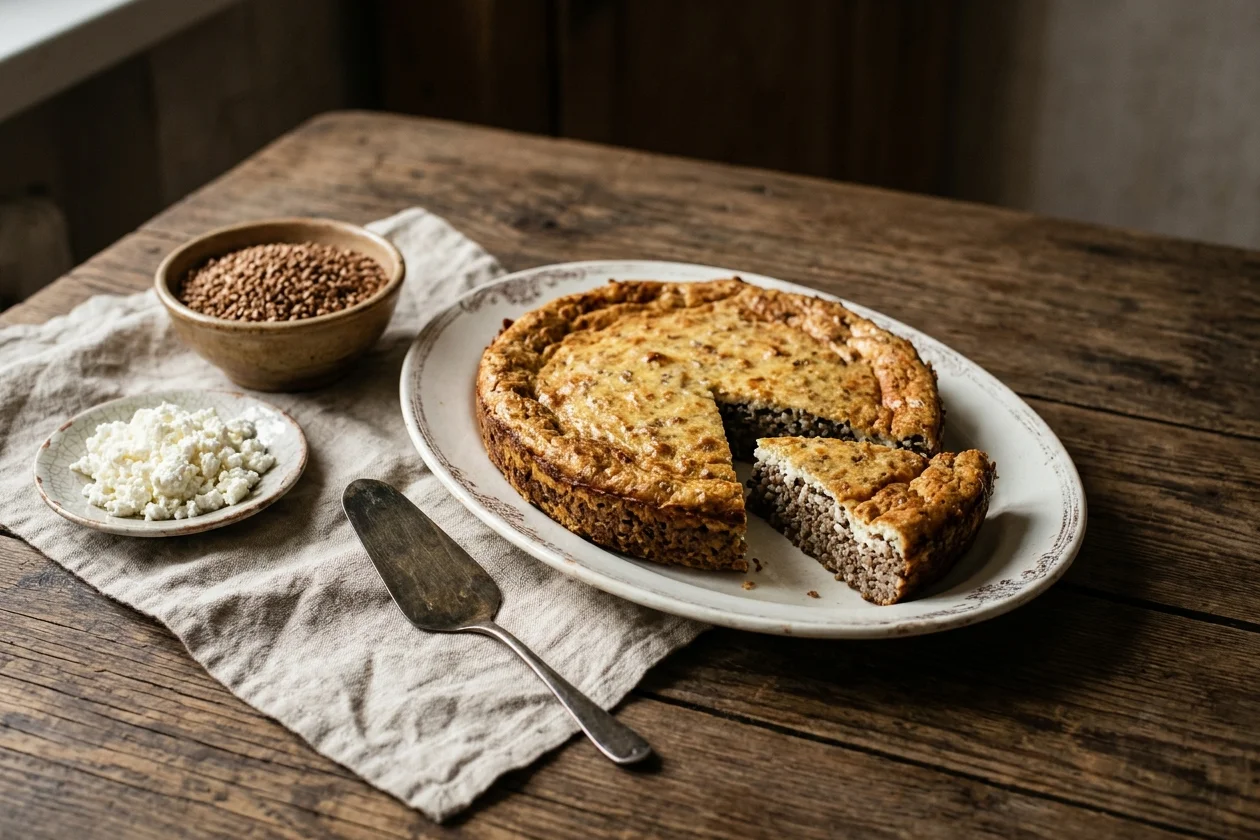
Two krupeniks in one supplement
No. 2826 gives krupenik with curd cheese, while No. 2827 describes krupenik of mixed groats. Both appear in the supplements; the first explicitly refers to Section XVII. The modern association with a buckwheat bake fits only one version. The author herself calls the second dish a pudding in the serving instruction. It contains no curd cheese and is not baked. This is an important feature of historical names: a shared heading does not guarantee the same composition or method.
Curd cheese and a choice of grain
No. 2826 requires fresh pressed curd cheese rubbed through a sieve. Raw semolina, salt, two whole eggs, butter and milk are added. Buckwheat groats may replace semolina, and in that case fresh sour cream may replace milk. Semolina is the first specified option, buckwheat an explicit alternative. It would be inaccurate to claim that authentic Molokhovets krupenik was necessarily made only with buckwheat. Sugar and preserves are not named.
Why curd cheese was sieved first
Pressed curd cheese has already lost much of its whey. Sieving reduces large lumps and facilitates mixing. Eggs form a cohesive structure when heated, and groats absorb some moisture. Milk or sour cream changes the mixture's moisture and richness. This explanation rests on ordinary ingredient properties; Molokhovets does not establish exact moisture or thickening strength. The historical entry cannot guarantee a uniformly crumbly or firm bake.
Mixed groats and dried currants
No. 2827 specifies equal quantities of sarachin millet, oat and buckwheat groats, rice and dried currants, one Russian pound in total. There is a noteworthy terminological issue: historically sarachin millet meant rice, yet the author lists it separately beside rice. We retain this distinction without correcting it by guesswork; it may reflect different commercial varieties or a textual feature. Dried currants are small dried grapes rather than grain. They supply sweetness although the recipe also contains salt and meat stock.
Why the second krupenik was boiled in cloth
The mixed ingredients are bound with eggs, placed in a buttered cloth and boiled in rich meat stock. The cloth holds the mixture together as the grains and eggs change structure. This differs fundamentally from the first recipe, which uses a saucepan and baking. The finished pudding is covered with deeply browned butter. Egg quantity, boiling time and stock volume are unspecified. Filling these gaps with arbitrary numbers would not produce a guaranteed modern recipe.
What the two versions have in common
Grain is important to both cohesive mixtures, but its role differs. In the curd version it complements a dairy base; in the mixed version it is a principal component alongside eggs and stock. An artistic illustration may depict the curd-and-buckwheat bake and identify it as the No. 2826 version. Comparing the entries reveals the breadth of the historical term krupenik rather than reducing it to one familiar modern recipe.
Original recipes and sources
Elena Molokhovets, A Gift to Young Housewives, 1901 edition. Links to scans are available on the original Russian recipe pages.