Brain Pudding: Why Molokhovets's Puddings Were Not Always Desserts
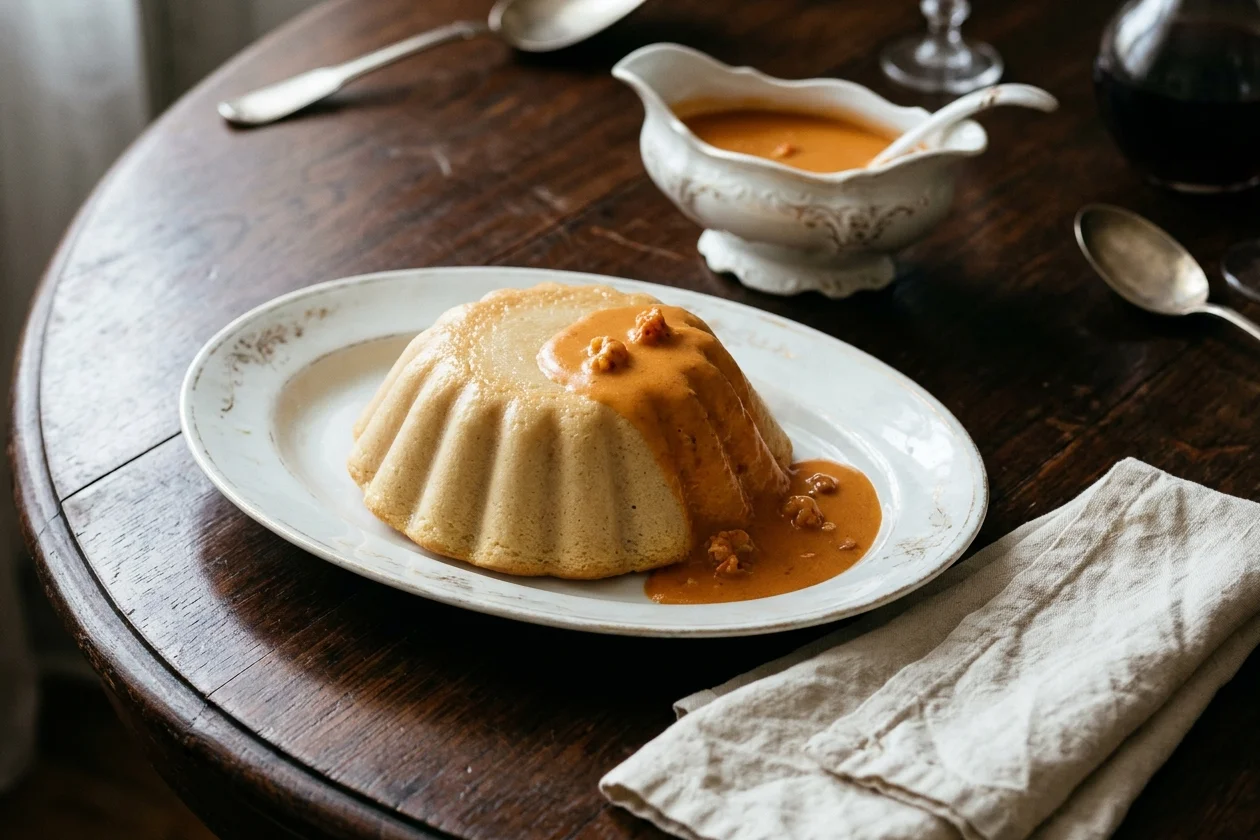
Savoury puddings Nos. 899 and 900 from 1901: beaten whites, a baking mould and three sauces. A history of the name, not advice to cook offal.
Pudding as a method, not just a sweet dish
The title of No. 899, Brain Pudding, surprises modern readers chiefly because pudding is often associated with a sweet dessert. Here it is a savoury moulded dish seasoned with salt, nutmeg, pepper and dill. Sugar is not specified. Eggs help bind the mixture, and beaten whites may produce a lighter structure. The name is associated here with preparing a homogeneous mixture in a mould and heating it. This observation applies to the particular recipe rather than a universal definition of historical puddings.
Two related recipes in the meat section
Nos. 899 and 900 are adjacent in the meat section. Both describe combining the minced base, following preliminary processing, with fat, yolks, spices and beaten whites. No. 899 allows cooking in the oven or by steaming, while No. 900 specifies a hot oven. Other differences involve seasonings and timing. These indications should not be converted into a modern cooking regime: safety of animal neural tissue demands particular attention and is not determined by temperature alone. We study the historical text as evidence of culinary vocabulary.
Why beaten whites were added to savoury mixtures
Egg whites can form a foam that retains air. Heat changes the protein structure, helping preserve some of that initial aeration. Yolks contribute cohesion and richness. Similar operations therefore occur in desserts, savoury puddings and other moulded dishes. Egg-white foam alone, however, does not make a pudding a tall soufflé: the density of the base, mixing and heating can produce different results. The book offers no measurements of the finished product's porosity or volume.
Crayfish, mushroom or rum sauce
Both meat entries propose three sauces, referring to Nos. 431, 435 and 494: crayfish sauce, button mushroom sauce and rum sauce. The pudding thus serves as a base that may be complemented with different sauces. Crayfish sauce connects it with the book's broader use of crayfish, and mushroom sauce with a cuisine in which button mushrooms were more than an independent ingredient. We do not claim that all three sauces were served together. An artistic reconstruction may choose one, clearly indicating its conjectural character.
Why the recipe reappears in another section
No. 1561 contains a short entry with the same name, directing readers to No. 900. This is a characteristic editorial device in the cookbook: a method can be useful in several sections without being printed in full each time. The digital library allows readers to navigate between those numbers while retaining the structure of the source. One historical essay combining these entries is more useful than three nearly identical essays. It illustrates both the organization of the book and the ambiguity of the word pudding.
Why we do not recommend reconstructing the original ingredients
The historical account of working with animal brains cannot be treated as a modern guarantee of safety. Neural tissue from certain animal species may be subject to special regulation because of the risk of transmissible spongiform encephalopathies. Ordinary cooking is not a reliable way to eliminate prion risks. We do not recommend seeking, acquiring or using this offal for home reconstruction. A safe moulded savoury dish with sauce is sufficient for an illustration, identified as a conjectural artistic interpretation without depicting the original tissue.
How this changes our reading of the cookbook
Reading the heading without the composition could lead us to classify all puddings as sweet dishes and miss the significance of the meat section. Comparing Nos. 899, 900 and 1561 reveals a familiar culinary category broader than its common modern association. The purpose of studying the dish is not to return every old ingredient to the modern diet but to understand the language, organization and culinary methods of the author.
Original recipes and sources
Elena Molokhovets, A Gift to Young Housewives, 1901 edition. Links to scans are available on the original Russian recipe pages.