Historical Kurnik: Two Pies in Molokhovets's 1901 Book
Why historical kurnik was made with rice or buckwheat: the tall pie, its filling, dough and stock in Nos. 1390 and 1391.
Kurnik is often imagined as one specific tall decorated pie, necessarily with pancake layers. Yet the 1901 book includes two neighboring historical kurniks differing in the organization of their fillings: rice, mushrooms and chicken in one; buckwheat, chicken and eggs in the other. Both reveal the connections between making a large pie, using stock and serving the dish.
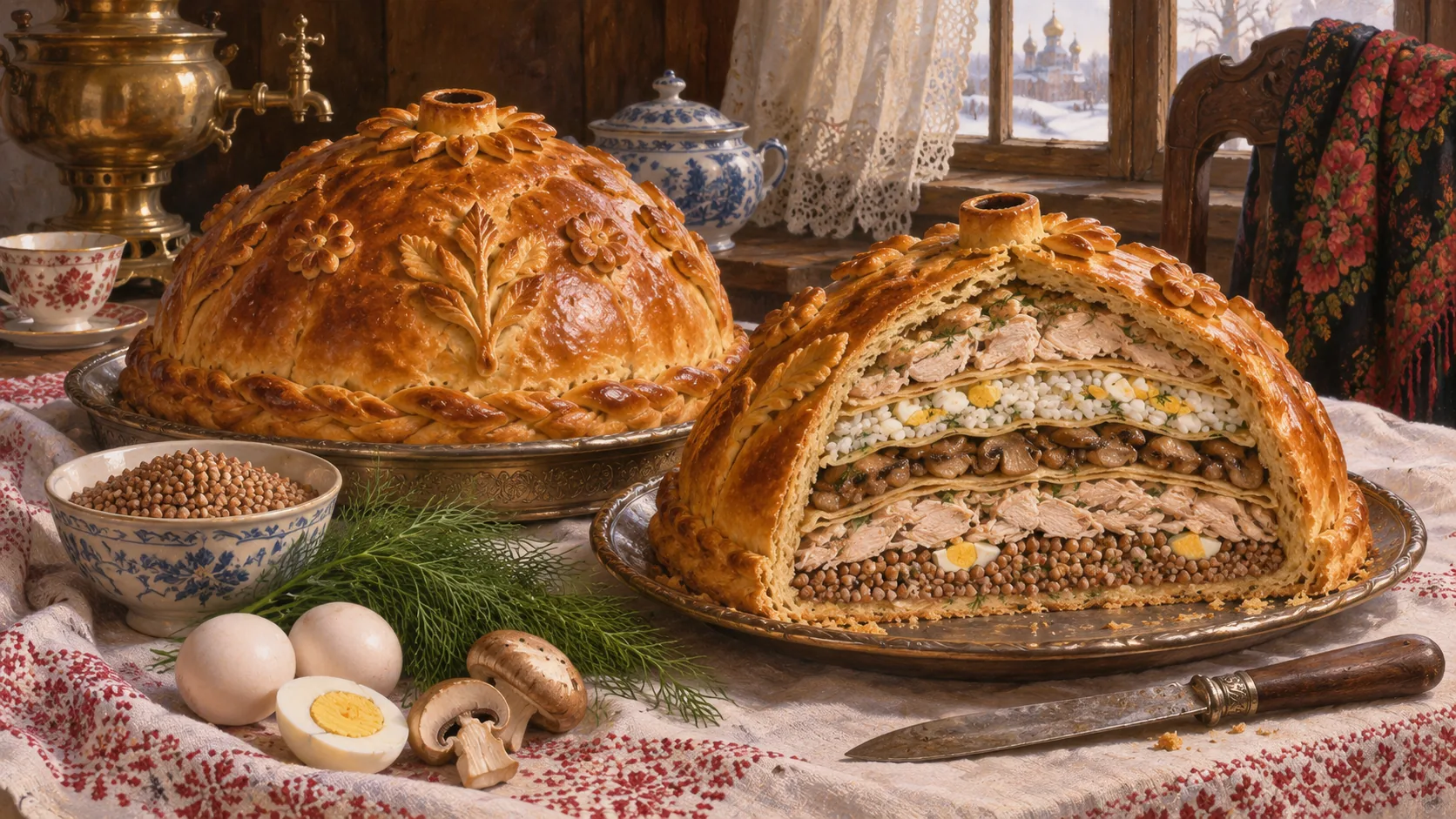
Two primary sources, two methods: No. 1390, Historical Chicken and Rice Kurnik, and No. 1391, Historical Kurnik of Fine Buckwheat Groats and Chicken, both in Section XI, Pies and Pâtés. This study explains history rather than replacing the original with a modern recipe.
The first kurnik: rice, mushrooms, eggs and chicken
No. 1390 begins with chicken and stock rather than rolling pastry. Some prepared stock is combined with cream, mushroom essence or nutmeg, reduced and mixed with the meat. Rice is cooked separately in chicken stock. Hard-boiled eggs and mushrooms fried with butter and sour cream are also used.
The filling is assembled in order: rice, eggs, chicken with mushrooms, then the layers repeat. The lower pastry sheet surrounds the filling and the top closes it like a lid. An opening and pastry ornament are made on top, producing the tall, almost conical form explicitly described.
The remaining chicken stock is suggested for soup: preparation of the large pie continues to contribute to the household table.
The second kurnik: buckwheat instead of rice
No. 1391 refers to the preceding pie's form but proposes a different filling. Fine buckwheat groats are worked with egg, dried, briefly cooked and combined with chopped eggs and herbs. Some porridge is placed on the pastry, followed by chicken and the remaining grain mixture. Strong chicken stock is poured into the centre before baking.
There is no mushroom layer as in No. 1390; dill and special buckwheat preparation are specified. The author suggests serving leftover stock at breakfast the next day, another example of organizing several dishes around one ingredient.
The word historical or old-fashioned in these headings belongs to Molokhovets. It reflects her presentation of the variants by 1901, not a precise date of origin.
How the tall pie was constructed
Both recipes share a round form, pastry casing, prepared chicken and grain filling. The first explicitly describes repeating layers; the second is built around buckwheat porridge and chicken. Both have a pastry top with an opening.
Neither No. 1390 nor No. 1391 requires separate pancake layers. This is a familiar modern construction, but it should not automatically be applied to the 1901 recipes. Here layers, where present, are made by the filling itself.
An artistic reconstruction can help visualize the form but cannot replace the text or prove that all householders made kurnik alike.
Why pastry was described in a separate recipe
No. 1390 refers to No. 1379, Excellent Sour Cream Pastry, an independent entry using flour, eggs, butter and sour cream. A reference is more convenient than repeating the pastry composition and method for each pie.
No. 1391 permits enriched or crumbly pastry and provides details in its ingredient list. The instructions should not be merged: the reference to No. 1379 belongs to the rice version, whereas the buckwheat entry is worded differently.
Cross-references are characteristic of the cookbook as a practical manual. One recipe refers to pastry, another to sauce, another to a general note. Linking the pages preserves this structure better than rewriting them into a universal recipe.
Kurnik was known before 1901
Nikolai Kostomarov's nineteenth-century Sketch of Domestic Life and Customs of the Great Russian People in the Sixteenth and Seventeenth Centuries mentions kurnik among baked pastry dishes and describes a meat-and-egg filling. Mutton appears in Kostomarov, while both Molokhovets recipes use chicken. The comparison shows the longevity of the name and changing preparations rather than one immutable formula.
Kostomarov's work is a reconstruction of earlier life, not the menu of every Russian household in those centuries. Its details should not be transferred to 1901 without verification.
Ethnographic descriptions often associate kurnik with weddings, but wedding pies varied by region and period. Neither every pie called kurnik nor these two entries must be interpreted as exclusively wedding food.
Stock, grain and eggs: household work behind an elaborate dish
The festive appearance conceals a chain of tasks: cooking chicken, separating meat and bones, preparing grain, boiling eggs, seasoning filling, making pastry, assembling and baking a large pie. The same stock serves several stages.
No. 1390 uses leftovers for soup and No. 1391 for breakfast the next day. These are the author's specific instructions, not an attempt to imagine equally thrifty or well-supplied householders. The book proposes how to organize work rather than supplying statistical evidence of everyday diets.
The studies of dinner planning and historical baking offer related context.
How historical kurnik differs from modern versions
Modern kurniks may use potatoes, onions, buckwheat, rice or pancake layers. None is automatically wrong for differing from 1901. Conversely, modern methods cannot be attributed to Molokhovets when she does not describe them.
The website's modern adaptation is explicitly identified as such. For historical research, read the original rice and buckwheat entries separately.
Practical poultry cooking requires current food-safety standards. Historical temperatures, storage times and signs of readiness are not sufficient modern guarantees.
Two entries and a history of the kitchen
The two neighboring entries reveal similar shapes with different fillings: rice and mushrooms or buckwheat and dill, independent references to pastry and stock used for several purposes. These details tell us more about Russian domestic tables than a legend of one authentic kurnik.
The study restores the recipes to context rather than replacing them, allowing readers to compare the texts, see the pie's construction and follow connections within the 1901 edition. The related study of little pies, large pies and pâtés explores their place in dinner menus.
Original recipes and historical sources
Elena Molokhovets, A Gift to Young Housewives, 1901 edition. Original source links are retained below.
- No. 1390 — Old-Fashioned Chicken and Rice Kurnik · Russian original
- No. 1391 — Old-Fashioned Chicken and Buckwheat Kurnik · Russian original
- Section XI: Pies and Pâtés — Filled Pies, Pastry Doughs and Historical Pâtés · Russian original
- No. 1379 — Excellent Sour-Cream Pastry · Russian original
- N. I. Kostomarov, Sketch of Domestic Life and Customs of the Great Russian People in the Sixteenth and Seventeenth Centuries
- Old Russian Baking: Kurnik, Drachena and Charlotte · Russian original
- Modern adaptation of kurnik (in Russian)
Related reading
The original is a historical source, not safety instructions. Historical baking times, raw ingredient conditions, storage rules and tests of readiness do not replace current requirements for poultry and multi-ingredient pies.